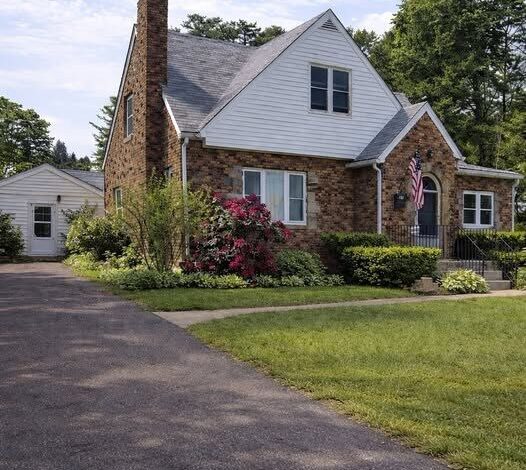
Set quietly within Sidney’s peaceful village landscape, the brick home seems to belong to another rhythm of time entirely.
Not frozen in the past.
Simply unhurried by the present.
Its exterior carries the kind of permanence modern construction often struggles to imitate — solid masonry softened by seasons, mature trees casting shifting shadows across the yard, windows that have watched decades of ordinary life unfold quietly behind them. Nothing about the house demands attention loudly, yet it possesses the unmistakable gravity of places built to last.
The moment you step inside, that feeling deepens.
Original hardwood floors stretch beneath your feet with the subtle imperfections only real age creates: faint creaks, softened edges, the polished wear of countless footsteps moving room to room across generations. Fireplaces anchor the living spaces with quiet dignity, suggesting winters filled with conversation, books left open on side tables, and evenings measured not by urgency but comfort.
The atmosphere feels instantly familiar even to first-time visitors.
Not because the house is generic.
Because authenticity carries emotional warmth impossible to manufacture artificially.
Every room holds traces of stories already lived there:
morning coffee near sunlit windows,
holiday gatherings spilling into dining rooms,
children racing through hallways,
late-night talks lingering beside the fireplace after everyone else had gone to bed.
And yet despite that history, the home never feels trapped by nostalgia.
Instead, it offers possibility.
That balance is rare.
Many older homes become museums to their own pasts — beautiful perhaps, but emotionally closed off to reinvention. This house feels different. Its structure and craftsmanship provide continuity, while the layout still leaves generous room for new ideas, evolving needs, and personal imagination.
The spaces invite interpretation rather than dictating it.
One owner might restore every traditional detail lovingly:
refinishing original woodwork,
preserving vintage fixtures,
leaning fully into the home’s timeless character.
Another might introduce contemporary updates carefully:
open brighter interiors,
modern finishes,
cleaner lines balanced against historic texture.
Most likely, the ideal future lies somewhere between those extremes.
Because the best renovations rarely erase character entirely.
They collaborate with it.
This home seems particularly suited for that kind of thoughtful evolution.
The layout offers flexibility that extends beyond aesthetics alone. Bedrooms can shift alongside changing stages of life. Work-from-home spaces fit naturally without feeling forced. Family gatherings, quiet retirement mornings, growing children, visiting grandchildren — the house appears capable of absorbing multiple versions of living without losing its identity in the process.
Outside, the generous yard expands that sense of possibility further.
Not merely decorative space, but usable space:
gardens,
summer dinners,
children playing,
dogs racing across grass,
future additions imagined slowly over years rather than rushed immediately.
Even the detached garage contributes practical freedom many village properties lack now. Storage, workshop potential, hobby space, seasonal projects — the structure quietly supports real life rather than existing only for visual charm.
That practicality matters because truly lasting homes succeed through more than beauty alone.
They function.
They adapt.
They survive changing decades and changing families without becoming disposable.
In today’s housing market, that quality feels increasingly uncommon. So many newer properties arrive polished but emotionally interchangeable — identical layouts, trend-driven finishes, spaces designed more for quick resale photography than long-term belonging.
This house resists that sameness completely.
Its imperfections become part of its appeal.
Its craftsmanship carries visible intention.
Its age adds texture rather than inconvenience.
You do not simply purchase a structure like this.
You inherit stewardship.
That idea changes the emotional relationship people develop with older homes. Ownership becomes less about consumption and more about continuation — preserving what deserves saving while gently shaping the property toward future needs and dreams.
And perhaps that is why homes like this resonate so deeply with certain buyers.
Not because they are flawless.
Because they feel human.
Layered.
Lived-in.
Capable of holding complexity.
The brick walls suggest stability, but not rigidity. The traditional details create warmth without preventing creativity. Every corner seems to ask quietly:
What kind of life will happen here next?
That question lingers as you move through the property.
You imagine furniture arranged differently.
Paint colors changing with light.
Family photos gradually appearing on walls.
The slow transformation that occurs when a house stops belonging to memory alone and begins belonging to someone new.
Because eventually, every meaningful home becomes a collaboration between past and future.
The people who built it leave traces behind.
The people who arrive next add their own.
This Sidney property seems uniquely prepared for that exchange.
Strong enough to preserve its soul.
Flexible enough to welcome reinvention.
And in a market crowded with homes designed primarily to impress quickly, that authenticity feels increasingly valuable.
Not flashy.
Not temporary.
Just enduring craftsmanship, thoughtful space, and quiet character waiting for the right person to recognize not only what the house has been —
but what it still has room to become.