When a Little Girl Gave Up Her Seat for an Elderly Stranger, No One Expected What Happened Next

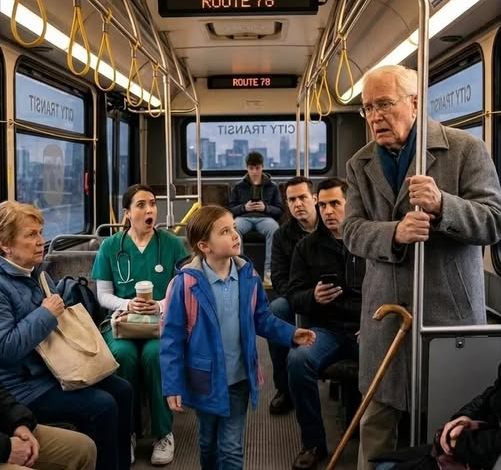
Emily was only seven years old the morning her life quietly changed forever.
At that age, most children worry about homework, playground games, and what might be packed inside their lunchbox. The world still feels large and mysterious, filled with things they don’t fully understand and places they have never seen. Yet for Emily, responsibility had arrived earlier than it does for many children.
She was already learning lessons about courage.
About independence.
About trust.
And about kindness.
Lessons that would eventually reach far beyond a simple bus ride across the city.
That morning began like so many others.
The small apartment was already awake before sunrise. The sounds of daily life echoed through the narrow rooms: running water, the rustle of clothing, the hum of an aging refrigerator. Outside, the city was beginning another busy day. Cars moved through wet streets. Shopkeepers unlocked doors. Commuters hurried toward buses and train stations.
Inside the apartment, Sarah was preparing for work.
Like every morning, she moved quickly.
There was never enough time.
Never enough money.
Never enough rest.
Yet somehow she always found enough love.
Sarah had spent years balancing impossible responsibilities. Since Emily’s father was no longer part of their lives, every burden rested on her shoulders alone. Rent. Utilities. Groceries. School supplies. Medical bills. Transportation. Every expense seemed larger than her paycheck.
She worked long hours at a neighborhood market.
The job was demanding.
The pay was modest.
The customers could be difficult.
Yet Sarah showed up every day.
Not because she loved the work.
Because she loved her daughter.
Every sacrifice she made had a purpose.
Every exhausting shift had a reason.
Every dollar earned represented another opportunity to give Emily a better future.
Many nights Sarah fell asleep worried.
Worried about overdue bills.
Worried about rising prices.
Worried about unexpected emergencies.
Worried that one setback might unravel everything she had worked so hard to build.
But she rarely allowed Emily to see those fears.
Children deserve hope.
And Sarah was determined to protect hers.
That morning, before leaving for work, she knelt beside Emily and repeated the instructions they had practiced countless times.
“Count five stops.”
Emily nodded.
“Stay near the front.”
Another nod.
“If you get confused?”
“I ask the driver for help,” Emily answered proudly.
Sarah smiled.
The route wasn’t complicated, but allowing her seven-year-old daughter to ride alone still filled her with anxiety.
She had rehearsed the journey again and again.
Walked the route.
Reviewed landmarks.
Memorized stop numbers.
Prepared for every scenario she could imagine.
Still, as she watched Emily board the bus, her heart tightened.
Being a parent often means teaching someone to become independent while secretly wishing you could protect them forever.
The bus doors closed.
The engine growled softly.
And as the vehicle disappeared around the corner, Sarah stood for a moment longer than usual.
Watching.
Hoping.
Praying.
Then she turned and headed toward work.
Unaware that the simple bus ride she had worried about all week would soon transform their lives.
Inside the bus, Emily followed every instruction perfectly.
She chose a seat near the front.
Held her backpack carefully in her lap.
And watched the city pass by through the window.
People came and went at each stop.
Workers in uniforms.
Students carrying books.
Parents rushing toward jobs.
The bus slowly filled with commuters beginning their day.
Emily felt nervous.
But also proud.
This was an important responsibility.
A sign that her mother trusted her.
And she was determined not to make any mistakes.
Several stops later, the bus doors opened again.
An elderly man stepped aboard.
Immediately, Emily noticed him.
He moved slowly.
Carefully.
Supporting himself with a cane.
His gray hair peeked from beneath a neatly pressed cap.
Each step seemed measured.
Intentional.
The bus was crowded now.
Nearly every seat was occupied.
People glanced in his direction.
Then looked away.
Some were staring at phones.
Others pretended not to notice.
A few seemed genuinely unaware.
Whatever the reason, nobody offered their seat.
The elderly man gripped a handrail and tried to steady himself as the bus lurched forward.
Emily watched.
The situation bothered her immediately.
She remembered countless conversations with her mother.
Lessons repeated so often they had become part of who she was.
Be kind.
Help when you can.
Respect older people.
Do the right thing even when nobody is watching.
Sarah had never presented kindness as something extraordinary.
She treated it as ordinary.
Expected.
Necessary.
A way of moving through the world.
Emily looked at her seat.
Then at the man.
Then back at her seat.
Her stomach fluttered nervously.
Leaving her place meant leaving the spot where she felt safe.
The spot her mother specifically told her to choose.
For a moment, uncertainty held her still.
Then compassion won.
She stood up.
“Sir, you can sit here.”
The words came quietly.
Almost shyly.
But the elderly man heard them immediately.
His surprised expression softened into a smile.
A genuine smile.
The kind that reaches the eyes.
“Thank you,” he said warmly.
Emily stepped aside while he carefully lowered himself into the seat.
The relief on his face was obvious.
And suddenly, Emily felt glad she had spoken.
What happened next seemed insignificant at the time.
Just a conversation.
A few minutes shared between strangers.
Yet those brief moments would alter the course of multiple lives.
The man introduced himself as Michael.
His voice was gentle.
Curious.
Kind.
As they talked, he discovered that Emily loved school.
Loved reading.
Loved drawing pictures.
Loved helping her mother.
The conversation eventually turned toward family.
And when it did, Emily spoke about Sarah with unmistakable pride.
Children have a unique way of describing the people they love.
Without exaggeration.
Without performance.
Without realizing how revealing their words can be.
Emily told Michael about her mother.
How hard she worked.
How tired she sometimes looked.
How she never complained.
How she always helped others.
How she taught Emily to be kind even when life was difficult.
How she said that a person’s character mattered more than money.
How she believed good things eventually come back to people who do good things.
To Emily, these were simply facts.
The normal realities of her life.
To Michael, they sounded extraordinary.
The little girl sitting beside him wasn’t reciting lessons.
She was living them.
The values her mother taught were visible in her actions.
Visible in the seat she had willingly given away.
Visible in her respect.
Visible in her generosity.
Visible in the effortless compassion she displayed.
When Emily eventually reached her stop, she waved goodbye and hurried toward school.
The interaction seemed finished.
A pleasant moment.
Nothing more.
But Michael remained deep in thought long after she left.
Because what he had witnessed felt increasingly rare.
Genuine kindness.
Unforced.
Unrewarded.
Unconditional.
The kind that appears when nobody expects recognition.
What Emily didn’t know was that Michael was far from ordinary.
Throughout the city, he was known as a successful businessman.
He owned properties.
Managed investments.
Supported charitable organizations.
His name carried influence.
His decisions affected hundreds of people.
Yet despite decades of professional success, he found himself unable to stop thinking about a seven-year-old girl in a patched raincoat.
Not because of anything she wanted.
Because of what she gave.
In the days that followed, curiosity led him to learn more about Emily’s family.
The more he discovered, the more impressed he became.
Sarah’s situation was difficult.
The financial strain was severe.
Bills had accumulated.
Housing challenges loomed.
The apartment she fought so hard to keep was increasingly at risk.
For months, she had carried the burden alone.
Working.
Sacrificing.
Struggling.
Trying desperately to maintain stability for her daughter.
And somehow, despite all that pressure, she had still raised a child capable of extraordinary kindness.
That realization moved Michael deeply.
Many people with abundance teach generosity.
Sarah had taught it while living with scarcity.
That difference mattered.
One afternoon, Sarah received an unexpected phone call.
At first, she assumed it was another bill collector.
Another creditor.
Another problem demanding attention.
Instead, she heard a calm voice introducing himself as Michael.
As the conversation continued, confusion slowly gave way to astonishment.
Michael explained how he had met Emily.
What had happened on the bus.
How deeply he had been touched by her kindness.
And how impressed he was by the values Sarah had clearly worked so hard to instill.
Then he made an offer.
An offer so unexpected that Sarah initially struggled to process it.
He wanted to help.
Not as charity.
Not as pity.
As gratitude.
Because Emily’s small act had reminded him of something important.
That goodness still existed.
That kindness still mattered.
That character still carried value.
By the end of the conversation, arrangements had been made.
The housing crisis that had haunted Sarah for months would be resolved.
The crushing burden she carried would finally be lifted.
For the first time in a very long while, she felt something unfamiliar.
Relief.
Pure relief.
That evening, Sarah returned home with tears in her eyes.
Not tears of fear.
Not tears of exhaustion.
Tears of gratitude.
Meanwhile, Emily sat at the kitchen table happily discussing her day at school.
Math lessons.
Art projects.
Friends.
Lunch.
The ordinary adventures of childhood.
Completely unaware that her kindness had set extraordinary events into motion.
Sarah listened quietly.
Watching her daughter.
Listening to the innocent excitement in her voice.
And understanding something profound.
The world often measures value through money.
Status.
Achievement.
Success.
Yet some of life’s most powerful moments begin with something far simpler.
A seat offered on a crowded bus.
A kind word.
A helping hand.
A choice to care.
Emily had not acted because she expected a reward.
She acted because kindness had become part of who she was.
And somehow, that simple act traveled farther than either of them could have imagined.
Weeks later, life looked very different.
The constant fear of losing their home was gone.
The financial pressure eased.
New opportunities appeared.
Hope returned.
But the greatest lesson remained unchanged.
Compassion matters.
Not because it guarantees rewards.
Not because it creates opportunities.
But because it has the power to touch lives in ways we rarely see.
A single act of kindness can move through the world like a ripple across water.
Touching strangers.
Changing outcomes.
Connecting lives.
Creating possibilities.
Most of the time, we never witness the full impact.
Most of the time, we never know how far it travels.
But sometimes, just sometimes, life allows us to see the chain unfold.
And when it does, we are reminded of something beautiful.
Goodness is never truly wasted.
Kindness is never truly lost.
And the smallest acts often carry the greatest power.
For Sarah, the experience confirmed everything she had spent years teaching her daughter.
For Michael, it restored faith in values that money cannot buy.
And for Emily, though she would not fully understand it until much later, it became proof that one person’s kindness can change more than a moment.
Sometimes it can change an entire future.