I found this at a flea market, and the seller had no idea what it was. It intrigued me. Does anyone know what it is?

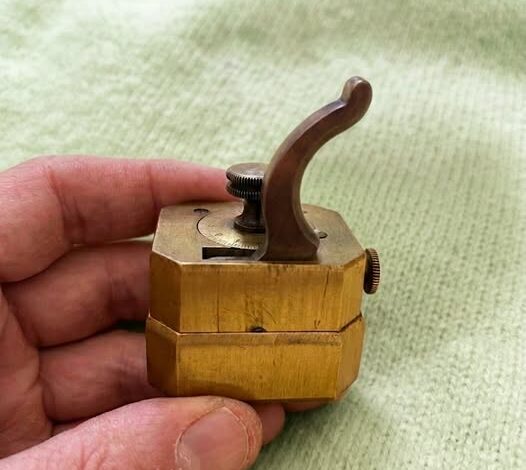
I Thought It Was Just an Odd Antique. Then I Learned It Once Drew Blood for a Living.
At first glance, it didn’t look particularly sinister.
It was small.
Compact.
Almost elegant.
The sort of object you might find buried inside an antique shop display case or tucked away in a forgotten drawer at an estate sale.
Made of metal and surprisingly well-crafted, it carried the quiet confidence of something built during an era when tools were expected to last a lifetime.
I turned it over in my hands several times.
Examined the mechanism.
Pressed a few parts carefully.
Wondered what purpose it might once have served.
A measuring device, perhaps.
A specialized mechanical tool.
Maybe something related to watches or early machinery.
It certainly didn’t look dangerous.
And it definitely didn’t look like an instrument that had once been used on living human beings.
But appearances can be deceptive.
The more closely I examined it, the stranger it seemed.
There was a hidden spring mechanism.
A curious trigger.
Small openings that suggested something moved inside.
Something precise.
Something intentional.
When I finally discovered what it actually was, a chill ran through me.
Because this wasn’t merely an antique.
It was a scarificator.
A medical instrument designed for bloodletting.
And suddenly the object in my hand stopped feeling like a relic.
It felt like a witness.
A Tool From Another World
Modern medicine has conditioned us to think about healing in very specific ways.
We think of scans.
Laboratories.
Medications.
Vaccines.
Sterile operating rooms.
Data.
Research.
Evidence.
We assume doctors have always approached illness through similar principles.
The truth is far more complicated.
For much of human history, medicine existed in a landscape of uncertainty.
People desperately wanted cures.
Doctors desperately wanted answers.
But scientific understanding remained limited.
Disease was mysterious.
The body was poorly understood.
Many conditions that are easily treated today once appeared almost supernatural in their complexity.
In that environment, theories emerged that now seem astonishing.
One of the most influential involved the balance of bodily fluids.
Known as the theory of the four humors, it dominated medical thinking for centuries.
According to this belief, health depended upon maintaining the proper balance between blood, phlegm, yellow bile, and black bile.
Illness was viewed not as infection, genetics, or biological dysfunction, but as imbalance.
If someone became sick, doctors often assumed one of these substances existed in excess.
And among all the proposed treatments, one became particularly popular.
Removing blood.
The Logic Behind Bloodletting
Today the idea sounds alarming.
Why would removing blood help someone recover?
Why would weakening an already sick patient be considered healing?
Yet within the framework of the time, the practice seemed logical.
If excess blood caused illness, reducing it made sense.
If imbalance created suffering, removing part of that imbalance seemed reasonable.
Medical history is filled with treatments that appear bizarre through modern eyes but seemed perfectly rational within the scientific understanding available at the time.
Bloodletting became one of the most common medical procedures in Europe and North America.
It was used to treat headaches.
Fevers.
Inflammation.
Infections.
Digestive complaints.
Respiratory illnesses.
Mental health struggles.
Even general fatigue.
When doctors lacked answers, bloodletting frequently became the answer.
Sometimes patients improved.
Not because the treatment worked.
Because many illnesses improve naturally over time.
Those recoveries reinforced confidence in the procedure.
Failures were often attributed to the severity of the disease rather than flaws in the treatment itself.
And so the practice continued.
Generation after generation.
Century after century.
The Device Itself
The scarificator represented an attempt to make bloodletting faster, more precise, and more efficient.
Earlier methods often relied on knives or lancets.
These worked, but they required skill and consistency.
The scarificator promised something different.
Mechanical accuracy.
Inside the small metal housing sat a series of tiny blades.
Hidden from view until activated.
When the trigger released the spring-loaded mechanism, the blades would emerge for a fraction of a second.
Just long enough to create a series of shallow, controlled cuts.
Then they immediately retracted.
The process happened almost instantly.
The cuts were uniform.
Predictable.
Repeatable.
To nineteenth-century physicians, this represented technological advancement.
An innovation.
A better medical tool.
Holding one today creates a strange emotional conflict.
Part of you admires the engineering.
The craftsmanship.
The ingenuity.
The mechanical elegance.
Another part remembers what it was designed to do.
Not repair.
Not build.
Not create.
Cut.
Draw blood.
Inflict pain in service of a treatment we now understand was often ineffective or harmful.
Trusting The Experts
Perhaps the most unsettling realization isn’t the device itself.
It’s what it represents about human nature.
Imagine sitting inside a doctor’s office two hundred years ago.
You have a fever.
You feel weak.
You are frightened.
You trust the person standing before you.
They possess education.
Authority.
Experience.
They confidently explain that removing blood will help.
What would you do?
Most people would agree.
Not because they were foolish.
Because they trusted expertise.
The patient wasn’t making the decision in isolation.
Society supported it.
Medical schools taught it.
Doctors practiced it.
Communities accepted it.
The treatment reflected the best understanding available at the time.
That realization humbles us.
Because every generation believes its knowledge is complete.
Every generation assumes future discoveries will be minor refinements rather than major corrections.
History repeatedly proves otherwise.
The Thin Line Between Science And Certainty
One of the most fascinating aspects of medical history is how often confidence exceeds understanding.
Doctors who practiced bloodletting were not villains.
Most genuinely wanted to help.
Most believed they were helping.
Many dedicated their lives to healing others.
Yet sincerity does not guarantee accuracy.
Good intentions do not guarantee effectiveness.
And certainty does not guarantee truth.
That lesson extends far beyond medicine.
It applies to science.
Politics.
Culture.
Technology.
Virtually every field of human knowledge.
People often assume progress happens because ignorance disappears.
In reality, progress frequently occurs because someone becomes willing to challenge certainty.
To ask difficult questions.
To test assumptions.
To examine evidence.
To admit that long-held beliefs might be wrong.
Medicine advanced not because doctors stopped caring.
Because they learned to demand stronger proof.
A Witness To Human Hope
Looking at the scarificator now, I find myself thinking less about pain and more about hope.
Not because the tool was beneficial.
Because of the people who endured it.
Every patient who submitted to bloodletting wanted something simple.
Relief.
A cure.
Another chance.
Less suffering.
The same things patients want today.
Human needs have changed surprisingly little across centuries.
People still fear illness.
Still seek healing.
Still place trust in those who promise answers.
The methods evolve.
The technology evolves.
The science evolves.
The desire remains constant.
That small metal device passed through countless hands.
Doctors.
Patients.
Families.
Caretakers.
Each interaction carried hope.
Sometimes desperate hope.
Sometimes misplaced hope.
But hope nonetheless.
And that makes the object feel strangely human.
The Cost Of Being Wrong
Medical history contains extraordinary achievements.
Vaccines.
Antibiotics.
Anesthesia.
Imaging technologies.
Organ transplants.
Life-saving medications.
Yet it also contains mistakes.
Treatments once celebrated that later proved harmful.
The scarificator belongs to that second category.
A reminder that progress often emerges through correction.
That understanding grows through failure as well as success.
That knowledge requires humility.
For every breakthrough we celebrate today, future generations may identify assumptions we failed to question.
Practices we misunderstood.
Limitations we overlooked.
The realization can feel uncomfortable.
Yet it also highlights one of science’s greatest strengths.
Its willingness to change.
Its willingness to revise conclusions when evidence demands it.
Its willingness to admit mistakes.
Seeing Antiques Differently
Before learning the history of the scarificator, I viewed old tools primarily as curiosities.
Interesting objects.
Mechanical puzzles.
Decorative reminders of the past.
Now I see something more.
Stories.
Not abstract history.
Human history.
The lives connected to these objects.
The fears.
The hopes.
The suffering.
The beliefs.
The mistakes.
Every antique carries traces of the world that created it.
Some reveal craftsmanship.
Others reveal culture.
A few reveal something deeper.
The scarificator reveals how desperately humans have always searched for healing.
And how complicated that search can become.
More Than A Medical Instrument
Today the device sits quietly on a shelf.
Small.
Unassuming.
Easy to overlook.
Visitors sometimes ask about it.
Most have no idea what it is.
Their guesses mirror my own first assumptions.
A measuring instrument.
A mechanical gadget.
A specialized tool.
Then I explain.
And their expressions change instantly.
Curiosity becomes surprise.
Surprise becomes fascination.
Because the object forces us to confront a reality that is both uncomfortable and inspiring.
Human beings have always sought answers.
Sometimes we found them.
Sometimes we convinced ourselves we had.
The difference matters.
The scarificator stands as a reminder of that distinction.
A beautifully engineered machine built around a flawed understanding of the human body.
A symbol of innovation and error existing side by side.
A witness to centuries of pain, hope, trust, and misguided healing.
And every time I look at it, I’m reminded of something easy to forget.
Progress isn’t simply about discovering new truths.
It’s also about recognizing old mistakes.
The little device in my hand once represented the future of medicine.
Today it represents a lesson.
One that remains as relevant now as it was then:
The most dangerous thing in science is not ignorance.
It’s certainty without understanding.
And sometimes the most fascinating objects are the ones that reveal just how human our mistakes have always been.