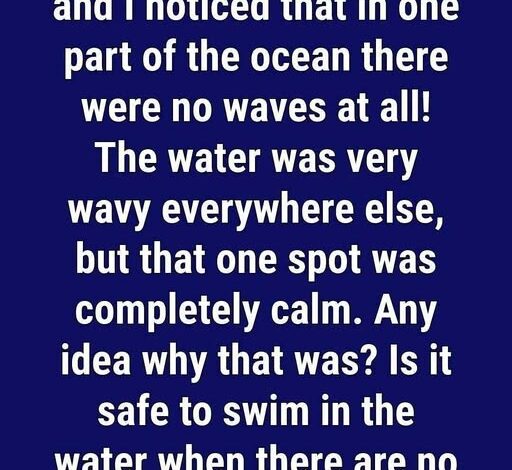
The ocean rarely looks dangerous when it is at its most deceptive.
Most people expect trouble to announce itself with towering waves, crashing surf, or stormy skies. They naturally avoid the places where the water looks wild and unpredictable.
But one of the greatest hazards at the beach often appears surprisingly calm.
It may look like a smooth, glassy opening between lines of breaking waves—a quiet channel where the water seems easier to enter. To an untrained eye, it can appear safer than the surrounding surf.
In reality, that peaceful-looking gap may be a rip current.
A rip current is a fast-moving channel of water flowing away from the shore. As waves push water toward the beach, that water must eventually find its way back out to sea. Instead of returning evenly across the shoreline, it sometimes funnels through narrow pathways, creating a powerful current that can carry swimmers away from land.
The current doesn’t pull people beneath the surface, as many believe.
Instead, it carries them outward.
Someone who was standing comfortably in waist-deep water may suddenly find the shoreline growing farther away, unable to make progress despite swimming as hard as possible.
That unexpected realization often sparks panic.
And panic is what makes rip currents so dangerous.
When people feel themselves drifting away from shore, their instinct is to turn immediately and swim straight back to the beach. Unfortunately, that means fighting directly against the current—the strongest part of it.
Even experienced swimmers can quickly become exhausted trying to overpower moving water.
Fatigue sets in.
Breathing becomes more difficult.
Fear grows stronger with every unsuccessful stroke.
The safer response is often the opposite of what instinct suggests.
Rather than battling the current head-on, swimmers should try to remain as calm as possible and swim parallel to the shoreline. Rip currents are usually much narrower than they are long, so moving sideways often allows a swimmer to escape the strongest flow.
Once free of the current, they can then angle back toward the beach with the assistance of incoming waves.
If swimming isn’t possible because of fatigue, conserving energy becomes essential.
Floating or treading water while signaling for help can significantly improve the chances of rescue. Rip currents generally weaken farther offshore, and staying calm allows rescuers—or the current itself—to provide an opportunity to return safely.
Preparation before entering the water is equally important.
One of the simplest safety habits is taking a few moments to watch the ocean before swimming.
Rip currents may appear as:
- A narrow gap where waves are not breaking.
- A darker channel of deeper water.
- Water that looks unusually smooth compared with surrounding surf.
- Foam, seaweed, or floating debris moving steadily away from shore.
While these signs are not always obvious, learning to recognize them can help swimmers avoid hazardous areas altogether.
Choosing beaches protected by trained lifeguards provides another important layer of safety.
Lifeguards monitor changing water conditions throughout the day and can identify hazards that visitors might overlook. Swimming near an active lifeguard station greatly increases the likelihood of receiving immediate assistance if an emergency occurs.
Children should also learn basic ocean safety before entering the water.
Understanding what a rip current is, knowing to stay close to adults, obeying beach warning flags, and recognizing the importance of listening to lifeguards can help build confidence while reducing unnecessary risk.
The ocean is one of nature’s most beautiful places.
It offers recreation, adventure, and unforgettable memories.
But it also demands respect.
Its greatest dangers are not always the loudest or the most obvious.
Sometimes they appear in the form of calm water that quietly conceals tremendous power beneath the surface.
Fortunately, knowledge is one of the strongest safety tools we have.
Learning how rip currents form, recognizing their warning signs, and knowing the proper response if caught in one can transform a frightening situation into a manageable one.
The sea will always be stronger than any individual swimmer.
But with preparation, awareness, and respect for its changing conditions, we can enjoy its beauty more safely. Sometimes the most important piece of beach equipment isn’t something you carry in your hands—it’s the understanding you bring with you before you ever step into the water.