Most cat owners know the moment.
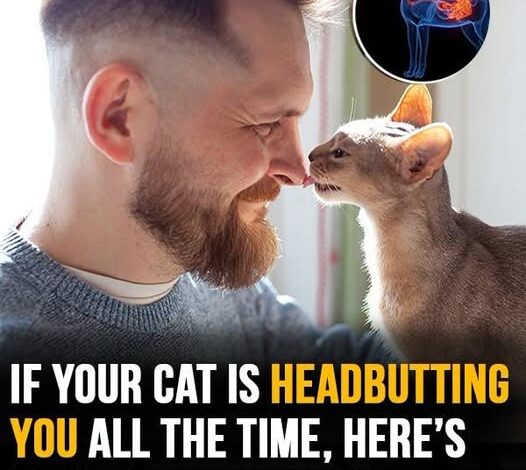
You’re sitting quietly on the couch, working at your desk, or lying in bed when your cat suddenly walks over, looks directly at you, and gently presses their forehead against your face, hand, or shoulder.
For a second, it feels almost deliberate.
Personal.
Intimate.
And that’s because it is.
While many people see these little head bumps as adorable quirks, cats are actually communicating something far more meaningful.
When your cat presses their forehead against you, they’re not simply looking for attention.
They’re offering trust.
In the feline world, this behavior is known as “bunting,” and it carries a message that goes much deeper than most people realize.
Cats navigate their world through scent as much as sight and sound. Hidden around their cheeks, forehead, chin, and face are scent glands that release chemical signals invisible to humans but incredibly important to other cats.
When a cat rubs these areas against furniture, doorways, favorite sleeping spots, or people they love, they’re leaving behind tiny scent markers.
It’s their way of saying:
“This belongs to me.”
“This is familiar.”
“This is safe.”
And when your cat chooses to rub those scent glands against you, they’re including you in that circle of security.
To a cat, scent creates a sense of home.
By sharing their scent with you, they’re doing something remarkably personal.
They’re blending your world with theirs.
In feline language, that gentle head bump is often the equivalent of a whispered declaration:
“You are part of my family.”
“You are one of my trusted people.”
“You belong here.”
For animals that evolved as both predators and prey, trust is not given casually.
Cats are naturally cautious creatures.
They constantly assess their environment, monitor potential threats, and choose carefully where they feel safe enough to relax.
That is why bunting carries such emotional significance.
When a cat lowers their guard enough to approach, lean in, and press their head against you, they’re revealing a level of comfort that has been earned over time.
And every cat expresses that affection differently.
Some are enthusiastic about it.
These are the cats who launch themselves into dramatic headbutts, practically throwing their entire body weight behind the gesture.
They bump your hand.
Your leg.
Your shoulder.
Sometimes even your phone or laptop if they feel it’s receiving more attention than they are.
Others are far more subtle.
A brief nudge.
A soft brush of the forehead.
A quick touch before moving on as though nothing happened.
And then there are the reserved cats.
The quiet observers.
The ones who love deeply but show it sparingly.
They may never become enthusiastic cuddlers or constant headbutters.
Yet even these independent personalities often find their own ways to communicate affection.
A slow blink from across the room.
Choosing to nap nearby.
Following you from room to room without demanding attention.
Sitting close enough to feel connected while maintaining their dignity.
Love, for cats, comes in many forms.
That is why understanding the full picture matters.
A head bump alone is meaningful, but the surrounding body language often tells an even richer story.
Watch their eyes.
Relaxed, half-closed eyes signal comfort and trust.
Notice the slow blinks.
Many feline behavior experts refer to slow blinking as a cat’s version of a smile.
Pay attention to their body posture.
A relaxed tail, loose muscles, and calm movements indicate they feel secure.
You may also hear gentle purring or feel soft kneading paws pressing against your lap.
These are all signs that your cat associates you with safety and contentment.
In other words, the headbutt rarely arrives alone.
It is often part of an entire conversation happening in feline language.
And perhaps that is what makes these moments so special.
Cats do not offer affection in the same way many dogs do.
Their love can be quieter.
More selective.
Sometimes even mysterious.
They choose their moments carefully.
They decide who earns their trust.
And because of that, their gestures often carry extraordinary meaning.
A cat that leans into your hand isn’t just enjoying a scratch.
A cat that rubs their face against yours isn’t simply seeking attention.
They’re actively choosing connection.
They’re sharing something deeply rooted in their instincts.
Something ancient.
Something personal.
To them, scent represents familiarity, security, and belonging.
When they leave that scent on you, they are quite literally weaving you into the fabric of their world.
You become part of the landscape they trust.
Part of the environment where they can rest without fear.
Part of the life they have chosen as their own.
So the next time your cat walks over, tilts that tiny head, and gently bumps you with their forehead, don’t dismiss it as a random habit.
Don’t assume it’s just a cute little game.
Pause for a moment.
Appreciate what is actually being offered.
Because in the quiet language of cats, that simple gesture carries remarkable meaning.
It says:
“I know you.”
“I trust you.”
“I feel safe with you.”
And perhaps most importantly:
“You are one of mine.”
For a creature that guards its trust so carefully, there may be no greater compliment than that.