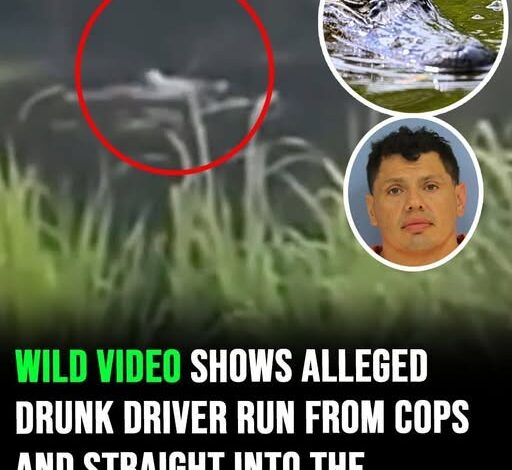
For a brief moment, it looked as though Victor Rivas had already used up every ounce of luck he had left.
Driving through the Louisiana night, Rivas lost control of his Toyota, sending it careening across Interstate 310 before crashing hard into a concrete barrier. The impact left the vehicle badly damaged, with at least one tire destroyed and the car barely operable. What may have begun as a reckless attempt to stay ahead of trouble had suddenly become a dangerous roadside disaster.
Then came the flashing blue lights.
As law enforcement officers closed in on the disabled vehicle, the situation appeared all but over. The damaged car wasn’t going anywhere. The highway offered few options for escape. Most people, faced with a wrecked vehicle and approaching deputies, would have accepted that the chase had reached its inevitable conclusion.
But Rivas made a different decision.
Instead of remaining at the scene and surrendering, he threw open the door and ran.
What happened next transformed an ordinary police pursuit into a bizarre ordeal that seemed more like the plot of a survival thriller than a routine traffic stop.
Desperate to avoid capture, Rivas sprinted away from the interstate and headed toward the darkness beyond the roadway. Moments later, he made a dramatic leap from the elevated highway, plunging into the swampy terrain below.
The Louisiana wetlands swallowed him almost instantly.
Surrounded by darkness, thick vegetation, and murky water, Rivas likely believed he had found the perfect place to disappear. The swamp offered natural cover, limited visibility, and countless hiding places. If he could move quickly enough through the brush, perhaps he could evade the officers searching above.
For a few fleeting seconds, that plan may have seemed possible.
Then nature intervened.
As Rivas pushed through the water, navigating blindly through waist-deep mud and tangled vegetation, he encountered a threat far more dangerous than the deputies pursuing him.
Hidden beneath the dark surface was an alligator.
Without warning, the reptile attacked.
The swamp erupted into chaos.
What had started as a flight from law enforcement instantly became a desperate struggle for survival.
The alligator clamped its powerful jaws onto Rivas, biting into his arms with crushing force. Startled and injured, he fought frantically in the water, thrashing against the animal as it attempted to maintain its grip.
The darkness made the encounter even more terrifying.
Visibility was limited.
The water churned violently.
And somewhere in the swamp, officers were still searching for him.
Body camera footage later captured portions of the unfolding drama as deputies worked to locate the fleeing suspect. Amid the confusion, Rivas somehow managed to break free from the alligator’s jaws.
The escape came at a cost.
Bleeding from multiple injuries and shaken by the attack, he stumbled deeper into the swamp.
Most people might have abandoned the escape attempt after surviving a confrontation with a large predator.
Rivas kept going.
Despite the pain and the danger surrounding him, he continued pushing through the wetlands, apparently hoping that distance and darkness would still provide a path to freedom.
What he didn’t know was that his chances of escaping had already vanished.
While he struggled through the swamp below, technology was quietly working against him above.
A police drone had been deployed over the area.
From the sky, deputies could monitor his movements in real time.
The darkness that concealed him from the naked eye offered no protection against the drone’s aerial view. Every step he took through the water was being tracked. Every attempt to hide was visible from above.
What Rivas believed was an escape route had effectively become a guided path for the officers closing in on him.
Deputies used the drone to direct search teams through the difficult terrain, steadily narrowing the distance between themselves and the injured suspect.
Eventually, they found him.
Exhausted.
Wounded.
And no longer capable of outrunning either the law or the swamp.
Deputies reached Rivas and pulled him from the water, bringing an end to one of the most unusual police pursuits imaginable.
By that point, the incident had evolved far beyond a simple traffic stop.
It had become a chain reaction of increasingly desperate decisions: a highway crash, a foot chase, a leap into a swamp, an alligator attack, and an aerial drone search that eliminated any remaining hope of escape.
Emergency medical personnel transported Rivas to a nearby hospital, where he received treatment for the injuries sustained during the alligator encounter.
Authorities later reported that the wounds, while serious, were not considered life-threatening.
The alligator had left its mark.
But it hadn’t ended his life.
It had, however, ended his escape.
Once treated, Rivas still faced the legal consequences waiting for him. The injuries from the attack would eventually heal. The charges stemming from the incident would not disappear so easily.
In the end, the story became a remarkable example of how quickly a bad decision can spiral into something far worse.
What began as a damaged vehicle on a Louisiana highway escalated into a dangerous confrontation with one of the state’s most feared predators. A man who had managed to survive a crash, evade officers temporarily, and escape the jaws of an alligator still could not escape the consequences of his actions.
For law enforcement, it was an unusual arrest.
For witnesses, it was an unforgettable story.
And for Victor Rivas, it was a painful reminder that sometimes the thing waiting in the darkness is far more dangerous than the problem you’re running from.
The law was closing in.
The swamp got there first.