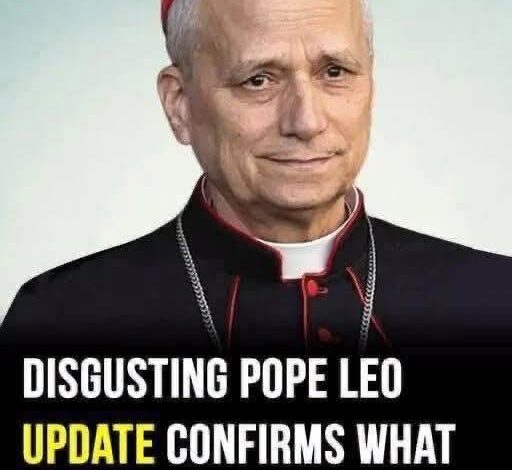
When Robert Francis Prevost emerged onto the central balcony of St. Peter’s Basilica as Pope Leo XIV, time seemed to pause. Below him, thousands of pilgrims packed St. Peter’s Square, their cheers rising beneath a sea of waving flags. Bells rang across Vatican City, cameras flashed from every direction, and centuries of tradition unfolded with a solemnity that has greeted new pontiffs for generations. It was a moment that connected the modern world to an institution nearly two thousand years old, reminding believers that history is often carried forward one quiet step at a time.
For many Catholics, the announcement marked the beginning of a new chapter filled with hope as much as expectation.
By choosing the name Leo XIV, the new pope linked himself to a line of predecessors stretching back through centuries of Church history. It was the first time in more than a hundred years that a pope had taken the name Leo, immediately inviting comparisons with those who had carried it before him. Names in the papacy are never chosen casually. They signal continuity, inspiration, and often a vision for the years ahead. With that single decision, Leo XIV inherited not only a title but the symbolic weight of thirteen earlier pontiffs who had shaped the Church during very different eras.
Yet the responsibilities awaiting him extended far beyond symbolism.
More than a billion Catholics around the world looked toward Rome hoping for guidance at a time marked by war, political division, economic uncertainty, and rapid social change. Every new pope steps into an office defined by immense spiritual responsibility, but today’s global communication ensures that every word, gesture, and decision is examined almost instantly by audiences with vastly different expectations.
Even before the celebrations in Rome had begun to fade, reactions were already multiplying across social media.
While countless believers focused on the significance of the election itself, others immediately interpreted the new pontiff through political lenses. Among some MAGA-aligned commentators in the United States, discussion quickly shifted away from theology and toward speculation about Pope Leo XIV’s perceived political views and what his leadership might represent within broader cultural debates.
The speed of those reactions illustrated how dramatically public life has changed.
A ceremony rooted in centuries of ritual found itself competing with the relentless pace of online commentary. Before many people had heard the pope speak at length or seen the direction his papacy might ultimately take, opinions had already begun hardening. Celebration and criticism unfolded simultaneously, separated not by days or weeks, but by seconds.
The contrast was striking.
In St. Peter’s Square, incense drifted through the air as prayers echoed beneath Renaissance architecture built to endure the passage of time.
Elsewhere, digital platforms filled with instant judgments, political arguments, and competing narratives moving at the speed of an algorithm.
It was as though two entirely different worlds were observing the same moment.
One viewed the election as a sacred milestone rooted in faith and continuity.
The other immediately absorbed it into the familiar rhythms of modern political conflict.
That reality may become one of Pope Leo XIV’s earliest challenges.
Throughout history, popes have addressed kings, emperors, presidents, and political leaders while attempting to maintain the Church’s broader spiritual mission. In the twenty-first century, however, every statement can be clipped, shared, reframed, and debated worldwide within minutes. Messages intended to encourage reflection often become headlines. Nuance is compressed into slogans. Complex moral teaching can be interpreted as partisan commentary regardless of its original context.
Navigating that environment requires unusual patience.
A pope is called to speak to people across every nation, political system, and culture—not simply to those who already agree with him. That universal mission inevitably places the papacy above ordinary political boundaries, even as others attempt to pull it into ongoing ideological disputes.
Whether Pope Leo XIV ultimately succeeds will not be measured solely by public approval or online reactions. History tends to judge pontiffs over years rather than hours, examining how they responded to crises, served the vulnerable, strengthened faith communities, and guided the Church through periods of uncertainty.
For now, however, his first days reveal something larger than the election of a single man.
They highlight the tension between ancient institutions built on reflection and a modern culture increasingly driven by immediate reaction. One world moves according to centuries-old ritual; the other rarely pauses before demanding instant conclusions.
Standing on that balcony, dressed in white before a cheering crowd, Pope Leo XIV inherited far more than an office. He stepped into the difficult task of offering spiritual leadership in an age where nearly every public figure is rapidly sorted into political categories. Whether he can remain a shepherd to people across those divisions may become one of the defining questions of his papacy. In a world eager to turn every symbol into another front in its cultural battles, his greatest challenge may simply be reminding people that some callings are meant to rise above them.