21-Year-Old Student Thought He Had ‘Fresher’s Flu’ — Days Later, His Family Faced Every Parent’s Worst Nightmare

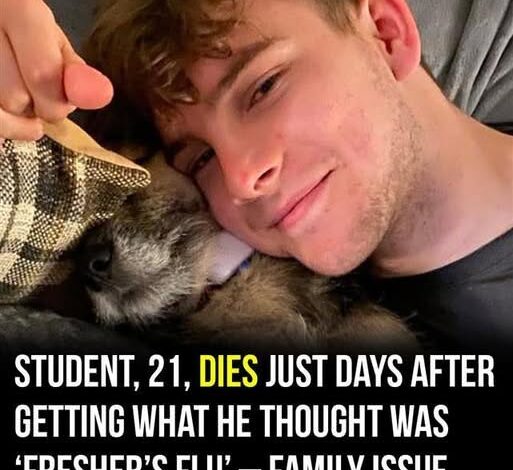
At first, it seemed like nothing more than a bad case of the flu.
A headache. Exhaustion. Feeling run down.
For a healthy 21-year-old university graduate with his whole future ahead of him, those symptoms hardly seemed alarming. Like many young adults, Lucas Martin had recently been surrounded by people, busy schedules, and the constant social contact that often comes with student life. When he came home feeling unwell, his family assumed he had picked up the kind of virus countless students experience every year.
There was no reason, at least at first, to believe anything was seriously wrong.
But what began as an ordinary illness would soon become a tragedy that changed a family forever.
Lucas had recently graduated from the University of Liverpool and was entering an exciting new chapter of life. Those who knew him describe a young man full of ambition, energy, and optimism. He had plans for the future, goals he wanted to pursue, and the confidence that comes from believing your best years are still ahead of you.
Then everything changed.
The symptoms initially seemed familiar. He complained of a severe headache, extreme tiredness, and a general feeling of being unwell. His family believed he was battling a particularly nasty virus. Nothing immediately pointed toward meningitis, a disease that can progress rapidly and become life-threatening within hours.
That is what makes meningitis so dangerous.
In many cases, it disguises itself as something ordinary.
The classic warning signs many people associate with the illness—such as a distinctive rash or intense sensitivity to light—were not immediately obvious. Instead, Lucas experienced symptoms that could easily be mistaken for flu, exhaustion, or a common infection.
Because of that, neither he nor his family realized the danger unfolding beneath the surface.
As the days passed, however, subtle changes began to emerge.
The illness wasn’t improving.
It was getting worse.
His exhaustion deepened. His confusion became more noticeable. Tasks that should have been simple suddenly seemed difficult. Conversations became harder to follow. Something was clearly wrong, but the speed with which the situation was deteriorating caught everyone off guard.
What had looked like a routine illness was becoming a medical emergency.
Then came the moment that transformed concern into fear.
On September 10, Lucas’s father noticed that his son was struggling to speak properly. His words were becoming difficult to understand, and his ability to communicate was deteriorating rapidly. The change was impossible to ignore.
The family knew immediately that this was no longer something that could wait.
They rushed him to the hospital.
By the time doctors assessed Lucas, the seriousness of his condition had become clear. Medical teams moved quickly, recognizing that they were dealing with something far more dangerous than a seasonal illness. In an effort to give his body the best possible chance of fighting the infection, doctors placed him into an induced coma.
For his family, those hours became a nightmare.
Only days earlier, they had believed he was battling a bad virus.
Now they were standing beside a hospital bed, watching specialists fight to save his life.
Hope remained, but it was fragile.
Every update mattered.
Every hour felt endless.
Loved ones waited, prayed, and searched for reasons to believe he would recover.
But despite the efforts of medical professionals, the illness proved devastatingly aggressive.
Just two days later, on September 12, Lucas Martin passed away.
He was only 21 years old.
The loss shattered those who loved him.
No amount of preparation can truly soften the shock of losing someone so young, especially when the decline happens so quickly. One week there were plans, conversations, and expectations for the future. The next, a family was left trying to understand how everything had changed so completely.
In the days that followed, Lucas’s loved ones began sharing memories of the young man behind the headlines.
His brother Connor described him as “a force of nature,” a phrase that captured the energy and spirit that seemed to define him.
Lucas wasn’t simply intelligent or ambitious.
He was the kind of person who filled a room.
The kind of person whose enthusiasm was contagious.
The kind of person who left an impression long after a conversation ended.
Friends and family remembered his humor, kindness, determination, and ability to make others feel valued. He had a way of lifting people up, encouraging them, and bringing positivity wherever he went.
Those memories became even more precious after his death.
Because when tragedy strikes, people often realize that the things they miss most are not the big milestones.
They are the small moments.
The everyday conversations.
The laughter.
The texts.
The plans made without thinking twice.
The simple comfort of knowing someone is there.
As the family searched for meaning amid their grief, they also came to understand something else: awareness could save lives.
One of the most heartbreaking aspects of meningitis is how easily its early symptoms can be mistaken for less serious illnesses. Fever, headaches, fatigue, confusion, and flu-like symptoms often appear first. By the time more severe warning signs emerge, the disease may already have advanced dangerously.
That realization inspired Lucas’s family to speak out.
They wanted others to learn from what happened.
They wanted parents, students, friends, and loved ones to understand that if something feels wrong, it is important to trust those instincts and seek medical attention quickly.
Connor’s message has remained clear and urgent.
Do not ignore severe symptoms.
Do not assume worsening confusion is normal.
Do not dismiss sudden deterioration as just a bad flu.
Act quickly.
Ask questions.
Get help.
In honoring Lucas’s memory, his family chose to transform their heartbreak into something meaningful.
They created Looky’s Aid, a charity established in his name.
The organization focuses on supporting young people through scholarships, educational opportunities, and health-awareness initiatives. Its mission reflects the qualities Lucas embodied throughout his life: generosity, ambition, encouragement, and hope.
Through the charity’s work, his influence continues to reach people he never had the chance to meet.
Young individuals are receiving support.
Families are learning potentially life-saving information.
Conversations about meningitis awareness are spreading further than ever before.
In that way, Lucas’s story continues.
Not in the way anyone wanted.
But in a way that ensures his life still matters to countless others.
Today, his story is being shared far beyond his hometown and university community. It serves as a powerful reminder of how quickly life can change and how important it is to recognize the warning signs of serious illness.
Most of all, it reminds us that behind every headline is a person.
A son.
A brother.
A friend.
A young man with dreams, plans, and a future that should have stretched far beyond his 21st year.
Lucas Martin’s life was tragically short, but the impact he made continues to grow.
Through the memories shared by those who loved him, through the awareness his story creates, and through the work being done in his name, his legacy lives on.
And while his family carries an unimaginable loss, they also carry something enduring: the knowledge that Lucas’s story may help save lives, inspire others, and ensure that his light continues shining long after he is gone.