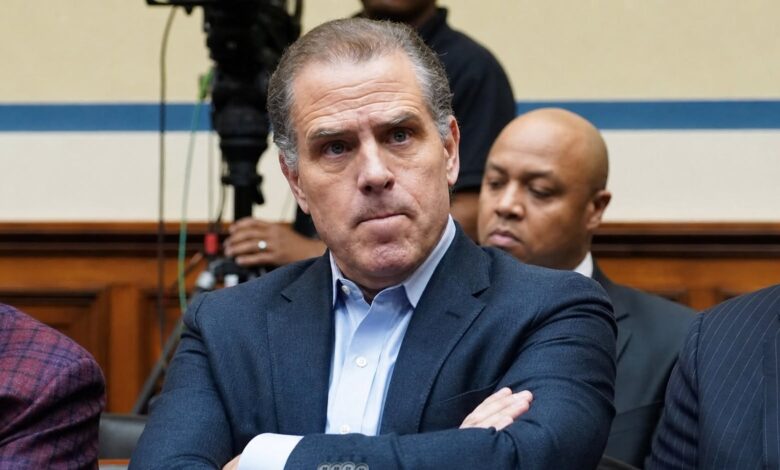
Before Hunter Biden could define himself, the country had already done it for him.
To millions of Americans, he was never simply a lawyer, businessman, recovering addict, son, father, or private citizen.
He was a Biden.
And that surname came with something most people will never experience: enormous privilege and almost nowhere to hide.
Now, news emerging from Delaware has pushed him once again into the center of a national argument. On paper, the development may look procedural—another official step in a story already crowded with investigations, courtrooms, political accusations, and family drama.
But almost immediately, it became something larger.
A debate about second chances.
A debate about influence.
A debate about whether powerful families are judged more harshly than everyone else—or protected in ways ordinary people could never imagine.
Hunter has spent years trapped between those competing narratives.
His supporters see a deeply flawed man whose worst years unfolded under a microscope.
They point to his well-documented struggles with addiction and the personal losses that surrounded his family. They see someone whose failures became political ammunition because his father happened to occupy one of the most powerful positions in the world.
In that telling, Hunter’s story is fundamentally human.
Addiction destroys judgment.
It humiliates families.
It leads people into decisions that can look incomprehensible once sobriety returns.
Recovery does not erase those decisions.
But neither should those decisions automatically erase the possibility of recovery.
That distinction matters.
Second chances are easy to support in theory.
They become much harder when the person asking for one has disappointed us.
Society loves redemption stories after redemption is complete.
We celebrate the former addict who has been sober for twenty years.
We applaud the person who rebuilt a career after prison.
We admire someone who transformed catastrophe into purpose.
The difficult part is watching reconstruction while it is still happening.
That process is rarely inspirational.
It can be awkward.
Contradictory.
Full of setbacks.
There may be apologies that don’t satisfy everyone.
There may be relationships that never recover.
There may be consequences that remain even after the behavior changes.
A genuine second chance is not the same thing as pretending the first chapter never happened.
For Hunter’s defenders, that is precisely the point.
They do not necessarily need to argue that every business decision was wise, every relationship appropriate, or every explanation convincing.
Their broader argument is that a person’s worst period should not automatically become his permanent identity.
A man can have behaved badly and still become better.
He can have benefited from privilege and still have suffered.
He can carry a famous surname and still experience addiction as brutally as someone nobody has heard of.
Human pain does not perform a background check before arriving.
But critics begin from somewhere entirely different.
They see power.
Connections.
Access.
A surname capable of opening doors.
And once that lens is applied, every opportunity becomes suspicious.
Would an ordinary person have received the same consideration?
Would someone without political connections have been treated the same way?
Would this opportunity exist if his father had never become president?
Those questions cannot simply be dismissed as partisan hostility.
They are legitimate questions whenever political families intersect with business, law, government, or public institutions.
Democracies depend not only on fairness.
They depend on the appearance of fairness.
That difference is crucial.
An institution can follow every technical rule and still damage public trust if citizens believe influence determined the outcome.
Likewise, an institution can treat a politically connected person appropriately while critics interpret that treatment as favoritism simply because of the person’s name.
That creates an almost impossible situation.
Treat Hunter leniently, and critics see privilege.
Treat him harshly, and supporters see political targeting.
Give him an opportunity, and someone asks who made the call.
Deny him one, and someone else asks whether his surname made ordinary rehabilitation impossible.
Once a person becomes politically symbolic, even routine decisions stop looking routine.
Everything becomes evidence.
To one side, evidence of persecution.
To the other, evidence of protection.
Hunter himself almost disappears beneath those interpretations.
That may be one of the strangest consequences of belonging to a political dynasty.
Your individual life becomes communal property.
Your mistakes become campaign advertisements.
Your private messages become public evidence.
Your relationships become political analysis.
Your recovery becomes a partisan argument.
Your failures are no longer allowed to remain merely yours.
This does not mean scrutiny is unfair.
Power deserves scrutiny.
Political families deserve scrutiny.
Potential conflicts of interest deserve scrutiny.
If someone benefits professionally from proximity to powerful people, journalists and citizens have every right to ask how and why.
But scrutiny and dehumanization are different things.
A person can be investigated without becoming a cartoon.
Hunter Biden’s addiction became one of the clearest examples of that tension.
There is nothing particularly partisan about addiction itself.
It exists in Republican families.
Democratic families.
Wealthy suburbs.
Rural communities.
Cities.
Boardrooms.
Factories.
Military families.
Political families.
It does not become less destructive because the person suffering from it has money.
Privilege can purchase treatment.
It cannot purchase immunity from grief, shame, relapse, or the damage addiction can inflict on relationships.
At the same time, addiction cannot become a universal explanation that dissolves accountability.
Understanding why someone behaved destructively does not require pretending the destruction never occurred.
Recovery asks for honesty precisely because consequences are real.
That principle should apply whether someone’s father is president or unemployed.
Compassion and accountability are not opposites.
A mature justice system should be capable of both.
That is where the argument surrounding Hunter becomes more interesting than the man himself.
What do Americans actually believe a second chance should look like?
Should someone who has made serious mistakes be allowed to rebuild professionally?
Most people would probably say yes.
What if that person is wealthy?
Probably still yes.
Politically connected?
Now the room gets quieter.
Because Americans have developed profound suspicion toward institutions that appear to operate differently depending on who you know.
That distrust did not begin with Hunter Biden.
For decades, people have watched wealthy defendants hire extraordinary legal teams.
They have watched corporations negotiate settlements ordinary citizens could never imagine.
They have seen politicians survive controversies that would destroy less powerful careers.
They have watched influential families convert relationships into opportunities.
Eventually, every high-profile case becomes connected to that accumulated resentment.
Hunter’s surname therefore functions simultaneously as protection and punishment.
It may have provided access unavailable to ordinary people.
It also guaranteed levels of scrutiny ordinary people will never experience.
Both can be true.
That complexity is precisely what partisan storytelling struggles to tolerate.
Politics prefers clean characters.
Victim.
Villain.
Hero.
Corrupt son.
Recovering addict.
Privileged insider.
Persecuted private citizen.
Choose one.
Reality refuses.
A person can receive advantages because of family connections and still experience genuine suffering.
Someone can deserve compassion for addiction while remaining responsible for conduct committed during that addiction.
A justice system can legitimately prosecute someone without every prosecution being politically motivated.
A powerful family can love one of its members without every act of loyalty constituting corruption.
The difficulty is separating those truths when politics rewards people for combining them.
For Joe Biden, the collision between public responsibility and private love was always particularly painful.
Presidents are institutions.
Fathers are not.
The public expects presidents to think in terms of law, precedent, ethics, and national interest.
A father looks at his son and sees birthdays.
Childhood.
Mistakes.
Loss.
Fear.
Perhaps memories of moments when he wondered whether that son would survive another night.
Those roles do not fit comfortably inside the same human being.
That doesn’t mean family loyalty should override public responsibility.
It means we should understand why these situations become morally difficult before pretending they are simple.
The same is true for Hunter’s next chapter.
If he receives another opportunity, the meaningful question isn’t merely whether he deserves one.
It is what he does with it.
Redemption is not a press release.
It is behavior repeated long enough that people begin believing the change without being asked.
It is showing up.
Accepting limitations.
Making fewer excuses.
Taking responsibility for harm.
Building something that doesn’t depend entirely on the sympathy of others.
And understanding that some people may never forgive you.
That last part is important.
A second chance does not require universal absolution.
Nobody is entitled to have the public forget.
Nobody can demand that critics stop criticizing.
Recovery gives a person the opportunity to live differently.
It does not give them control over how everyone interprets the past.
Hunter may spend the rest of his life carrying two identities.
The person he was.
And the person he says he is trying to become.
Most people carry that tension privately.
His happens in public.
That makes every new development feel disproportionately significant.
A photograph becomes evidence of rehabilitation.
A controversy becomes proof that nothing changed.
A professional opportunity becomes either redemption or corruption depending on which headline someone reads first.
But perhaps the healthiest measure is simpler.
Watch what happens over time.
Not one announcement.
Not one speech.
Not one political argument.
Patterns.
Does the person demonstrate responsibility?
Does he acknowledge consequences?
Does he behave as though privilege entitles him to exceptions?
Does he use opportunity constructively?
Does he remain accountable when nobody is applauding?
Character is rarely revealed by a single dramatic moment.
It is revealed through repetition.
The same standard should apply to institutions.
If people believe Hunter Biden received special treatment, the answer should not be outrage at the question.
It should be transparency.
Explain the process.
Show the rules.
Demonstrate that comparable people would receive comparable treatment.
Public trust grows when systems can withstand examination.
“Trust us” is no longer enough.
Perhaps it never was.
That is especially true in an era when Americans increasingly assume institutions are captured by political, financial, or cultural elites.
Every unexplained exception feeds that suspicion.
Every transparent process weakens it.
So the Hunter Biden story is not merely about Hunter Biden.
It asks whether America genuinely believes in rehabilitation.
Whether political connections distort opportunity.
Whether addiction should change how wrongdoing is understood.
Whether famous families can ever receive ordinary treatment.
Whether accountability can coexist with mercy.
And whether citizens can evaluate complicated people without turning them into symbols for everything they already believe.
Those are harder questions than deciding whether Hunter is good or bad.
Good and bad are convenient categories.
Human beings are inconvenient.
They fail.
Recover.
Relapse.
Love people badly.
Try again.
Receive advantages they didn’t earn.
Suffer losses they didn’t deserve.
Sometimes they become better.
Sometimes they don’t.
And sometimes the only responsible answer is to keep watching.
If Hunter wants a life beyond scandal, no headline can grant it to him.
He has to build it.
Slowly.
Publicly or privately.
Decision after decision.
Likewise, if institutions want Americans to believe powerful families are treated fairly, they cannot demand that trust.
They must demonstrate it.
That is where the two sides of this story finally meet.
Second chances require accountability.
Accountability requires fairness.
And fairness requires rules that remain recognizable regardless of the surname attached to the person standing before them.
Hunter Biden may always be Joe Biden’s son in the public imagination.
He cannot change that.
He cannot rewrite everything that came before.
What he can control is what he does with whatever comes next.
And perhaps that is ultimately what a second chance really means.
Not erasing the past.
Not demanding forgiveness.
Not pretending privilege never existed.
Simply being given enough future to prove that yesterday does not have to become tomorrow.