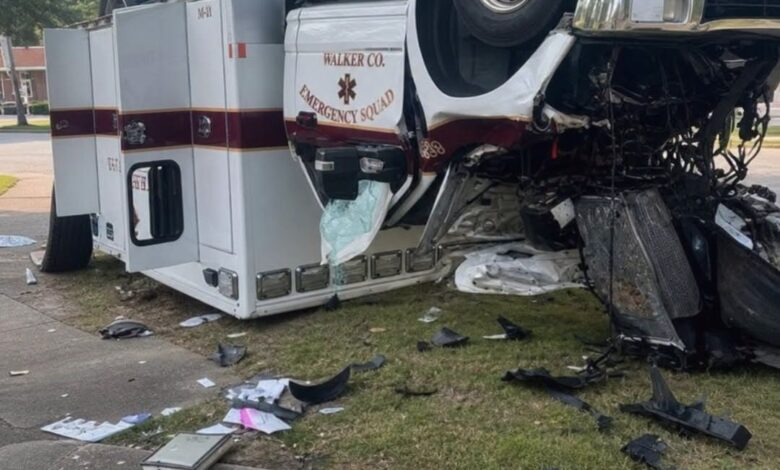
The siren was still screaming when the ambulance left the road.
One second, its lights were cutting through the darkness, clearing intersections and carrying a critically ill patient toward the hospital.
The next, there was the sound nobody inside an ambulance ever expects to hear from their own vehicle.
Metal struck pavement.
Glass exploded.
Equipment tore loose from its mounts.
Then the entire world rolled.
For the crew, the emergency had begun minutes earlier with a call that sounded urgent even by their standards. A patient was deteriorating rapidly, and the nearest hospital capable of providing the needed treatment was far enough away that every minute suddenly felt expensive.
The paramedics had made emergency runs countless times.
They knew the procedure.
Secure the patient.
Notify the receiving hospital.
Monitor vital signs.
Treat what could be treated en route.
Move quickly without allowing urgency to become recklessness.
It was a balance emergency crews practiced constantly.
Tonight, that balance felt impossibly thin.
In the rear compartment, paramedic Sarah Bennett kept her attention on the patient while her partner, Marcus, called out changes in vital signs.
“Pressure’s dropping.”
“I see it.”
Sarah adjusted what she could.
“How far?”
Marcus relayed the question toward the front.
“Seven minutes.”
Seven minutes could be nothing.
Seven minutes could be everything.
The ambulance continued through the night.
Traffic pulled aside as the siren approached. Streetlights flashed across the windows. Inside, Sarah barely noticed the speed.
Her world had narrowed to numbers on a monitor.
“Stay with me,” she told the patient.
Then came the intersection.
Later, everyone would remember it differently.
A witness would say the ambulance entered with lights and siren operating.
Another would remember seeing a vehicle moving through the crossing.
Investigators would eventually examine road markings, video, vehicle data, weather, speed, braking, visibility, and every other measurable fragment they could recover.
But inside the ambulance, there was no time for analysis.
There was only impact.
Sarah felt herself thrown sideways.
The ceiling became the wall.
Something struck her shoulder.
A medical bag flew past.
Marcus shouted.
Then came another violent crash as the ambulance rolled.
When it finally stopped, the siren was still sounding.
For several seconds, nobody moved.
Sarah opened her eyes.
She was hanging at an angle, restrained but disoriented.
“Marcus?”
A groan answered.
Then training took over.
“The patient.”
Everything had changed.
Seconds earlier, they had been rescuers.
Now they were casualties too.
Outside, people were already running toward them.
A man abandoned his car in the intersection.
A woman standing outside a convenience store called emergency services even though she could see the wrecked ambulance directly in front of her.
Another driver approached, then stopped when someone shouted about broken glass.
“Is anybody inside?”
“Yes!”
The answer came from somewhere within the wreckage.
Those strangers didn’t have uniforms.
They didn’t have medical bags.
Most had probably never imagined themselves approaching an overturned ambulance.
But they did what ordinary people so often do when something terrible happens in front of them.
They moved toward the people who needed help.
Someone warned approaching traffic.
Someone kept others from getting too close.
Another person spoke through a shattered opening, telling those trapped inside that help was coming.
Sarah could hear voices outside.
“Don’t move unless you have to!”
“We’ve called them!”
“Fire department’s coming!”
The irony was almost unbearable.
The people whose job was to arrive when others were in trouble were waiting to be rescued.
At the hospital, the expected patient suddenly became multiple patients.
The notification reached the emergency department quickly.
Ambulance crash.
Crew injured.
Original patient still inside.
Prepare trauma bays.
Doctors and nurses moved automatically.
Beds were cleared.
Equipment appeared.
Teams assembled.
Then names began filtering through.
Some of the hospital staff knew the paramedics.
That changed nothing about the medical protocol.
Emotion would have to wait.
When the first injured crew member arrived, people who had joked with him in hallways were suddenly cutting clothing away and checking him for injuries.
The original patient arrived too.
The emergency that had started the entire journey had not disappeared simply because another catastrophe had occurred.
Now there were several lives balanced against the consequences of one violent moment.
By sunrise, the intersection was almost empty.
The wreckage had been removed.
Only scattered debris and marks on the roadway suggested what had happened.
But the questions were beginning.
How fast had the ambulance been traveling?
What did the signal show?
When had the driver begun braking?
Could the collision have been avoided?
Had another motorist failed to yield?
Had visibility contributed?
Had urgency influenced a decision that would otherwise have been different?
Investigators didn’t have the luxury of answering emotionally.
They needed evidence.
Vehicle data.
Radio traffic.
Surveillance footage.
Witness statements.
Physical measurements.
The siren itself couldn’t answer whether the risk had been justified.
Neither could the seriousness of the patient’s condition.
That is what makes emergency driving so complicated.
An ambulance exists because time sometimes matters desperately.
A critically ill patient may genuinely benefit from reaching definitive care sooner.
Yet every increase in speed introduces risk—not only to the patient and crew, but to everyone sharing the road.
Emergency lights do not create an invisible shield around a vehicle.
Sirens do not guarantee that every driver will hear them.
Intersections remain intersections.
Physics remains physics.
The crew understood that before the crash.
Every emergency professional does.
But knowing risk exists doesn’t make every decision obvious while someone is deteriorating behind you.
In the days afterward, the community wanted a simple explanation.
Some blamed the ambulance driver immediately.
Others insisted emergency crews should never be criticized for moving quickly when someone’s life was at stake.
Both conclusions came before the investigation was finished.
The truth demanded more patience.
Because emergency response cannot be governed by the belief that saving one person justifies unlimited danger.
Nor can it function if crews are expected to drive as though urgency never matters.
The difficult work lives between those extremes.
Protocols exist there.
Training exists there.
Judgment exists there.
So does human fallibility.
For the crew, recovery involved more than physical injuries.
Sarah found herself replaying the sound of the impact.
Marcus remembered equipment flying through the compartment.
The driver remembered the seconds approaching the intersection and questioned decisions that had once felt routine.
People told them they were heroes.
Some days, that word helped.
Other days, it made everything heavier.
They knew something the public often forgot:
First responders are not protected from fear simply because they are trained to enter frightening situations.
They carry the aftermath too.
Weeks later, Sarah returned to the ambulance station.
A replacement vehicle sat outside.
She walked around it slowly before climbing inside.
Everything looked familiar.
Monitor.
Cabinets.
Straps.
Oxygen.
The ordinary architecture of emergencies.
She ran one hand along the rail where she normally steadied herself.
Then she sat down.
There was no triumphant moment.
No applause.
Just a paramedic sitting inside an ambulance, learning to trust the sound of an engine again.
The crash would eventually become reports, diagrams, recommendations, and lessons.
That work mattered.
If something could be changed—training, procedure, equipment, intersection practice—then it needed to be learned.
But the community remembered something else.
People remembered strangers running toward overturned steel.
They remembered hospital workers treating colleagues as patients.
They remembered a rescue mission transforming, in seconds, into an emergency involving the rescuers themselves.
And they were left with a question no flashing light can completely resolve:
How much risk should anyone accept to save another human life?
There is no answer that fits every emergency.
There is only the responsibility to keep asking.
Because urgency matters.
Seconds sometimes matter.
But the people inside the ambulance matter too.
So does the patient.
So does the stranger crossing the intersection.
The purpose of an emergency response is not simply to arrive quickly.
It is to bring as many people as possible safely through the worst moment of their lives.
That night, one ambulance began its journey trying to save a single life.
By the time the siren finally stopped, an entire community had been reminded how fragile the line between rescuer and rescued really is.