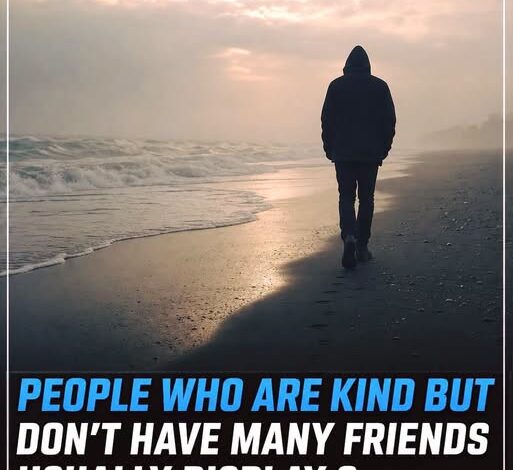
When people picture a kind person, they often imagine someone surrounded by friends.
The image is familiar: a warm, friendly individual constantly receiving invitations, moving effortlessly between social circles, and never lacking company. Popular culture has taught us to associate kindness with popularity, as though generous and compassionate people naturally attract large groups wherever they go.
But real life is often much more complicated.
In fact, some of the kindest people you’ll ever meet are not the most socially connected. They are not the center of every gathering. They do not have hundreds of close friends or an endless stream of social plans.
Instead, they often have surprisingly small circles.
Not because they struggle socially.
Not because people dislike them.
But because they approach relationships differently.
While many people seek quantity, kind individuals often seek depth. They are less interested in collecting connections and more interested in building meaningful ones. Their social worlds may appear smaller from the outside, but they are often richer in trust, loyalty, and emotional authenticity.
In today’s fast-paced culture, where attention is constantly divided and communication rarely slows down, this approach can make them seem unusual. Yet the reasons behind their smaller social circles reveal some of the most admirable qualities they possess.
They Listen More Than They Talk
One of the defining characteristics of genuinely kind people is their ability to listen.
In many social situations, conversations become competitions. People wait for their turn to speak, share their opinions, or redirect attention back to themselves.
Kind individuals often do the opposite.
They listen carefully.
They notice details.
They pay attention not only to words but also to emotions, pauses, and changes in tone.
When someone speaks to them, they feel heard.
This is why people often trust kind individuals with their deepest struggles and most personal concerns. They become the friend others call during difficult times, the coworker people confide in, or the family member everyone turns to when life becomes overwhelming.
Ironically, this gift can make them less visible in large groups.
Because they are not competing for attention, louder personalities often dominate social settings while kind listeners quietly remain in the background.
As a result, they may be deeply valued by a few people rather than widely recognized by many.
They Distance Themselves From Gossip
Many social groups bond through shared conversations about other people.
Sometimes those conversations are harmless.
Sometimes they are not.
Kind individuals tend to feel uncomfortable when discussions become judgmental, cruel, or unnecessarily negative.
They rarely enjoy tearing others down.
When gossip begins, they often change the subject, remain silent, or excuse themselves entirely.
This isn’t because they believe they are better than anyone else.
It’s because negativity drains them.
Over time, this preference naturally separates them from environments where gossip serves as a primary social currency.
While others may strengthen friendships through shared criticism, kind people usually seek connection through understanding, encouragement, and genuine conversation.
The trade-off is clear.
They may have fewer social opportunities, but they preserve their peace of mind.
They Understand the Importance of Boundaries
Many people assume that kindness means saying yes to everyone.
True kindness is far more balanced than that.
The kindest people eventually learn that endless availability is unsustainable. Constantly giving without limits leads to exhaustion, resentment, and emotional burnout.
Instead, they develop boundaries.
Not aggressive boundaries.
Not dramatic ones.
Quiet boundaries.
They gradually step away from relationships that consistently drain them. They decline invitations when they need rest. They protect their time and emotional resources without feeling guilty about it.
Unfortunately, others sometimes misunderstand this behavior.
Some interpret boundaries as rejection.
Others mistake self-care for distance.
But kind individuals understand an important truth: they cannot pour from an empty cup.
Protecting their own well-being allows them to continue showing up fully for the people who truly matter.
Their Empathy Runs Deep
Few qualities define kindness more than empathy.
Many kind individuals don’t simply recognize other people’s emotions—they feel them.
They notice subtle shifts in mood.
They sense unspoken pain.
They often understand when someone is struggling long before anyone else realizes it.
This emotional awareness creates powerful connections.
It also comes at a cost.
Absorbing the emotions of others can be exhausting.
Constant exposure to stress, sadness, conflict, and disappointment takes energy. Over time, even the most compassionate people need space to recover.
This is why kind individuals sometimes withdraw from social situations.
Not because they don’t care.
But because they care deeply.
And deep caring requires recovery.
A quiet evening alone may be what allows them to continue supporting others tomorrow.
They Don’t Depend on Validation
Modern society often encourages people to seek approval.
Social media rewards visibility.
Attention becomes currency.
Popularity is frequently mistaken for value.
Kind individuals tend to operate differently.
Their self-worth usually comes from within.
They don’t need constant praise to feel secure.
They don’t measure their importance by the number of followers they have, the invitations they receive, or the amount of attention they attract.
Instead, they focus on personal integrity.
They care more about being genuine than being admired.
This independence allows them to avoid many social pressures, but it also makes them less likely to chase large social circles simply for the sake of appearances.
They Become Selective With Experience
As kind people grow older, they often become more intentional about relationships.
Life teaches them valuable lessons.
They learn which friendships provide mutual support.
They recognize which relationships consistently take more than they give.
They begin to understand that time and emotional energy are limited resources.
Rather than spreading themselves thin across dozens of shallow connections, they choose to invest deeply in a handful of meaningful ones.
This selectiveness isn’t exclusionary.
It’s practical.
They know that authentic connection requires attention, trust, and emotional investment.
Those things cannot be endlessly divided.
They Often Attract Emotionally Draining People
Kindness is attractive.
People naturally gravitate toward those who are patient, understanding, and supportive.
Unfortunately, not everyone arrives with healthy intentions.
Some individuals become overly dependent on kind people, relying on them for constant emotional support while offering little in return.
At first, compassionate individuals often tolerate this imbalance because they genuinely want to help.
But eventually, many recognize the pattern.
They realize that healthy relationships require reciprocity.
Support should flow both ways.
As a result, they become more careful about who they allow into their lives.
This doesn’t make them less kind.
It makes them wiser.
They Prefer Meaningful One-on-One Conversations
Large gatherings can be enjoyable for some people.
For deeply kind individuals, however, they often feel exhausting.
Surface-level conversations, constant interruptions, and social performance can leave them feeling disconnected rather than fulfilled.
What they truly enjoy are meaningful conversations.
The kind that happen over coffee.
During a long walk.
Late at night when distractions disappear.
In these quieter moments, people reveal who they really are.
And that’s where kind individuals thrive.
They are often less interested in entertaining a crowd than understanding a single person.
As a result, they naturally gravitate toward smaller circles and deeper relationships.
Authenticity Matters More Than Belonging
Perhaps the strongest reason kind people maintain smaller social circles is their commitment to authenticity.
They don’t enjoy pretending.
They don’t want to perform a version of themselves simply to gain acceptance.
If a group requires them to compromise their values, hide their personality, or participate in behavior that feels wrong, they are usually willing to walk away.
Even when it costs them socially.
This commitment to authenticity acts as a filter.
Many relationships fall away.
The ones that remain become stronger.
Because the people who stay appreciate them for who they truly are—not for who they pretend to be.
The Quiet Strength Behind a Small Circle
Kindness is often misunderstood.
People assume it should look loud, visible, and socially dominant.
In reality, some of the kindest people live remarkably quiet lives.
They are not surrounded by crowds because they are not chasing crowds.
They are searching for something deeper.
Trust.
Honesty.
Loyalty.
Emotional safety.
Genuine understanding.
Their friendships may be fewer, but they are often stronger.
Their circles may be smaller, but they are often more meaningful.
And their influence frequently reaches further than they realize.
Because true kindness is not measured by how many people know your name.
It is measured by how deeply your presence improves the lives of those who do.
In the end, popularity fades.
Attention comes and goes.
But authentic connection endures.
And that is why some of the kindest people in the world are not surrounded by everyone—they are simply cherished by the few who truly know them.