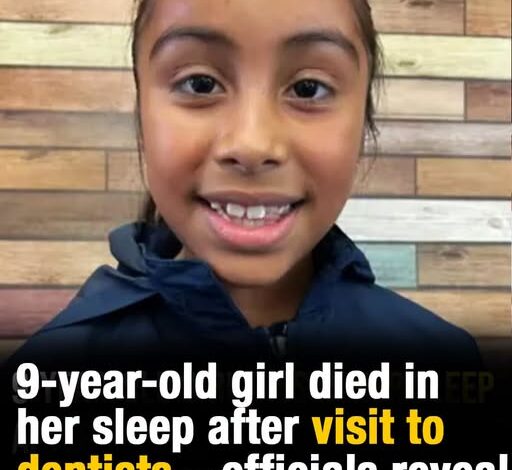
Silvanna Moreno’s family walked into what they believed would be a routine dental appointment, expecting to return home with nothing more than a sleepy little girl recovering from anesthesia. Instead, they found themselves living a nightmare that would forever change their lives. What should have been an ordinary day ended in unimaginable heartbreak, leaving behind painful questions that continue to echo far beyond one family’s loss.
After the procedure, Silvanna appeared drowsy, which her loved ones understood to be a normal effect of the medication she had received. She was discharged and taken home, where she remained heavily asleep. Her deep snoring, something that might have alarmed many parents under different circumstances, was reportedly explained as a typical part of recovering from anesthesia.
Wanting to trust the medical guidance they had been given, her family believed she simply needed time to rest.
But as the afternoon unfolded, subtle changes began to emerge.
Her breathing, once steady, gradually became quieter. Then it slowed.
At first, the signs were easy to mistake for the lingering effects of sedation. Yet as the minutes passed, concern quickly turned into panic. Realizing something was terribly wrong, her family rushed to get help, desperately hoping doctors could reverse whatever was happening.
By the time they reached the hospital, however, there was nothing left to save.
Medical staff confirmed the devastating reality that every parent fears. Silvanna’s heart had stopped, and despite every effort, she could not be revived.
The unimaginable loss left her family searching for answers.
A subsequent autopsy concluded that Silvanna had likely suffered from methemoglobinemia, an exceptionally rare condition in which the blood loses much of its ability to carry oxygen effectively throughout the body. According to the findings, the reaction was believed to have been triggered by a combination of anesthetic medications administered during her dental procedure, including nitrous oxide.
Although the condition is considered extremely uncommon, its consequences can be catastrophic when it develops.
As news of the tragedy spread, attention quickly shifted toward the dental practice involved.
The clinic maintained that every appropriate protocol had been followed throughout Silvanna’s treatment. According to its statements, standard procedures were observed, her vital signs remained stable during the procedure, and there had been no indication that such a rare medical emergency was developing before she was discharged.
Even so, the family’s heartbreaking loss prompted renewed scrutiny.
Public records revealed that the same dentist had previously been the subject of an investigation following another serious incident involving a patient, an event that reportedly resulted in professional probation after a near-fatal outcome. While separate cases cannot, on their own, determine responsibility for subsequent events, the history intensified public concern and fueled questions about oversight, patient safety, and whether additional safeguards might have prevented another tragedy.
For Silvanna’s loved ones, however, those broader discussions cannot erase the reality they now face.
A daughter who should have been growing up, celebrating birthdays, and creating memories is gone.
No investigation, expert opinion, or official statement can fill the space left behind.
Her story has also resonated with parents everywhere because it challenges a deeply held assumption—that routine medical and dental procedures are always free from life-threatening risks. While serious complications from anesthesia remain rare, tragedies like this remind families that even commonly performed procedures carry some degree of risk, however small, and that unexpected medical reactions can occur despite careful planning and adherence to established standards.
That reality is difficult to accept precisely because it is so uncommon.
Parents place immense trust in healthcare professionals every time they consent to a procedure involving sedation or anesthesia. They rely on trained experts to recognize risks, monitor recovery, and guide them safely through what is often described as routine care. When an outcome defies every expectation, the grief is compounded by uncertainty and unanswered questions.
As investigations and legal processes continue, Silvanna Moreno’s death stands as a heartbreaking reminder of how quickly an ordinary day can become an irreversible tragedy. Her family’s loss has shaken a community, sparked renewed conversations about patient safety, and encouraged many parents to ask more questions before procedures involving anesthesia.
For those who loved Silvanna most, however, the conversation is no longer about policies, protocols, or medical terminology. It is about a little girl whose life ended far too soon and a family left carrying a grief that no explanation can ever fully ease. Their hope now is that, through greater awareness and continued efforts to improve patient safety, no other family will have to endure the same unimaginable heartbreak.