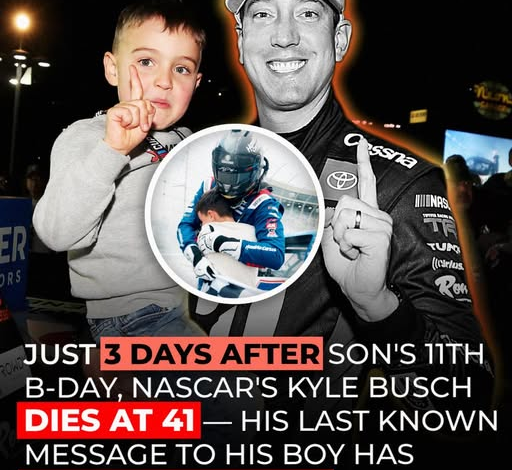
The NASCAR world has always lived close to danger, but lately the grief feels heavier, closer, more personal. Within only a few months, fans have watched two names deeply tied to racing become memorials instead of competitors: Kyle Busch and Chase Pistone.
For longtime followers of the sport, the losses feel disorienting because both men represented very different sides of motorsports culture, yet each embodied the same relentless devotion that racing demands from the people who build their entire identities around speed, competition, and survival.
Kyle Busch was impossible to ignore.
Even people who disliked him watched him closely because talent at that level becomes magnetic whether audiences love it or not. He drove with visible emotion, with aggression that sometimes crossed into recklessness, and with a confidence that made every race feel personal. Over time, “Rowdy” stopped being merely a nickname and became a kind of racing mythology. He was the driver fans booed loudly and secretly hoped would still somehow end up battling for the lead with ten laps remaining.
And now suddenly, that energy is gone.
NASCAR confirmed his death at 41 after reports earlier that day stated he had been hospitalized with a severe illness. No official cause was immediately released, which only deepened the shock rippling through garages, broadcasts, and living rooms across the country.
What made the loss feel especially cruel was the ordinary tenderness of his final public moments.
Only days earlier, Kyle had posted lovingly about his son Brexton’s birthday, sharing pride not only in the child’s racing ability but in the kind of person he was becoming. Those posts now read differently, as final messages always do after sudden tragedy. Every sentence gains accidental weight. Every family photo starts looking less like content and more like evidence of a life paused mid-motion.
That is the strange violence of unexpected death:
it turns routine moments into artifacts overnight.
For years, Samantha Busch had spoken publicly about how different Kyle was away from the racetrack. Fans saw the fire, the arguments, the emotional radio transmissions, the unapologetic confidence. She saw the husband who helped carry her through infertility struggles and private heartbreak. That contrast mattered because it reminded people that athletes, especially those whose careers depend on aggression, are never fully captured by television broadcasts.
Competition simplifies people.
Family complicates them again.
And grief does the same.
The reactions from fellow drivers reflected that complexity immediately. Dale Earnhardt Jr. described how rivalry eventually evolved into friendship. Denny Hamlin admitted he was struggling to process the loss at all. Those tributes carried unusual emotional force because NASCAR culture has traditionally celebrated toughness, emotional control, and resilience. Yet death cuts through performance quickly. Suddenly all the old rivalries become secondary to memory.
Fans began revisiting old races almost immediately.
The bump-and-run finishes.
The heated interviews.
The spectacular saves.
The moments where Kyle seemed to drive not only against opponents but against the limits of the car itself.
And beneath all those clips lived another realization:
an entire generation grew up with him already there.
That is when an athlete becomes woven into culture rather than merely participating in it.
For younger NASCAR fans especially, Kyle Busch did not feel temporary. He felt permanent, like Daytona in February or engines firing on Sunday afternoons. The possibility that he would someday disappear existed abstractly somewhere far away, not suddenly at 41 while still actively racing.
But grief in motorsports had already been building before Kyle’s death.
Earlier in the year, the racing world was shaken by the loss of Chase Pistone, whose death carried a very different but equally devastating emotional weight. While Kyle represented NASCAR superstardom, Chase embodied grassroots racing culture—the world of smaller tracks, family-run teams, late nights in garages, and careers built more on persistence than celebrity.
His brother Nick’s public statement after Chase’s death felt raw in a way polished announcements rarely do. He described losing not only a sibling but his best friend. There is something uniquely painful about reading grief written before shock has fully settled. The words arrive unevenly, emotionally exposed, stripped of media polish.
And perhaps that honesty is why the racing community responded so strongly.
Because motorsports, for all its glamour at the highest levels, remains deeply rooted in family culture. Fathers teach sons. Brothers work on engines together. Entire weekends revolve around trailers, tools, dirt, gasoline, and inherited obsession.
Chase Pistone came directly from that world.
Grandson of NASCAR winner “Tiger” Tom Pistone, Chase grew up inside racing almost from birth. He began competing at six years old and built a respected career not only as a driver but as a car builder, crew chief, and mentor to younger racers. He represented the countless figures who keep motorsports alive outside national television coverage—the people who spend decades helping others chase dreams even after their own spotlight dims.
That legacy matters enormously within racing communities.
Because unlike many professional sports, motorsports depends heavily on generational continuity. Knowledge passes hand-to-hand. Setup advice, driving instincts, fabrication techniques, emotional resilience—much of it travels through mentorship more than formal systems.
When someone like Chase dies, the loss ripples outward through dozens of younger drivers shaped quietly by his guidance.
And the circumstances surrounding his death added another painful dimension.
His family requested that the 988 Suicide & Crisis Lifeline be shared publicly alongside the announcement. That detail shifted the conversation from mourning alone toward mental health, emotional isolation, and the pressure many athletes carry privately while continuing to perform publicly.
Bubba Wallace’s emotional social media posts reflected that atmosphere clearly. His words did not read like public relations statements. They read like someone confronting the fragility of life in real time and struggling to process how quickly people can disappear while the world keeps moving around them.
That may be the deepest common thread connecting both losses:
fragility.
Motorsports often projects invincibility. Speed itself creates that illusion. Drivers become symbols of fearlessness because they repeatedly survive situations most people instinctively avoid.
But helmets cannot protect anyone from illness.
Trophies cannot prevent despair.
Fame cannot guarantee peace.
Eventually every sport is forced to confront the humanity underneath performance.
And NASCAR has been confronting it repeatedly.
What remains afterward are stories.
Kyle Busch kneeling beside Brexton in victory lane.
Chase Pistone helping younger drivers prepare cars late into the night.
The rivalries.
The mentorship.
The arguments.
The celebrations.
The ordinary moments now transformed by absence.
That is the difficult thing about grief in sports:
fans often mourn people they never truly knew, yet the emotional connection still becomes real because these athletes occupied consistent places inside their lives for years.
Sunday routines.
Race weekends.
Highlight reels.
Childhood memories shared with parents and grandparents.
Athletes become timestamps for entire eras of our lives.
And when they disappear unexpectedly, part of those memories suddenly feels vulnerable too.
Perhaps that is why these losses hit the racing world so deeply.
Not only because of who Kyle Busch and Chase Pistone were individually.
But because together they reminded everyone of something easy to forget inside competitive culture:
behind every firesuit and sponsor logo exists a human being carrying invisible struggles, private tenderness, unfinished plans, exhausted hopes, and people who love them far beyond the racetrack.
The engines eventually go silent for everyone.
What remains afterward is not merely statistics or championships.
It is the imprint people leave on others:
the children they inspired,
the families they built,
the communities they shaped,
and the memories still echoing long after the final lap is over.