Kyle Busch’s Final Interview Takes Haunting Turn as NASCAR Star’s Last Words Prove Eerily Prophetic

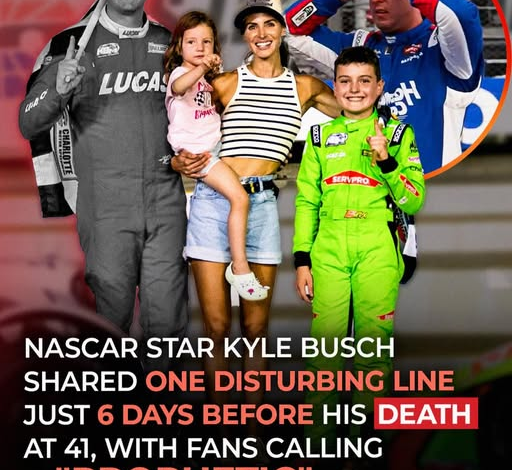
For NASCAR fans, the most haunting moments are rarely the crashes themselves. Often, they are the ordinary clips replayed afterward — the interviews, the jokes, the exhausted smiles — suddenly transformed by hindsight into something unbearably heavy. That is exactly what happened in the days following Kyle Busch’s sudden death at 41.
Only a week earlier, Busch looked like the same fierce competitor fans had watched for decades. He had climbed from his truck after another victory at Dover Motor Speedway, still sharp, still sarcastic, still visibly fueled by the same competitive fire that built “Rowdy Nation” into one of the sport’s most loyal fan bases. The interview felt routine at the time: another win, another celebration, another chapter in a career already guaranteed a place in NASCAR history.
Now, people watch it differently.
Not because the interview itself changed.
Because death changed the meaning around it.
Fans began replaying every detail after NASCAR confirmed Busch’s passing on May 21, 2026. They noticed things that barely registered before: the heaviness in his voice, the swelling in his face, the fatigue behind the confidence. Some viewers pointed out that he looked sick. Others said his energy felt unusually subdued for someone fresh off a victory.
At the time, none of it seemed alarming enough to stop the momentum of race weekend.
That is another cruelty of hindsight:
warning signs often only become visible once people know where the story ends.
Earlier radio audio from Watkins Glen soon resurfaced online as well. During the race weekend, Busch had asked his crew to locate Dr. Bill Heisel after the event, saying quietly over team radio, “I’m gonna need a shot.” FOX Sports later mentioned he was reportedly dealing with a sinus cold, and the moment disappeared quickly into the endless noise of racing coverage.
Until it didn’t.
After his death, fans stitched those moments together like emotional detectives trying to understand whether the ending had announced itself earlier than anyone realized.
But it was one sentence from that Dover interview that hit people hardest.
While reflecting on why victories still mattered after more than twenty years in NASCAR, Busch smiled and said:
“Because you never know when the last one is, you know?”
The line exploded across social media within hours of his death being announced.
Not because it was supernatural.
Because it was painfully human.
Athletes say things like that often. Veterans in any sport understand careers are fragile. Injuries happen. Opportunities vanish. Retirement arrives suddenly. In racing especially, drivers become intimately familiar with uncertainty.
Yet hearing those words again after his passing felt different.
Suddenly the sentence no longer sounded reflective.
It sounded final.
Fans described the clip as eerie, prophetic, heartbreaking. But perhaps what unsettled people most was how ordinary the moment originally seemed. Busch was not delivering some grand farewell speech. He was simply speaking honestly about appreciating victories while they still existed.
That honesty became devastating only afterward.
And maybe that is why grief around public figures affects people so deeply sometimes. Death rewrites ordinary footage into emotional evidence. Every smile becomes loaded. Every sentence gains accidental symbolism. The brain begins searching desperately for meaning hidden inside moments that were never meant to carry it.
The racing world’s reaction reflected more than admiration for Busch’s achievements. It reflected shock at how abruptly permanence can disappear.
Kyle Busch had spent over two decades woven into NASCAR culture itself. Fans watched him evolve from the brash young driver everyone loved to hate into a veteran champion, husband, father, and mentor. Rivalries mellowed into respect. Emotional outbursts became part of his mythology. He was not simply another driver on the grid anymore.
He was part of the structure of Sunday afternoons.
That is why the loss feels disorienting.
For many fans, Busch always seemed like someone who would simply keep racing forever in some form — maybe slower someday, maybe older, maybe mentoring younger drivers, but still present somewhere near the garage, still arguing over strategy, still chasing another win.
Instead, the final victory came without anyone realizing it was final at all.
There is something uniquely painful about “last times” we fail to recognize while they are happening.
The last interview.
The last race.
The last joke over team radio.
The final wave to fans in Victory Lane.
Nobody pauses properly in those moments because nobody knows they are standing inside the ending yet.
Busch’s final public appearances also reminded people how much athletes separate public performance from private reality. Even while reportedly dealing with illness, he continued competing, speaking to media, thanking fans, and functioning inside the demanding machinery of professional racing.
That endurance is admired culturally, especially in sports.
But afterward, it also raises uncomfortable questions about how often athletes normalize pushing through pain because the environment around them expects it.
In motorsports particularly, toughness becomes identity very early. Drivers are trained psychologically to compartmentalize discomfort, fear, exhaustion, and injury because hesitation at high speeds can become dangerous itself. Over time, many racers learn to minimize symptoms automatically.
Fans then absorb that same mentality.
They see resilience instead of warning.
Only after tragedy does vulnerability fully reappear.
The emotional response from fellow NASCAR figures reflected this clearly. Dale Earnhardt Jr. spoke openly about rebuilding friendship with Busch after years of rivalry. Denny Hamlin admitted he was struggling to process the news at all. These were not polished tributes designed for publicity cycles. They felt raw, unsettled, unfinished — exactly the way sudden grief usually feels.
And underneath all of it sat another quiet realization:
Kyle Busch’s final public moments were overwhelmingly centered around family.
His last Instagram posts celebrated Brexton.
Samantha’s birthday tribute described him as a devoted husband and father.
Old interviews resurfaced where she called him her “rock” during fertility struggles and difficult periods in their marriage.
The contrast between the aggressive competitor and the deeply family-oriented man behind the scenes made the loss feel even more intimate to fans.
Because eventually, after enough years watching athletes, audiences stop seeing only statistics.
They start seeing people.
That same emotional weight has lingered over the NASCAR community more broadly following the earlier death of Chase Pistone, another deeply respected figure in grassroots racing culture. Together, the losses forced many inside motorsports to confront how fragile life remains even in environments built around fearlessness and speed.
Helmets cannot protect people from illness.
Fame cannot protect them from emotional pain.
Talent cannot guarantee more time.
And perhaps that is why Busch’s final quote continues echoing so strongly online.
Not because fans believe he predicted his death.
Because his words accidentally touched something universal:
most people never realize which conversation, victory, hug, or ordinary day will become the last one attached to someone they love.
We live assuming repetition.
Tomorrow.
Next season.
Next race.
Then suddenly there isn’t one.
And all that remains are memories replayed endlessly through screens and stories, while people search old footage for signs they somehow missed.
In the end, Kyle Busch’s final interview now feels less like a farewell and more like an unintended reminder:
life rarely announces its endings clearly beforehand.
Sometimes a champion thanks the fans, smiles beneath bright lights, celebrates another hard-earned victory—
and unknowingly drives straight into history.