The 2026 ACM Awards red carpet felt less like a single fashion event and more like a visual argument about what country music itself has become.
Before the ceremony even started, social media was already dissecting every arrival in real time, turning outfits into instant cultural commentary. Screenshots spread across X, TikTok, Instagram, and Reddit within minutes of celebrities stepping onto the carpet, and fans reacted with the same intensity usually reserved for the awards themselves. But what people were really debating wasn’t only fashion.
It was identity.
Country music has always carried a complicated relationship with image. The genre sells authenticity more aggressively than almost any other corner of entertainment, yet it also exists inside an industry increasingly shaped by branding, celebrity culture, crossover marketing, and internet visibility. The result is a constant balancing act between heritage and reinvention — between cowboy tradition and modern performance.
The ACM red carpet captured that tension perfectly.
Every outfit seemed to answer the same unspoken question differently:
What does a country star look like now?
Some artists leaned hard into classic Western symbolism.
Others blurred the line between country, pop, luxury fashion, and streetwear.
And some appeared almost deliberately indifferent to expectations altogether.
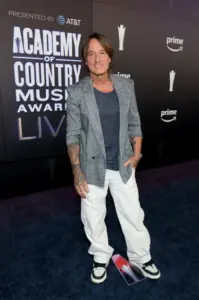
Keith Urban became the clearest example of how emotionally charged celebrity presentation has become online.
His outfit itself was not especially outrageous by broader entertainment standards: a gray blazer layered over a dark shirt, paired with loose white trousers and sneakers. In another context — an indie film festival, a relaxed press appearance, a casual music industry event — the look might barely have registered as controversial.
But country audiences often read clothing symbolically.
And Urban’s relaxed styling immediately divided viewers.
Some fans appreciated the effortlessness of it. They saw someone comfortable enough in his legacy to stop performing exaggerated formality for cameras. Others interpreted the outfit entirely differently, describing him as disconnected, uncomfortable, tired, or strangely subdued.
What fascinated observers most was how quickly discussion shifted away from fabric and toward emotional projection.
People analyzed his facial expressions.
His posture.
The way he stood beside photographers.
The angle of his shoulders.
Modern celebrity culture encourages audiences to treat still photographs like psychological evidence. One neutral expression becomes “proof” of unhappiness. A relaxed posture becomes evidence of exhaustion or tension. Social media users now interpret body language with extraordinary confidence despite possessing almost no actual context.
And because Urban has existed publicly for decades, fans unconsciously compare every appearance against older versions of him preserved in memory:
younger,
more energetic,
more visibly performative.
Aging quietly in public has become almost impossible for celebrities because audiences expect perpetual familiarity from people who continue changing privately like everyone else.
While Keith Urban sparked debate through understatement, Riley Green generated attention by embracing country tradition almost theatrically.
His textured brown three-piece suit, cowboy hat, tie, and matching boots leaned fully into the iconography audiences still associate instinctively with “real” country music. The look felt deliberate in its commitment to Western aesthetics — polished enough for a major awards show while still rooted in rural visual identity.
That balance matters in country music specifically.
Unlike many genres where reinvention itself becomes the goal, country stars are often rewarded for signaling continuity. Fans want to believe the artist remains connected to something grounded and familiar even after fame arrives.
Green’s outfit communicated exactly that.
Yet even his appearance generated mixed reactions online. Some viewers praised him for staying true to genre traditions. Others joked about the theatricality of modern “cowboy branding,” pointing out how carefully curated authenticity can become once fashion enters the equation.
That contradiction sits at the center of country celebrity culture now:
the performance of authenticity.
Chris and Morgane Stapleton approached the carpet differently altogether.
Their appearance felt almost immune to trend-chasing. Chris wore his familiar combination of dark blazer, black shirt, jeans, boots, and cowboy hat — a look audiences have come to associate so completely with him that changing it dramatically might feel stranger than keeping it. Morgane complemented him in a fitted black gown that added elegance without competing for attention.
Together, they projected something increasingly rare on celebrity carpets:
stability.
No obvious attempt to dominate headlines.
No viral-fashion bait.
No calculated spectacle.
Just consistency.
And ironically, that restraint often makes a stronger impression now precisely because so much modern celebrity styling feels engineered for immediate online reaction.
Michael Bublé’s electric-blue suit shifted the atmosphere instantly.
Standing among darker earth tones and traditional Western palettes, the vivid color looked almost theatrical by comparison. It reminded viewers that the ACM Awards no longer belong solely to traditional Nashville aesthetics. Country music has expanded commercially and culturally to include crossover performers, broader fashion influences, and audiences increasingly comfortable with stylistic experimentation.
His appearance injected old-school showmanship into the event.
That contrast became important visually because much of the carpet reflected an ongoing negotiation between ruggedness and polish. Bublé skipped the negotiation entirely and simply embraced spectacle.
Then there was Shaboozey, whose black leather coat, layered jewelry, cowboy hat, and monochromatic styling represented perhaps the clearest example of country fashion evolving into something hybridized and modern.
His look pulled simultaneously from Western imagery, luxury streetwear, and contemporary music fashion. Instead of treating cowboy aesthetics as fixed tradition, he reinterpreted them through a newer cultural lens.
That shift reflects broader changes happening inside country music itself.
The genre increasingly absorbs influences from hip-hop, pop, indie rock, Southern rap, and alternative fashion culture while still trying to preserve recognizable country identity. Artists like Shaboozey embody that transition visually.
For younger audiences especially, authenticity no longer necessarily means strict traditionalism.
It means individuality.
Kane Brown generated similar attention through his sleeveless brown pinstripe suit, which exposed his tattooed arms and blended formal tailoring with relaxed masculinity. His look stood out because it challenged conventional country red-carpet menswear without abandoning structure entirely.
The outfit communicated confidence more than tradition.
And that distinction reflects another major evolution within country culture:
male performers increasingly embracing fashion as self-expression rather than merely functional presentation.
For decades, country menswear remained relatively rigid:
boots,
jeans,
hats,
blazers.
Now artists experiment more openly with silhouette, tailoring, accessories, and crossover aesthetics without automatically sacrificing genre credibility.
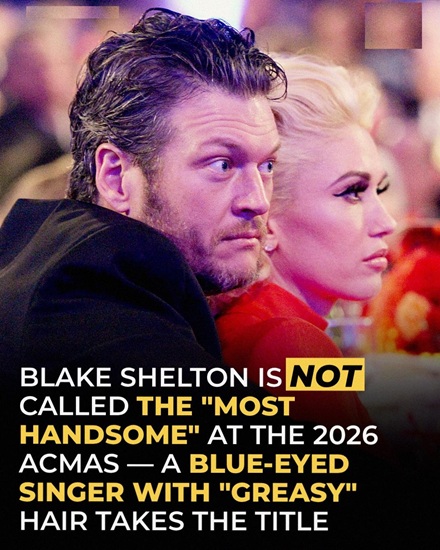
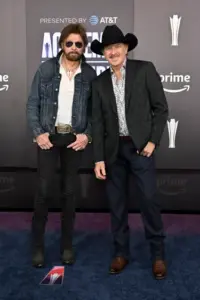
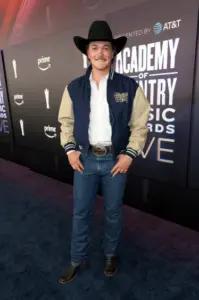
Meanwhile, artists like Blake Shelton and Cody Johnson anchored the evening in more recognizable country simplicity. Shelton’s dark vest, button-down shirt, and acoustic guitar projected familiarity over spectacle. Johnson’s blazer, jeans, cowboy hat, and oversized belt buckle reinforced long-standing Western iconography.
These artists function almost like emotional anchors for portions of the country audience uneasy about rapid cultural change within the genre.
Their styling says:
the roots still exist here.
And perhaps that is why the red carpet felt so fascinating overall.
It was not visually unified.
It was culturally fragmented.
Every artist represented a slightly different answer to what country music should become moving forward.
Traditional Western heritage.
Pop crossover polish.
Streetwear fusion.
Relaxed anti-fashion confidence.
Luxury tailoring.
Working-class symbolism.
All existing simultaneously under one industry banner.
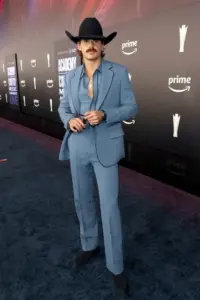
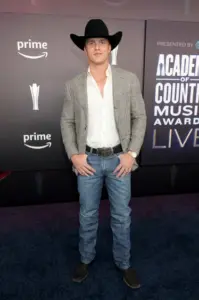
Even the younger artists reflected this split clearly. Tucker Wetmore’s powder-blue suit paired with cowboy boots and an open shirt blended youthful experimentation with classic Western markers. Tyler Hubbard’s jeans-and-blazer combination leaned toward accessible comfort rather than high-fashion ambition. Zach Top mixed varsity-jacket influences with cowboy aesthetics, creating a look that felt intentionally less formal and more generationally fluid.
The result was a red carpet that looked less coordinated than in previous decades — but perhaps more honest about the state of modern country music itself.
Because country culture is no longer singular.
It is urban and rural.
Traditional and experimental.
Conservative and evolving.
Heritage-driven and algorithm-aware.
The fashion reflected all of that tension visually.
And beneath the clothing itself sat another reality shaping celebrity appearances now:
the overwhelming influence of social media interpretation.
The red carpet no longer exists only for photographers or entertainment networks.
It exists for instant public dissection.
Every expression becomes analyzed.
Every wrinkle becomes commentary.
Every styling choice becomes a referendum on authenticity, aging, masculinity, femininity, relevance, or identity.
Celebrities are no longer simply attending events.
They are entering real-time global interpretation machines.
That dynamic explains why Keith Urban’s appearance became so heavily debated despite being relatively understated. The internet now treats celebrity imagery less like fashion photography and more like psychological evidence. Audiences project narratives onto still images instantly:
he looks tired,
he looks unhappy,
he looks confident,
he looks disconnected.
Public figures become mirrors for collective interpretation.
In the end, the 2026 ACM Awards red carpet succeeded not because everyone looked perfect, but because the event captured a genre actively negotiating its future in public view.
Some stars held tightly to country tradition.
Others stretched against it.
Some blended influences until the categories themselves blurred.
And maybe that is the clearest reflection of country music today:
a culture still rooted in boots, heartbreak, storytelling, and rural mythology —
yet increasingly shaped by modern celebrity, internet scrutiny, fashion experimentation, and audiences far more diverse than the genre once imagined.
The carpet became more than a showcase of clothing.
It became a snapshot of transformation itself.