The morning the alcohol finally loosened its grip on her skull, the first thing she noticed was the scent of expensive soap on hotel sheets that were far too white to belong to her life

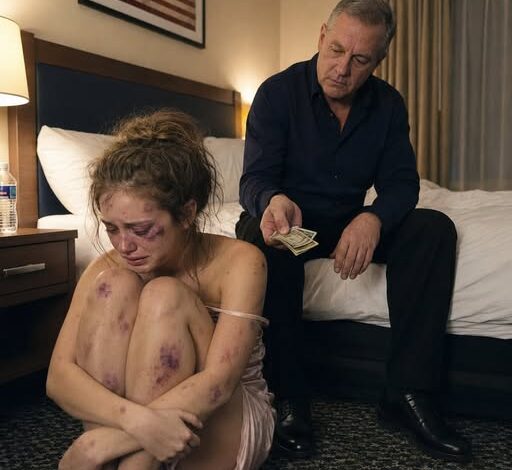
A gray-haired attorney stepped into the apartment first.
He moved carefully, like someone entering a church after a funeral — respectful, measured, painfully aware that whatever happened next would alter lives permanently. His expensive shoes made almost no sound against the hardwood floor.
Behind him came the man from the hotel.
For a second, Elena genuinely thought her mind was betraying her.
Because ghosts are supposed to stay buried in memory.
Not walk calmly into your apartment twenty years later wearing a charcoal coat and carrying sorrow like a second skin.
He was older now.
Not simply older in the ordinary sense, but weathered. Time had hollowed parts of him out. His dark hair had gone silver at the temples. Illness seemed to linger beneath the surface of his movements, slow and heavy, as though every step cost him something physical. Grief had settled into the lines around his mouth permanently.
But his eyes were unchanged.
Calm.
Controlled.
Unreadable in the same terrifying way she remembered.
Elena stood so abruptly her chair slammed backward into the wall behind her.
“You,” she whispered.
The attorney quietly closed the door.
The soft click echoed through the apartment like the locking of a vault.
For several seconds, nobody spoke.
Rain tapped softly against the windows. Somewhere outside, a siren wailed faintly through city traffic before fading into distance again.
The man looked at her not with the cold detachment of a stranger, but with the exhausted sadness of someone who had spent years walking toward a punishment he already believed he deserved.
Finally, his voice came low and rough.
“I didn’t pay for your time that night,” he said.
“I paid for your survival.”
Elena’s hands curled instantly into fists.
Her entire body felt electric with rage.
“You think that makes it better?”
His jaw tightened slightly.
Not from anger.
Pain.
“No,” he answered quietly.
“But I hoped one day you would be alive enough to hate me for it.”
The words hit her harder than shouting would have.
Because hatred requires survival.
Requires years.
Requires someone making it long enough to feel anger at all.
And suddenly the apartment felt too small to contain the past rushing back into it.
Twenty-one years earlier, Elena had been nineteen years old, starving, terrified, and standing outside a hotel bar in heels that blistered her feet so badly she could barely walk home afterward.
She had arrived in the city with impossible dreams and exactly eighty-seven dollars hidden inside her coat lining. Modeling agencies promised opportunities before quietly explaining what opportunities actually cost. Waitressing barely covered rent. Men looked at her constantly but never really saw her.
By winter, she was three months behind on bills.
The landlord stopped asking politely.
The grocery store owner stopped extending credit.
And the man she thought loved her disappeared the moment she told him she might be pregnant.
The city became colder after that.
Not physically.
Emotionally.
Hunger changes the way people see themselves. Fear rewrites dignity slowly. Every unpaid bill narrows the future until survival becomes the only thing visible anymore.
The woman outside the hotel approached Elena near midnight.
“You’re beautiful,” she said simply.
“There’s a gentleman upstairs willing to pay generously for company.”
Elena knew exactly what that meant.
And for nearly ten full seconds, she seriously considered saying yes.
That was the part she carried shame about all these years:
not what happened afterward,
but how close desperation came to breaking something permanent inside her.
The woman handed her a room number anyway.
“Think about it,” she said.
Elena rode the elevator upstairs shaking so badly she nearly dropped her purse.
She told herself she could leave anytime.
That maybe the man only wanted conversation.
That maybe this was survival.
When the hotel room door opened, she found him sitting beside the window reading documents beneath dim amber lighting.
He looked up once.
And immediately understood everything.
Not the details.
Not her history.
But the fear.
Real fear has a recognizable shape.
He stood slowly.
“You’re too young to be here,” he said quietly.
Elena almost turned and ran right then.
But humiliation rooted her in place.
“I need money,” she whispered.
He studied her silently for a long moment.
Then he asked the strangest question she had ever heard.
“When did you last eat?”
Her throat tightened instantly.
Because predators do not ask questions like that.
“Yesterday morning,” she admitted.
The man nodded once.
Then he picked up the hotel phone and ordered enough food for four people.
Elena remembered staring at him suspiciously while room service arrived twenty minutes later. Steak. Bread. Soup. Tea. Real food arranged beneath silver covers while her stomach cramped painfully from the smell alone.
“I don’t understand,” she whispered.
“You don’t have to.”
When she tried apologizing repeatedly, embarrassment pouring out of her faster than words could organize themselves, he stopped her gently.
“You are not the first frightened person this city has cornered,” he said.
She cried while eating.
Not delicate tears.
Humiliating ones.
The kind people cry when their body realizes survival might continue a little longer after all.
Later, after she calmed enough to speak normally, he asked questions carefully:
Where was her family?
Was anyone hurting her?
Did she owe dangerous people money?
And slowly, between exhaustion and shame, Elena told him the truth.
About the pregnancy scare.
About losing work.
About sleeping in train stations twice that week because the electricity in her apartment had been shut off.
He listened without interruption.
Then near dawn, he slid an envelope across the table.
“There’s enough in there for six months of rent,” he said.
“And information for someone who can help you find legitimate work.”
Elena stared at the envelope without touching it.
“What do you want from me?”
His expression shifted then.
Something dark flickering briefly beneath the calm.
“Nothing.”
“No one gives away money for nothing.”
A sad smile crossed his face.
“Not true.”
Then he said something she never forgot.
“Sometimes people spend money because they’re trying unsuccessfully to buy back parts of themselves.”
At nineteen, Elena did not understand what he meant.
She left the hotel at sunrise carrying enough money to survive and a business card for a woman who eventually helped her get office work instead of disappearing deeper into desperation.
She never saw him again.
Until now.
Standing inside her apartment decades later, Elena realized her heart was pounding exactly the same way it had that night.
Only now fear mixed with fury.
“You should’ve left me alone,” she snapped.
“You should’ve stayed a memory.”
The attorney glanced uneasily toward the older man.
But he never looked away from Elena.
“I tried.”
“Then why are you here?”
Silence stretched painfully.
Finally, he removed a folded medical document from his coat pocket and handed it toward her.
She didn’t take it.
“I’m dying,” he said simply.
The words landed strangely flat at first.
Not dramatic.
Not theatrical.
Just tired.
The attorney spoke carefully then.
“Mr. Laurent was diagnosed eighteen months ago with terminal pancreatic cancer.”
Elena felt anger rise defensively.
“And?”
The older man exhaled slowly.
“And before I die, there’s something you deserve to know.”
She laughed once bitterly.
“What possible explanation could matter now?”
His eyes lowered briefly toward the floor.
“That night wasn’t an accident.”
Something inside her went still.
“What?”
“I didn’t meet you randomly.”
The room suddenly felt colder.
Every instinct inside Elena screamed simultaneously.
The attorney stepped forward carefully.
“Please let him explain.”
But Elena was already backing away.
“No.”
Her voice cracked sharply.
“No, you don’t get to walk in here after twenty years and suddenly rewrite my life again.”
The older man looked devastated by the word rewrite.
Because that was exactly what he had done.
And they both knew it.
“You need to understand,” he whispered.
“The man who abandoned you after learning about the pregnancy…”
Elena stopped breathing.
“…was my son.”
Silence exploded through the apartment.
Not ordinary silence.
The kind that physically alters oxygen.
Elena stared at him blankly.
“No.”
“He was twenty-two,” the older man continued weakly. “Spoiled. Cowardly. He panicked after you told him.”
Elena’s knees nearly gave out beneath her.
The room blurred around the edges.
“You’re lying.”
“I hired someone to find you after he disappeared,” he said. “I wanted to know if you were safe.”
Every memory from that hotel room suddenly twisted violently into something unrecognizable.
The calm.
The questions.
The envelope.
None of it random.
None of it coincidence.
“You paid me off,” she whispered horrified.
“No.”
“Yes!” she shouted suddenly. “You decided what happened to my life without asking me!”
Pain crossed his face sharply.
“I know.”
“You should’ve told me who you were!”
“I was ashamed.”
That answer only made her angrier.
“Ashamed?” she repeated incredulously. “You thought feeding me and throwing money at me erased what your son did?”
“No,” he said again quietly. “I thought it might keep you alive long enough to build something beyond what he destroyed.”
Tears blurred Elena’s vision unexpectedly.
Because despite everything —
despite the rage,
despite the manipulation,
despite twenty years of violated truth —
part of her understood something unbearable.
Without that night, she probably would not have survived.
The realization felt monstrous.
She hated him for it.
Hated that gratitude and fury could coexist inside the same human heart.
The older man reached slowly into his coat pocket again.
This time he removed a photograph.
A little girl smiling beside a piano.
“Elena,” he whispered, voice breaking for the first time, “you have a daughter.”
The world stopped.
“She survived,” he continued through trembling breath. “My son never knew. But I did.”
Elena physically staggered backward.
“No…”
“She was adopted at birth after the complications.” His eyes filled suddenly. “I tracked her for years from a distance because I couldn’t bear abandoning another child connected to my family.”
The attorney quietly placed adoption records onto the table.
Elena stared at them unable to breathe.
Every hidden grief she buried twenty years earlier suddenly ripped itself back open.
Not just betrayal.
Not just survival.
A child.
Alive.
The older man looked at her with the exhausted devastation of someone carrying unbearable guilt too long.
“I came here because I don’t deserve forgiveness,” he said softly.
“But before I die, you deserved the truth.”
Elena sank slowly into the chair behind her.
The rain outside intensified softly against the windows.
And across from her sat the man she hated,
the man who saved her,
the man who ruined her life,
and perhaps the only reason she still had one at all.