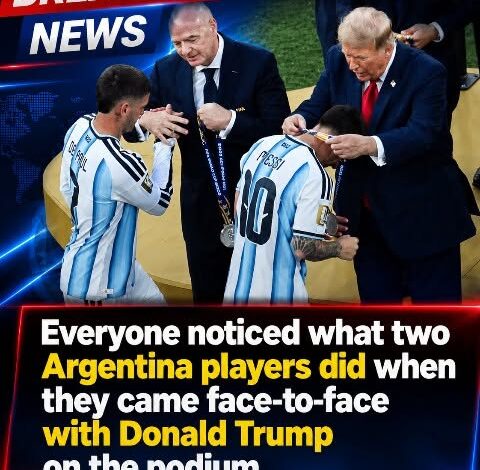
Everyone noticed what two Argentina players did when they came face-to-face with Donald Trump on the podium

What should have been a solemn farewell for one of football’s greatest generations instead became a night defined by heartbreak, frustration, and moments that will be debated long after the final whistle.
Argentina arrived hoping to defend its world title and give Lionel Messi one last unforgettable triumph on the sport’s biggest stage. Instead, a 1-0 extra-time defeat to Spain ended that dream, leaving players, coaches, and supporters struggling to process the collapse of a journey that had carried so much expectation.
The disappointment did not end with the match itself.
As the runners-up climbed the podium to receive their silver medals, a brief sequence during the presentation ceremony immediately captured worldwide attention. Television cameras appeared to show defenders Cristian Romero and Lisandro Martínez passing by U.S. President Donald Trump without shaking his hand, while both acknowledged other officials further down the line, including Mexican President Claudia Sheinbaum and Canadian Prime Minister Mark Carney. The clips spread rapidly online, prompting widespread speculation about whether the gestures were deliberate or simply the product of an emotional, fast-moving ceremony. Neither player publicly explained the moment.
Because no official statement has been made, the players’ intentions remain open to interpretation.
What is beyond dispute is that the images became one of the defining talking points of the medal ceremony, adding an unexpected political dimension to a night that was already emotionally charged. The World Cup had been accompanied throughout its run by debate surrounding FIFA, its leadership, and the increasingly visible role of political figures during tournament events, ensuring that even fleeting interactions on the podium drew intense scrutiny.
On the field, emotions had already boiled over before the medals were handed out.
Spain’s extra-time winner shattered Argentina’s hopes, and frustration spilled into several confrontations involving Argentine players during and after the closing stages of the match. Tempers flared as the realization set in that the title they had fought to defend was slipping away.
For Lionel Messi, the defeat carried particular emotional weight.
At 39 years old, the captain stood quietly absorbing the moment as Spain celebrated around him. Images of Messi in tears quickly circulated across the world, symbolizing the painful ending to what may prove to be his final World Cup appearance. Rather than lifting another trophy, he was left watching a new generation step into the spotlight while Argentina wrestled with the disappointment of coming so close.
The emotion extended beyond the players.
Head coach Lionel Scaloni, who had guided Argentina through one of the most successful eras in its football history, was visibly devastated after the defeat. In the immediate aftermath, he acknowledged uncertainty about what comes next, fueling questions about his future with the national team at a moment when the program faces an inevitable period of transition.
Taken together, the night’s events became about far more than a single result.
There was the anguish of losing a World Cup final after extra time.
There were the viral moments from the medal ceremony that sparked political debate far beyond football.
There was the sight of one of the game’s greatest players confronting what could be the final chapter of an extraordinary international career.
And there was a nation left wondering how to rebuild after watching a dream dissolve only one match short of history.
Sport has always been about more than trophies.
It carries emotion, identity, pride, disappointment, and, at times, symbolism that different people interpret in very different ways. On this night, Argentina’s story contained all of those elements at once. The result on the scoreboard will forever show Spain as world champions, but the images that followed—the tears, the tense exchanges, the quiet gestures on the podium, and the uncertainty surrounding the team’s future—ensured that the final would be remembered for far more than the winning goal alone.
Whether the ceremony’s most discussed moments ultimately prove to have been intentional statements or simply split-second reactions born from disappointment, they became part of the larger narrative surrounding an unforgettable World Cup finale—one in which football, emotion, and global attention intersected in ways few could have predicted.