An Incredible Body Transformation From An Ordinary Teen Into A Six-Figure Real-Life Dragon Cosplayer

Amber Luke’s transformation unsettles people not only because of how dramatically she looks today, but because her appearance forces a confrontation many viewers instinctively try to avoid: the uncomfortable truth that identity is often built from pain long before it becomes visible on the surface.
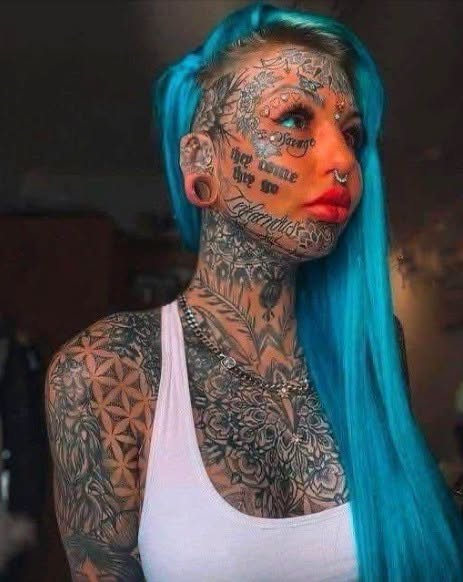
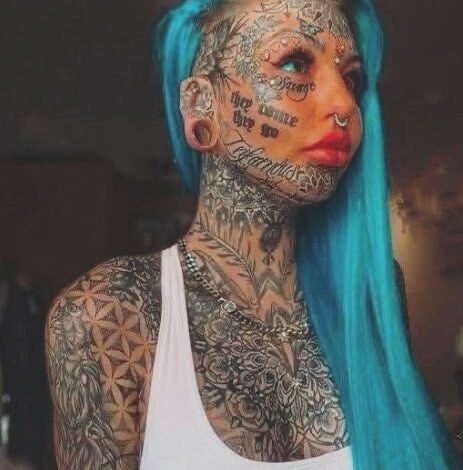
To strangers encountering her online for the first time, she can appear almost unreal — her body covered almost entirely in tattoos, her eyes altered through risky cosmetic procedures, her tongue split into a forked shape that reinforces the reptilian “Dragon Girl” persona she became famous for. Photos of her circulate constantly across social media, usually framed with dramatic before-and-after comparisons designed to provoke shock.
And shock comes easily.
The internet thrives on transformation stories that can be reduced into extremes:
before and after,
natural versus altered,
beautiful versus ruined,
normal versus unrecognizable.
But Amber’s story becomes much harder to simplify once she begins speaking for herself.
Because beneath the tattoos, piercings, surgeries, and headlines lies something far less sensational and far more human:
a woman trying to survive herself.
Born and raised in Brisbane, Australia, Amber has described her early life not as rebellious or attention-seeking, but emotionally disconnected. Long before her appearance became globally recognizable, she says she struggled intensely with depression, detachment, and a profound sense of not belonging inside her own identity.
That emotional context matters enormously.
Without it, people often interpret her transformation only aesthetically — as spectacle, performance, or deliberate provocation. But according to Amber herself, the modifications were never merely about appearance. They were about control.
Control over a body she once felt disconnected from.
Control over pain she struggled to explain.
Control over a life that internally felt fragmented long before her exterior changed.
And perhaps that is why her story resonates so powerfully even among people who do not personally understand or agree with her choices.
Because almost everyone understands the desire to escape versions of themselves associated with suffering.
Most people simply pursue that transformation in more socially accepted ways:
new careers,
new cities,
fitness,
religion,
relationships,
fashion,
therapy,
reinvention.
Amber pursued hers through body modification.
The scale is different.
The emotional impulse often is not.
By her teenage years, she had already begun experimenting with tattoos and alternative aesthetics, though the changes remained relatively modest compared to what would follow later. Over time, however, the process intensified into something deeply intentional. Tattoos expanded across nearly every visible part of her body. Piercings multiplied. Surgical modifications followed.
Eventually, she adopted the identity that would make her internationally recognizable:
the “Dragon Girl.”
To outsiders, the title sounds theatrical.
To Amber, it appears symbolic.
Dragons traditionally represent transformation, survival, danger, rebirth, and power across many mythologies. Her body art follows those themes consistently, functioning less like random decoration and more like a carefully constructed visual language expressing how she sees herself emotionally.
That distinction is important because body modification culture is often misunderstood by people who interpret all extreme appearance changes as impulsive or self-destructive automatically.
For many individuals inside those communities, modification becomes ritualistic and deeply psychological. The body stops feeling like a static object inherited passively and becomes instead something actively authored.
Amber repeatedly describes her body exactly that way:
not fixed,
but evolving.
And evolution, in her telling, became healing.
One of the most widely publicized chapters of her transformation involved scleral tattooing — the dangerous procedure in which pigment is injected into the whites of the eyes. The process remains controversial even within body modification communities because of the enormous medical risks involved, including infection, blindness, and permanent eye damage.
During one procedure, Amber temporarily lost vision after complications occurred.
The incident became international news almost immediately because it appeared to confirm public fears surrounding extreme body modification. Headlines framed the story dramatically:
woman goes blind after eye tattoos,
body modification gone wrong,
extreme beauty obsession nearly destroys vision.
But Amber’s own reflections afterward complicated the narrative significantly.
She openly acknowledged the seriousness and danger of what happened. She described the experience as terrifying and painful. Yet she also resisted framing it as proof that her entire transformation was a mistake.
That refusal frustrated many observers.
People often want suffering to produce moral reversal stories:
I realized I was wrong,
I regret everything,
I returned to normal.
Amber did not provide that ending.
Instead, she continued insisting her choices remained deeply personal and meaningful despite the risks involved.
That response reveals something psychologically fascinating about public reactions to her story:
many people are less disturbed by her appearance itself than by her refusal to apologize for it.
Because culturally, visible deviation from beauty norms is often tolerated only if accompanied by regret, shame, or cautionary framing.
Confidence unsettles people more.
Especially female confidence detached from conventional attractiveness standards.
Amber’s online presence intensified those reactions further. Through social media, she began documenting not only her appearance changes but also her emotional reasoning, mental health struggles, and philosophy surrounding self-expression. Followers connected deeply with her honesty about depression, identity confusion, and emotional survival. Critics, meanwhile, accused her of glamorizing dangerous procedures or encouraging unstable behavior.
Both responses followed her constantly.
That duality has become central to her public identity:
simultaneously inspirational and controversial,
empowering and alarming,
admired and condemned.
Yet perhaps the most revealing aspect of her story is how often people discuss her body while ignoring her language.
Because Amber herself repeatedly frames the transformation not as vanity, but as reclamation.
She speaks about previous versions of herself almost as though describing emotional imprisonment. Photos from her earlier life — often circulated online beside current images for dramatic contrast — show a conventionally attractive young woman with relatively minimal tattoos and a more socially recognizable appearance.
Many viewers look at those “before” photos and instinctively ask:
Why would someone change that?
Amber’s answer seems to be:
because outward normality did not equal inner peace.
That disconnect sits at the center of her entire story.
People often assume conventional beauty guarantees emotional well-being.
It does not.
Someone can look socially acceptable while feeling psychologically detached from themselves entirely.
And for Amber, body modification became a way of externalizing an identity she felt internally but could not previously see reflected physically.
Whether others understand that process is almost secondary to her.
What matters is that she does.
And perhaps that is why she continues provoking such intense reactions culturally.
Her existence challenges deeply rooted assumptions about what healing is supposed to look like.
Society generally approves of transformation only when it moves toward familiarity:
healthier,
cleaner,
more polished,
more conventionally beautiful.
Amber moved in the opposite direction visually while still insisting she became mentally healthier in the process.
That contradiction makes people uncomfortable.
Because if her transformation genuinely helped her survive emotionally, then appearance alone becomes a far less reliable indicator of wellness than many people want to believe.
At the same time, her story also raises difficult ethical questions that deserve honesty rather than romanticization.
Extreme body modification carries real risks.
Some procedures remain medically dangerous.
Mental health struggles can sometimes influence self-perception in ways that complicate consent and long-term decision-making.
These realities matter too.
The challenge lies in discussing them without reducing individuals like Amber to caricatures, warnings, or spectacles.
Human beings are rarely simple enough for those categories.
Amber Luke is not merely “the Dragon Girl.”
She is also a woman navigating trauma, identity, autonomy, internet scrutiny, and emotional recovery inside a culture obsessed simultaneously with self-expression and conformity.
And perhaps the deepest reason her story remains so widely discussed is because it exposes an uncomfortable tension modern society still cannot fully resolve:
How much ownership should a person truly have over their own body —
especially when their choices disturb everyone else?
For some people, Amber represents artistic freedom and radical authenticity.
For others, she symbolizes the dangers of unchecked body modification culture.
But underneath both interpretations exists the same undeniable reality:
every tattoo,
every procedure,
every alteration
was attached to a human being trying to feel more real inside her own skin.
Not everyone will understand that path.
Not everyone needs to.
But reducing her transformation to shock value alone misses the deeper truth entirely.
Because the most dramatic thing about Amber Luke’s story is not how different she looks now.
It is how desperately she once wanted to stop feeling invisible to herself —
and how far she was willing to go to finally recognize the person staring back in the mirror.