Spain had just conquered the world. The confetti was ready, the cameras were fixed on the champions, and billions of viewers expected the trophy ceremony to belong entirely to the players who had earned it. Instead, another moment quietly stole the spotlight—one that had nothing to do with football and everything to do with appearances.
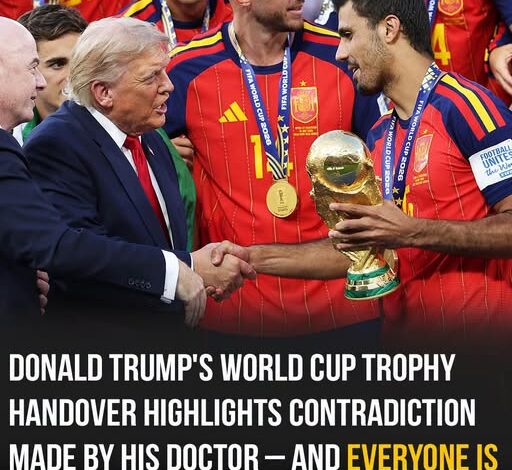
As Spain’s captain Rodri stepped onto the podium alongside U.S. President Donald Trump during the post-match celebrations, social media users noticed something they couldn’t ignore. Official White House medical records have long listed Trump at 6 feet 3 inches, exactly the same height commonly attributed to Rodri. Yet standing side by side beneath the stadium lights, the two men did not appear evenly matched. Within minutes, screenshots flooded the internet. Freeze-frames multiplied across X, Reddit, TikTok, and Instagram as viewers enlarged images, drew comparison lines, and debated whether the official numbers reflected reality.
What should have been a routine presentation ceremony suddenly evolved into one of the night’s most talked-about side stories.
The internet wasted no time.
Clips of the encounter circulated at remarkable speed, with users posting side-by-side comparisons from multiple camera angles. Some pointed to Rodri appearing visibly taller despite both men supposedly sharing the same listed height. Others cautioned that perspective, footwear, body posture, camera placement, and the height of the podium could all create misleading visual impressions.
Still, the debate gathered momentum.
For critics of the president, the footage fit neatly into a much larger narrative that has followed Trump for years. Throughout his public life, discussions about his height and weight have repeatedly surfaced whenever official medical reports have been released. Those reports have occasionally drawn skepticism from political opponents, who argue that the figures portray an unusually flattering image.
The ceremony reignited those conversations almost instantly.
Online commentators joked that Trump’s height seemed to change depending on the occasion, while memes compared the official measurements with what viewers believed they were seeing on screen. Others revived older controversies surrounding previous medical examinations, suggesting that the latest images raised familiar questions rather than introducing new ones.
The humor was relentless.
Posts describing his height as “flexible,” “adjustable,” or “campaign-sized” spread rapidly across social media platforms. Edited graphics, exaggerated illustrations, and sarcastic captions transformed a brief podium appearance into hours of online entertainment.
Supporters, however, were quick to push back.
Many argued that drawing conclusions from television footage is inherently unreliable. Camera lenses distort perspective. People rarely stand perfectly upright during ceremonial events. Athletic footwear, dress shoes, stage elevation, and subtle body positioning can all influence how tall someone appears in photographs. Without controlled conditions, they argued, comparing two individuals through isolated images proves very little.
Experts in photography often make similar observations. A wide-angle lens can exaggerate distances, while telephoto lenses compress them. Slight differences in footing or posture may appear dramatic once captured from a single angle. Even where photographers choose to stand can create optical illusions that disappear when viewed from another perspective.
Despite those explanations, public fascination continued because the discussion extended beyond physical measurements.
For many observers, the controversy reflected broader questions about image management.
Donald Trump has spent decades cultivating a carefully constructed public persona built around strength, confidence, and dominance. Every aspect of that image—from clothing choices to body language—has received extraordinary public scrutiny throughout his business and political careers. Because of that history, even seemingly trivial details can become symbols in much larger debates over authenticity, perception, and self-presentation.
The ceremony offered another moment for those interpretations to flourish.
Yet the evening’s conversation did not end with height comparisons.
Another sequence from the celebration generated almost as much discussion.
As Spain prepared for the defining image of its victory—the captain raising the World Cup trophy before teammates, coaches, and supporters—attention briefly shifted toward Trump’s position on the stage. Cameras showed FIFA President Gianni Infantino appearing to gesture toward him as the players assembled around the trophy.
Viewers interpreted the interaction in different ways.
Some believed Infantino was politely encouraging Trump to step aside so the champions could enjoy their historic moment without distraction. Others saw nothing unusual, suggesting the FIFA president was simply coordinating where dignitaries and officials should stand during an event involving dozens of participants moving simultaneously.
Regardless of the intent, the clip spread rapidly online.
Critics portrayed the moment as symbolic, arguing that Trump appeared reluctant to surrender the spotlight during a celebration that belonged entirely to Spain. Supporters dismissed those claims as exaggerated, noting that ceremonial stages are often crowded and chaotic, with organizers constantly directing participants into position.
As often happens with viral moments, the footage became less about establishing objective facts than reinforcing existing opinions.
People who already viewed Trump as deeply invested in public image saw confirmation of that belief.
Those inclined to defend him saw another example of critics overanalyzing ordinary interactions.
The result was two entirely different interpretations emerging from the same few seconds of video.
Meanwhile, Spain’s remarkable achievement risked becoming secondary to debates that had little to do with football itself. Players who had spent years preparing for the sport’s biggest stage suddenly found portions of the post-match conversation focused on podium etiquette, camera angles, and presidential height rather than their extraordinary performance.
It served as another reminder of how quickly modern media ecosystems can redirect public attention. In the age of social media, every glance, gesture, and photograph can become a standalone story, sometimes overshadowing the event that created it in the first place.
Whether the apparent height difference reflected perspective, posture, footwear, or inaccurate official measurements remains impossible to determine from televised images alone. Visual comparisons, while compelling, cannot definitively establish a person’s height without controlled conditions and reliable measurements.
What is beyond dispute, however, is the speed with which a fleeting moment transformed into an international talking point.
Within hours, millions had watched the clips.
Thousands had dissected every frame.
Countless debates unfolded across the internet, fueled by politics, personality, and perception as much as by the images themselves.
In the end, a ceremony designed to celebrate Spain’s greatest footballing achievement unexpectedly produced another lesson about the modern media landscape. On today’s global stage, even the smallest visual detail—a few seemingly missing inches, a brief hesitation, or a subtle gesture—can eclipse the event itself, inviting endless speculation and reminding us that in the digital age, perception often travels faster than certainty.