Lip reader reveals what FIFA president whispered to Trump as he refused to leave Spain’s World Cup photo

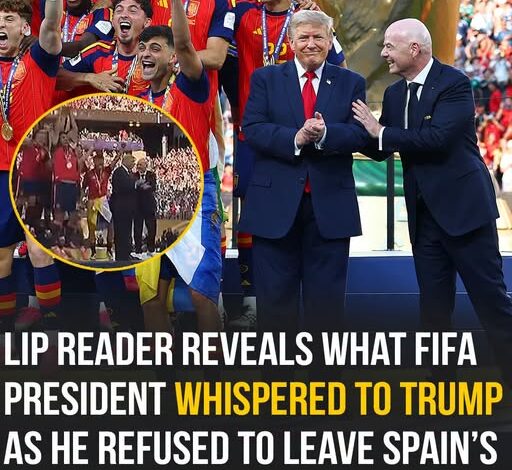
Spain had just reached football’s summit. Confetti burst into the night sky, teammates embraced with tears in their eyes, and a generation of players prepared for the photograph that would forever symbolize their place in sporting history. It was supposed to be a moment untouched by distraction—a celebration belonging solely to the newly crowned world champions.
Instead, another scene unfolded alongside the triumph, drawing unexpected attention away from the players and onto the crowded podium itself.
As Spain gathered to lift the World Cup trophy, cameras captured U.S. President Donald Trump remaining near the center of the celebration while officials attempted to organize the traditional championship photograph. The players, still overwhelmed by the magnitude of their achievement, waited to assemble around the trophy as FIFA President Gianni Infantino appeared to gesture toward Trump during the brief but highly visible exchange.
Within minutes, clips of the interaction began circulating across social media.
Millions of viewers replayed the footage frame by frame, trying to interpret what had happened during those few seconds. Some believed Infantino was politely encouraging Trump to step aside so Spain could enjoy an uninterrupted team photograph. Others argued the exchange was simply part of the normal coordination that accompanies large trophy presentations, where officials, photographers, security personnel, and dignitaries all move simultaneously in a carefully choreographed space.
The discussion intensified after a professional lip reader reportedly suggested that Infantino’s message was straightforward: “This is for them. We’ve given them the trophy, let’s go.” While lip-reading interpretations can never be verified with complete certainty and should be treated cautiously, the reported dialogue spread rapidly online, adding another layer to an already viral moment.
Whether those were the exact words or not, the images themselves fueled an enormous public conversation.
Many viewers felt the ceremony had briefly shifted away from the players who had earned football’s highest honor. Critics argued that the focus should have remained entirely on Spain’s historic victory rather than any political figure present at the event. Supporters countered that dignitaries frequently participate in major sporting ceremonies and that the interaction was being exaggerated far beyond its actual significance.
As the debate unfolded, another development attracted widespread attention.
Photographs distributed through FIFA’s official channels appeared to differ from some of the images circulating online. In several of the organization’s published celebration photos, Trump did not appear in the final composition, prompting observers to speculate that official imagery had been selected—or edited—to emphasize Spain’s players and coaching staff rather than the visiting dignitaries who had participated in the trophy presentation.
For many fans, that decision felt entirely appropriate.
The defining image of any World Cup victory, they argued, should belong to the athletes whose years of sacrifice culminated in lifting the trophy. The spotlight, in their view, naturally belonged to the champions rather than the officials invited to present the medals.
Online reaction was immediate and characteristically divided.
Memes spread across social media within hours. Users joked about the crowded podium, edited together humorous comparison videos, and debated every gesture captured by television cameras. Some mocked what they viewed as an unnecessary interruption during Spain’s celebration, while others dismissed the controversy as another example of social media transforming an ordinary ceremonial moment into an international spectacle.
The discussion reflected something larger than a single photograph.
Modern sporting events no longer end with the final whistle. Every interaction, expression, and movement can become its own viral story, dissected by millions of viewers long after the medals have been awarded. A few seconds of video can generate days of headlines, competing interpretations, and endless online analysis.
Yet amid the arguments, Spain’s players appeared determined not to let anything overshadow their achievement.
Once the formalities concluded, the celebration returned to its rightful owners.
Players embraced family members, waved flags draped over their shoulders, danced across the stage, and lifted the World Cup high above their heads as confetti continued to fall. Laughter echoed across the stadium, teammates posed for countless photographs, and supporters celebrated a victory that had been earned through talent, resilience, and months of extraordinary performances.
Those scenes ultimately reminded everyone why the night mattered in the first place.
The debates surrounding the podium may dominate social media for a time, but history is unlikely to remember the celebration for a brief exchange between officials. Instead, it will remember the team that conquered the world’s biggest tournament, the captain raising the trophy into the night sky, and the joy shared by players who had fulfilled the dream of an entire nation.
Moments of distraction often accompany events watched by billions. Cameras capture everything, and the internet ensures that even the smallest interactions can become global talking points. But those distractions rarely define history.
Championships do.
In the years to come, fans will remember Spain’s brilliant football, the resilience that carried them through the tournament, and the unforgettable image of a team standing together at the pinnacle of the sport. The online arguments, the freeze-frame analyses, and the debates over podium etiquette will gradually fade into the background.
The victory itself will not.
Because despite the unexpected controversy and the brief shift in attention, nothing could erase the accomplishment unfolding before the world. Spain remained exactly what they had fought to become—world champions. Their smiles never disappeared, their celebrations never slowed, and their joy proved stronger than any fleeting distraction.
When the confetti settled and the lights finally dimmed, the lasting story was the simplest one of all: a remarkable team had written another glorious chapter in football history, and no awkward interruption could take that away.