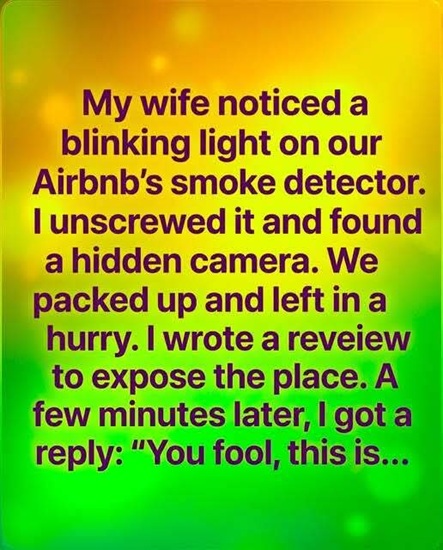
Vacationers were shocked after discovering disturbing secrets hidden inside a highly rated Airbnb smoke detector

Travel has always carried a quiet promise with it — the promise that somewhere beyond our routines, beyond work schedules, unpaid bills, crowded commutes, and endlessly repeated obligations, there exists a temporary version of life that feels lighter.
People travel not only to see new places, but to feel different inside them.
That is part of why short-term rentals became so popular so quickly around the world. Hotels, for all their convenience, often feel emotionally interchangeable. But private homes, apartments, beach villas, mountain cabins, and city lofts offer something travelers crave deeply:
the illusion of belonging somewhere new.
With a few photographs and a glowing list of reviews, strangers now willingly sleep inside spaces owned by people they have never met. Entire vacations are built on trust formed through screens. A listing appears polished and inviting, ratings seem reassuring, and within minutes someone books a place they assume will become a safe temporary refuge.
Most of the time, that trust works.
But the disturbing reality is that modern technology has quietly changed the meaning of privacy itself inside those spaces.
And for one couple, that realization arrived through something as ordinary as a blinking light on a ceiling.
The vacation had started exactly the way they hoped it would.
After months of work stress and postponed plans, the trip was meant to feel restorative — a chance to disconnect from constant notifications, deadlines, and the exhausting pace of daily life. The rental property they booked looked almost perfect online:
modern interior,
warm lighting,
minimalist décor,
large windows,
high ratings,
professional photographs.
Everything about the listing projected safety and comfort.
When they finally arrived, the property initially matched those expectations completely. Sunlight spilled through the windows in soft afternoon streaks, illuminating carefully arranged furniture and clean open spaces that looked almost identical to the online photos.
That visual consistency reassured them immediately.
Travelers subconsciously rely on confirmation moments like that. When a property matches its listing, people relax psychologically. Suspicion fades. The mind stops scanning for problems and begins settling into temporary trust.
The couple unpacked slowly.
Opened windows.
Placed toiletries in the bathroom.
Charged phones beside the bed.
Ordinary actions.
The kind people perform automatically once a space begins feeling temporarily like home.
And perhaps that is what made the later discovery feel so violating:
the sense that trust itself had been quietly weaponized against them.
For the first several hours, nothing seemed remotely unusual. The apartment felt calm and private. Like most modern rentals, it contained small smart devices integrated throughout the space:
thermostats,
wireless speakers,
smoke detectors,
motion sensors.
None of it initially attracted attention because technology has become nearly invisible in modern living environments. People stop noticing devices once they become normalized.
That normalization creates vulnerability.
Most travelers no longer question what hangs from ceilings or sits mounted on walls because smart-home systems are now marketed as convenience features:
security,
automation,
energy efficiency,
remote access.
The assumption is simple:
if a device looks ordinary, it probably is.
Late that evening, however, the wife noticed something subtle.
A blinking light.
At first, it barely registered consciously — a faint rhythmic flicker coming from the smoke detector mounted above the bedroom. In another context, she might have ignored it entirely. Smoke detectors often contain indicator lights. Routers blink. Sensors pulse quietly in the background.
But instinct is strange.
Sometimes the body notices discomfort before logic fully explains it.
The blinking felt wrong somehow.
Too rhythmic.
Too deliberate.
She tried ignoring it initially, telling herself it was probably normal. Yet the awareness lingered in the back of her mind the way unresolved sounds sometimes do at night. Eventually curiosity overcame hesitation.
Standing carefully on a chair beneath the detector, she leaned closer expecting reassurance.
Instead, she felt her stomach drop.
Inside the casing, partially obscured within what should have been a standard smoke detector interior, sat something unmistakably out of place:
a tiny reflective lens.
At first her brain resisted the conclusion instinctively.
People often hesitate before accepting something disturbing because the mind searches desperately for innocent explanations:
maybe it’s part of the sensor,
maybe it’s damaged,
maybe I’m misunderstanding what I’m seeing.
But the longer she stared, the clearer the reality became.
The device appeared to contain recording hardware positioned directly toward the bed.
In that instant, the emotional atmosphere of the room transformed completely.
Psychologically, few experiences feel more violating than realizing privacy may have been an illusion all along. Spaces that moments earlier felt comforting suddenly become threatening. Every object acquires new meaning. Walls no longer feel protective.
They feel observant.
The couple reacted immediately. There was no dramatic argument or prolonged debate because fear often sharpens decision-making. Within minutes, they began gathering belongings rapidly, adrenaline replacing exhaustion.
Shoes thrown into bags.
Chargers unplugged.
Toiletries swept hurriedly from bathroom counters.
The husband reportedly checked additional devices quickly while the wife photographed the smoke detector repeatedly, documenting every visible detail before leaving. Neither wanted to remain inside the apartment any longer than necessary.
Because once surveillance becomes a possibility, the nervous system stops distinguishing between confirmed danger and potential danger.
Everything begins feeling contaminated by uncertainty.
Outside the property, the emotional impact intensified rather than fading. They sat inside their car trying to process what had happened while replaying the previous hours mentally:
changing clothes,
private conversations,
sleeping arrangements,
moments they believed were unwitnessed.
That retrospective realization often becomes the most psychologically disturbing part of privacy violations.
The mind starts reconstructing ordinary moments through a new lens:
Were we watched then?
How long had it been recording?
Were there more devices?
And because uncertainty leaves gaps, imagination fills them aggressively.
Once they reached a safer public location, they began reviewing the photographs carefully. The more they examined the images, the more unsettled they became. In one reflection captured unintentionally near the edge of a mirror, they believed they noticed evidence suggesting another hidden device elsewhere in the room.
That possibility changed the emotional scale of the situation entirely.
This no longer felt potentially accidental.
It felt systematic.
They contacted the rental platform immediately and attempted to reach the host directly, hoping desperately for some innocent explanation that could undo the growing panic settling into their thoughts.
Instead, the response deepened their alarm.
According to the account, the host reacted defensively and aggressively rather than expressing concern or confusion. The tone reportedly felt confrontational rather than cooperative, intensifying the couple’s suspicion that the surveillance may have been deliberate.
That interaction mattered psychologically because human beings rely heavily on emotional cues when evaluating uncertainty. An innocent misunderstanding typically invites clarification.
Aggression often signals fear of exposure.
Whether intentional or not, the host’s response destroyed whatever remaining sense of reassurance existed.
The couple eventually left the area entirely and continued their trip elsewhere. But emotionally, the experience did not end when they checked into a new accommodation.
That is another truth about violations involving privacy:
the damage extends beyond the immediate event itself.
Afterward, unfamiliar rooms begin feeling different.
People scan ceilings automatically.
Smoke detectors become suspicious instead of invisible.
Trust stops functioning effortlessly.
The experience fundamentally altered how they approached travel moving forward. Future accommodations were inspected carefully before unpacking. Small devices drew attention immediately. Listings emphasizing transparent safety policies became priorities.
In psychological terms, this is hypervigilance —
the nervous system adapting after perceived threat by remaining alert to future risk.
And while that heightened awareness can feel exhausting, it also reflects an important modern reality:
technology has changed the meaning of personal space.
Smart devices now exist everywhere:
doorbells,
voice assistants,
wireless cameras,
automated sensors,
hidden connectivity embedded inside ordinary objects.
Most serve legitimate purposes.
But the possibility of misuse has quietly expanded alongside convenience.
This tension sits at the center of modern digital life generally.
The same technology that increases comfort can also increase vulnerability.
The same connectivity that creates convenience can erase boundaries.
And often, people accept these trade-offs gradually without fully recognizing how much privacy they have surrendered until something unsettling forces awareness suddenly.
The story resonates so strongly because it touches a fear many modern travelers already carry subconsciously:
the fear of being observed without consent in spaces meant to feel intimate and safe.
Bedrooms especially hold psychological importance because they represent one of the few environments where human beings expect complete vulnerability without surveillance. Sleep itself requires trust. People can only truly rest when they believe they are unobserved and protected.
A hidden camera inside such a space therefore feels like more than a technical violation.
It feels deeply personal.
Yet despite the disturbing nature of the incident, the larger lesson is not necessarily paranoia.
Most rental properties are operated ethically.
Most hosts respect privacy completely.
Most smart devices genuinely serve practical functions.
But the story does reinforce the importance of awareness in a world increasingly saturated with hidden technology.
Sometimes protection begins simply with noticing small details:
a blinking light,
an unusual angle,
a device positioned strangely,
an instinct that something feels wrong.
Modern travelers often spend enormous energy planning destinations, budgeting expenses, and organizing itineraries while giving comparatively little thought to digital privacy inside temporary spaces.
That imbalance is beginning to change.
Because as travel becomes more connected, privacy awareness becomes inseparable from personal safety itself.
And perhaps that is the most unsettling truth hidden beneath stories like this:
the greatest vulnerabilities in modern life often do not look dangerous at all.
They look ordinary.
Mounted quietly on ceilings.
Blinking softly in the dark while trust sleeps beneath them.