Every routine oil change depends on a tool that most drivers never think about.
Hidden beneath the hood, an oil filter quietly protects the engine by trapping dirt, metal particles, and other contaminants that accumulate as oil circulates through the system. But when it comes time to replace that filter, removing it isn’t always easy. Covered in oil, tightened by heat, and wedged into increasingly cramped engine compartments, a stubborn filter can defeat even the strongest grip.
That’s why the oil filter wrench became such an essential part of automotive repair.
Its story began during the rapid growth of the automobile industry in the early 20th century. As engines became more reliable and maintenance routines evolved, mechanics faced a recurring problem: smooth, cylindrical oil filters often refused to loosen by hand after months of exposure to heat, pressure, and vibration.
The harder they tried to twist them loose, the more their hands slipped.
A better solution was needed.
Early mechanics improvised with whatever they had available, wrapping chains, leather straps, or pieces of heavy material around the filter to gain additional leverage. These simple methods transformed gripping power into turning force, allowing even tightly stuck filters to break free without requiring excessive strength.
What started as a practical workaround quickly inspired purpose-built tools.
Manufacturers recognized that mechanics needed equipment specifically designed for the task, and the first dedicated oil filter wrenches soon appeared. Though simple by today’s standards, they solved a problem that had frustrated repair shops for years and made routine maintenance far more efficient.
As automobile technology advanced, so did the tools designed to service it.
No single wrench could fit every engine.
Oil filters varied in diameter, shape, and location, forcing tool designers to develop specialized solutions for an expanding range of vehicles.
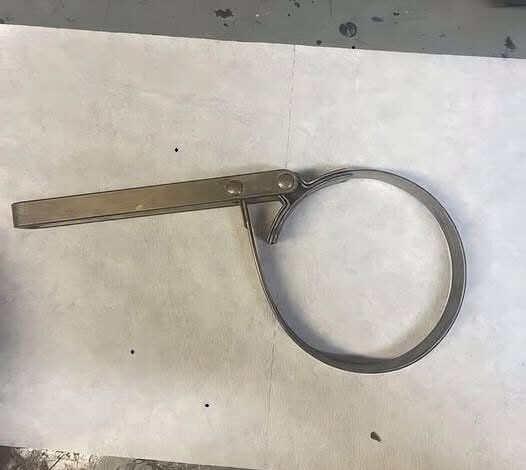
One popular innovation was the strap wrench.
Using a flexible metal, rubber, or fabric strap that tightened around the filter as force was applied, it provided a secure grip without relying on perfectly sized jaws. Its versatility made it useful for filters of many different sizes.
Chain-style wrenches continued to evolve as well.
Their rugged construction delivered tremendous gripping power, making them especially effective for filters that had become seized after years of service or improper installation. Although they could leave marks on the old filter’s exterior, that was rarely a concern since the filter was being replaced anyway.
Later came cup-style filter wrenches.
Designed to fit over the end of a specific filter like a socket, these tools offered exceptional precision. Connected to a ratchet or extension, they allowed mechanics to remove filters even when there was very little room to work.
Claw-style designs expanded those capabilities even further.
Their spring-loaded jaws automatically adjusted to different filter sizes, tightening securely as torque increased. This adaptability proved especially valuable as modern engine compartments became more compact and increasingly difficult to access.
Manufacturers also focused on improving comfort and efficiency.
Ergonomic handles reduced strain during repetitive work.
Ratcheting mechanisms minimized the need to reposition tools repeatedly.
Longer handles and extension bars helped mechanics reach filters hidden deep within crowded engine bays, where traditional hand tools often struggled.
These refinements may seem modest, but together they transformed a once-frustrating maintenance task into a quicker, safer, and more reliable process.
The oil filter wrench also became a symbol of professional craftsmanship.
Experienced mechanics know that using the correct tool not only saves time but also reduces the risk of damaging surrounding components or crushing the filter unnecessarily. Proper leverage allows filters to be removed with greater control, protecting both the engine and the technician performing the work.
Beyond repair shops, the tool found a loyal following among home mechanics.
For generations of car enthusiasts, changing engine oil has been more than routine maintenance. It’s an opportunity to understand how a vehicle works, develop practical skills, and care for an investment with their own hands. In countless garages, an oil filter wrench has become as familiar as a socket set or screwdriver.
Older versions of these tools have even earned a place in collections.
Collectors of vintage automotive equipment value early oil filter wrenches as reminders of an era when mechanics relied heavily on ingenuity, durable steel tools, and hands-on experience. For restorers of classic automobiles, period-correct tools add authenticity to the work, preserving not only the vehicles themselves but also the traditions of the people who maintained them.
Despite dramatic advances in automotive engineering, the basic purpose of the oil filter wrench has remained unchanged.
It exists to make preventive maintenance possible.
A clean oil filter helps ensure that engine oil continues circulating efficiently, reducing wear and extending the life of vital engine components. By making filter replacement easier, this simple tool plays a quiet but important role in protecting one of a vehicle’s most expensive systems.
Its contribution is easy to overlook because it happens during ordinary maintenance rather than dramatic repairs.
Yet every successful oil change reflects the same principle that inspired its invention more than a century ago: the right tool can turn a difficult job into a manageable one.
In the end, the oil filter wrench represents more than a clever piece of equipment.
It tells the story of practical problem-solving, steady innovation, and the enduring value of skilled workmanship. From the earliest repair shops to today’s professional service bays and home garages, it has helped countless mechanics keep engines running smoothly.
Sometimes the most important innovations aren’t the ones that transform an entire industry overnight.
They’re the simple, dependable tools that quietly perform their job, year after year, connecting generations through the shared craft of keeping machines—and the people who rely on them—moving forward.