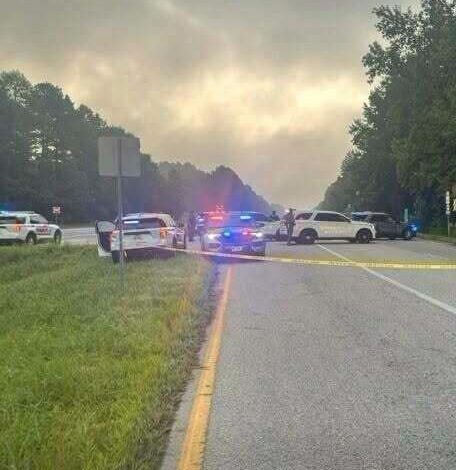
As the last flashes of red and blue disappeared into the distance, the neighborhood slowly settled back into silence.
The emergency vehicles were gone.
The streets reopened.
The immediate danger had passed.
But the uncertainty lingered.
Front doors cracked open one by one as cautious residents stepped onto porches and sidewalks, scanning the darkness as though it might still hold answers that had escaped them. Small groups gathered beneath porch lights, speaking in hushed voices, each person trying to piece together what had happened from scattered observations and incomplete information.
Someone mentioned hearing shouting.
Another recalled seeing several police cars arrive within minutes.
Others repeated snippets they had heard over police scanners or through neighborhood text messages, though no one could say with confidence how much of it was accurate.
The only official reassurance anyone had received was that the situation was under control.
Yet that phrase, comforting as it was intended to be, left room for countless unanswered questions.
What exactly had happened?
How close had the danger come?
Was everyone safe?
Without clear answers, imagination often fills the empty spaces where facts have yet to arrive.
As the night wore on, conversations gradually came to an end.
Lights switched off.
Curtains closed.
Families returned indoors, hoping sleep would quiet the unease that had settled over the neighborhood.
For many, however, rest came slowly.
Every unfamiliar sound seemed louder than usual.
A passing car drew curious glances through bedroom windows.
Even the ordinary creak of a house settling in the cool night carried a weight it hadn’t held before.
By morning, the streets looked remarkably ordinary.
Garbage bins appeared along the curb, waiting for collection.
Parents walked their children to school.
Commuters backed out of driveways on familiar schedules.
Dogs eagerly tugged their owners along sidewalks they had traveled hundreds of times before.
From a distance, it seemed as though nothing had happened at all.
Yet the people who lived there knew otherwise.
Something intangible had changed.
Not the buildings.
Not the roads.
But the way neighbors looked at one another.
People who had once exchanged little more than polite smiles now paused to ask if everyone was doing all right. Conversations that might previously have lasted only a few seconds stretched into several minutes as residents shared concerns, compared experiences, and reflected on the previous night’s events.
There was comfort in knowing that others had felt the same uncertainty.
Shared experiences, even unsettling ones, have a way of drawing communities closer together.
Neighbors who had spent years living side by side without truly knowing one another suddenly found common ground in a night they would all remember.
They had witnessed the same flashing lights.
Heard the same sirens.
Felt the same uneasy silence once everything was over.
Although each person had experienced those moments differently, the memory became something quietly shared.
In the days that followed, official information gradually replaced speculation, allowing rumors to fade as verified facts emerged. Even so, many residents reflected on how quickly uncertainty can spread when reliable information is limited.
The experience also reminded many people of the importance of patience during unfolding emergencies.
In situations where authorities are still responding, complete details are often unavailable at first. Initial reports may change as investigations continue, making it important to avoid drawing conclusions before verified information is released.
For those who lived through that evening, however, the greatest impact wasn’t found in any headline or official statement.
It was found in the realization that ordinary life can change in an instant.
A familiar street can become the center of an emergency.
An ordinary evening can become one neighbors remember for years.
The routines that often feel automatic suddenly reveal how precious they truly are.
Perhaps that is why the neighborhood felt just a little different afterward.
People waved more often.
They lingered a little longer outside.
They checked on elderly neighbors.
They paid closer attention when something seemed out of place.
Not because they expected another emergency, but because they had been reminded how interconnected their lives really were.
The sirens eventually faded into memory.
The flashing lights disappeared.
The investigation moved forward.
Life continued.
Yet what remained was something quieter and more enduring: a renewed appreciation for community, a greater awareness of how quickly certainty can give way to uncertainty, and the understanding that even in moments when answers are scarce, compassion, patience, and looking out for one another remain among the strongest foundations any neighborhood can have.