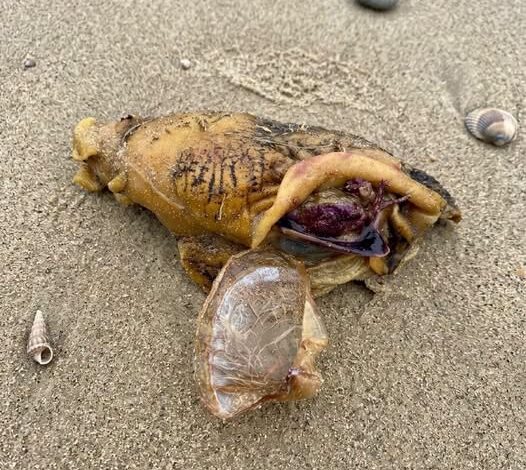
At first glance, I couldn’t even tell what I was looking at.
It was one of those moments when your instincts react before your mind has time to make sense of what your eyes are seeing. Half-buried in damp sand and tangled grass, the strange mass looked like something pulled straight from a nightmare. It was swollen far beyond recognition, its skin stretched tight in some places and torn away in others, exposing pale, rubbery tissue that seemed almost unreal.
A jagged, shell-like fragment rested a short distance away, making the scene even more unsettling.
For several long seconds, I simply stood there.
The beach around me was peaceful.
Waves rolled gently onto the shore.
Seabirds drifted overhead.
Families walked in the distance, laughing as though nothing unusual had happened.
Yet at my feet lay something so strange that my imagination immediately filled in the blanks.
Was it some unknown sea creature?
A diseased animal?
Something dragged in from the depths by a storm?
The more I looked, the less recognizable it became.
Its body no longer resembled any marine animal I could identify. The proportions seemed distorted, parts appeared to be missing, and the remaining features had been altered so dramatically that nothing looked familiar anymore.
Curiosity eventually overcame my discomfort.
I wanted to know what had happened.
The answer, it turned out, was both ordinary and surprisingly sobering.
It wasn’t a mysterious sea monster.
It was a dead sea turtle in an advanced stage of decomposition.
Once I knew what I was looking at, many of the confusing details suddenly made sense.
Marine animals undergo dramatic physical changes after death, particularly when their bodies remain in the water before washing ashore. As bacteria naturally break down tissues, gases accumulate inside the body, causing it to swell dramatically. This bloating can distort the animal’s original shape until it becomes almost impossible to recognize.
The skin also changes.
As decomposition progresses, the outer layers loosen and begin separating from the underlying tissue. Areas that once appeared smooth may tear open, exposing muscles, connective tissue, or fat beneath. These natural changes often create appearances that seem shocking to anyone unfamiliar with the process.
Even the shell can become misleading.
Although a sea turtle’s shell is firmly attached during life, decomposition, wave action, scavenging animals, and the constant movement of sand can cause portions of the shell or surrounding tissues to separate over time. Pieces may end up scattered nearby, making the remains appear even more fragmented and unfamiliar.
Scavengers also play an important role.
Crabs, seabirds, fish, and other animals naturally feed on carcasses, accelerating the breakdown process. By the time a turtle reaches the shoreline, nature may already have transformed it so extensively that identifying the species becomes difficult without closer examination.
Marine biologists and wildlife experts encounter scenes like this more often than most beachgoers realize.
Although disturbing, decomposition is a normal part of every ecosystem. Dead animals provide nutrients that support countless other forms of life, helping recycle energy back into the environment. While the process can appear harsh, it plays an essential role in maintaining healthy coastal ecosystems.
That doesn’t make the sight any less emotional.
Standing only a few feet away, I found myself looking beyond the shock.
Sea turtles are among the ocean’s most remarkable creatures. Many species travel thousands of miles during their lifetimes, navigating vast oceans with astonishing precision before returning to the beaches where they were born to lay their own eggs.
Yet they also face countless dangers.
Pollution.
Plastic waste.
Boat strikes.
Fishing gear.
Habitat loss.
Disease.
Natural predators.
Climate change.
Every year, many turtles never complete the journeys they began decades earlier.
Of course, not every turtle found on a beach died because of human activity. Some succumb to old age, illness, predation, or natural environmental conditions. Determining the exact cause of death often requires examination by trained wildlife professionals.
For that reason, experts generally advise people not to handle stranded marine animals or remains themselves. Instead, unusual sightings—particularly of protected species like sea turtles—can often be reported to local wildlife authorities or marine conservation organizations, which may investigate the animal’s condition and, when appropriate, collect valuable scientific information.
As I stood quietly watching the tide move around the shoreline, the scene began to feel very different.
What had first appeared terrifying gradually became something else.
A reminder.
The ocean we admire for its beauty is also a place where life and death unfold every day, usually far beyond human sight. Its tides carry extraordinary stories beneath the surface—stories of migration, survival, struggle, and the natural cycles that sustain marine life.
Most days, the sea gives us sunsets, seashells, and gentle waves.
Occasionally, it returns something far more difficult to witness.
Not to frighten us.
But to remind us that nature is neither sanitized nor predictable.
It is beautiful because it is real.
Walking away, I looked back one last time.
The waves continued their steady rhythm, indifferent to the discovery on the shore.
What had first seemed like something mysterious or even monstrous was, in truth, simply another chapter in the quiet, unending cycle of the natural world—a powerful reminder that every coastline holds stories we rarely see, and that even in death, the ocean continues to reveal the hidden realities of the life it sustains.