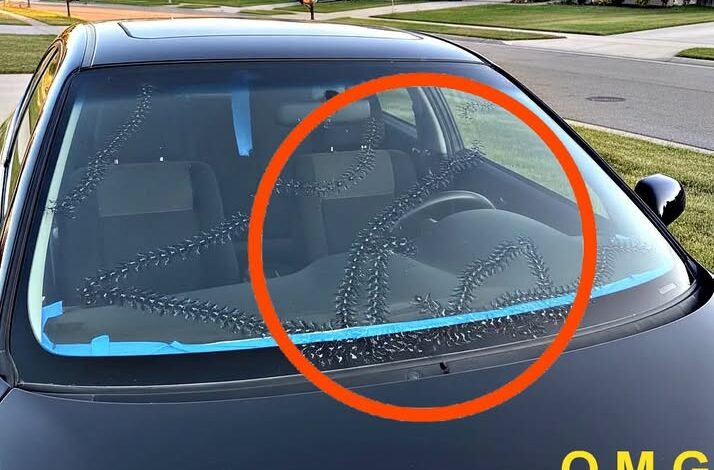
The night before had been completely ordinary.
I parked my car, locked the doors, and went inside thinking about tomorrow’s meetings, errands, and the usual list of things waiting to be done. There wasn’t the slightest hint that the next morning would begin with a mystery.
Then I stepped outside.
My windshield was covered in strange, looping marks that stretched across the glass in twisting, uneven paths. They didn’t look like fingerprints, bird tracks, or anything I recognized. For a moment, I simply stared, trying to make sense of what I was seeing.
My imagination immediately filled in the blanks.
Had an animal climbed onto the car during the night?
Was something trapped under the hood?
Had someone tampered with the vehicle?
I walked around it again and again, searching for clues. I looked for scratches in the paint, tufts of fur, broken branches—anything that might explain the strange pattern spread across the windshield.
There was nothing.
The car was otherwise untouched.
Like many people would, I snapped a photo and searched online.
Within minutes, I found dozens of confident opinions.
Someone insisted it had to be a raccoon.
Another was certain it was a snake.
A few suggested squirrels, opossums, or even something far more alarming. Every answer seemed to create a new question, and before long I was mentally preparing for an expensive mechanic’s inspection—or perhaps even a call to animal control.
The mystery grew larger with every theory.
Then I sent the picture to a friend.
A few seconds later, my phone rang.
Before saying hello, she laughed.
“Zoom in,” she said.
I did.
“Those are tree frog footprints.”
For a moment, I wasn’t sure whether she was joking.
Then she explained.
Tree frogs have tiny adhesive toe pads that allow them to climb smooth surfaces with remarkable ease. During warm, humid nights, they sometimes wander across windows, cars, and other shiny surfaces while searching for moisture, insects, or simply exploring. As they move, they can leave faint tracks made visible by condensation, pollen, dust, or morning dew.
Suddenly, the mystery wasn’t frightening anymore.
It was fascinating.
The dramatic story my imagination had created vanished in an instant, replaced by the image of a tiny frog quietly making its nighttime journey across my windshield before hopping away long before sunrise.
A damp cloth erased the tracks in seconds.
The lesson lasted much longer.
Our minds are remarkably good at preparing for danger.
When we don’t immediately understand something, we naturally imagine possibilities—sometimes the most alarming ones first. It’s an instinct that has helped humans survive for thousands of years, but in everyday life it can also lead us to mistake harmless mysteries for looming disasters.
Sometimes the explanation is surprisingly simple.
A tree frog.
A curious cat.
A windblown leaf.
A trick of morning dew.
Taking a moment to gather more information before jumping to conclusions often reveals that reality is far less dramatic than our first assumptions.
Now, whenever I notice something unusual, I try to remember that windshield.
Not every unexplained mark is a warning.
Not every mystery hides a problem.
Sometimes it’s simply evidence that, while we were asleep, the natural world quietly carried on around us—tiny creatures climbing, exploring, and leaving behind small reminders that we share our neighborhoods with lives far smaller than our own.
What looked like the beginning of a disaster turned out to be nothing more than the nighttime adventure of a tree frog.
And every time I think about it now, I smile instead of worry. Sometimes the most unsettling discoveries of the morning become the stories we laugh about most by afternoon.