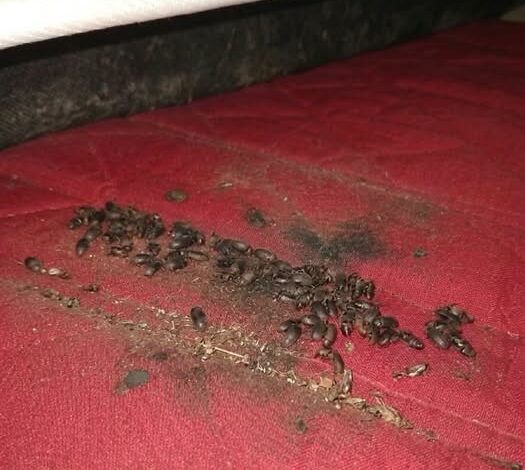
The first thing I noticed wasn’t movement.
It was the feeling that something simply didn’t belong.
When I lifted the mattress, tiny brown shells and strange little husks were scattered along the edges of the bed frame. For a few seconds, I just stared, trying to convince myself there had to be a simple explanation.
Instead, my imagination took over.
Bedbugs.
Roaches.
Some hidden parasite that had been crawling around while I slept.
Within minutes, I was crouched on the floor taking photographs from every angle, zooming in on every speck and comparing them to alarming pictures online. The longer I searched, the worse it became. Every website seemed to feature the most frightening possibilities, and before long I had convinced myself that my bedroom had become the center of a full-blown infestation.
Fear has a way of making every image look familiar.
Eventually, I did what I probably should have done first.
I shared the photos with friends and asked for help identifying what I was seeing. A local community group responded almost immediately, and several people reached the same conclusion.
They weren’t bedbugs.
They appeared to be carpet beetles and the shed skins left behind as their larvae developed.
The relief was immediate—but so was the realization that I still had work to do.
Carpet beetles are very different from bedbugs. Unlike bedbugs, they do not feed on human blood or bite people. Instead, they are attracted to natural materials such as wool, feathers, fur, lint, pet hair, and other organic fibers that can quietly collect beneath beds, inside closets, and along baseboards.
Their presence doesn’t necessarily mean a home is dirty.
But it often signals that hidden areas could benefit from a thorough cleaning.
That evening, I pulled everything away from the walls.
I vacuumed beneath the bed, along the edges of the room, and inside every corner where dust had quietly collected. Bedding went into a hot wash according to the care labels, storage boxes were inspected, and forgotten spaces finally received the attention they had missed for far too long.
With every pass of the vacuum, the panic faded.
In its place came something more useful.
Understanding.
The experience reminded me how easily uncertainty can grow when we rely on the internet before gathering the facts. Online searches often highlight the most dramatic possibilities, while the simplest explanations receive far less attention.
Identifying a household pest correctly is important because the solution depends entirely on what you’re dealing with. While bedbugs, fleas, and cockroaches may require very different approaches, carpet beetles are often managed through careful cleaning, reducing lint and pet hair, storing susceptible fabrics properly, and monitoring for any ongoing activity. If an infestation is extensive or persistent, a licensed pest control professional can help confirm the identification and recommend appropriate treatment.
Looking back, what stayed with me wasn’t the insects themselves.
It was how easily something small, hidden, and harmless enough to overlook had occupied a space I rarely thought about.
We spend so much of our lives in familiar rooms that it’s easy to stop truly seeing them.
Sometimes all it takes is lifting a mattress, opening a forgotten cupboard, or looking behind a piece of furniture to discover places we’ve ignored for years.
The carpet beetles weren’t the nightmare I had imagined.
They were simply a reminder that homes, like everything else, need occasional attention in the places we rarely see.
And that sometimes the biggest relief comes not from discovering there was nothing there—but from finally understanding exactly what was.