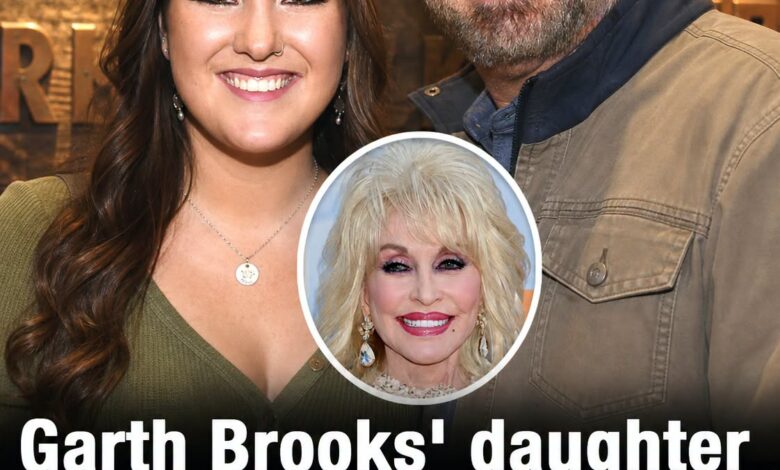
Dolly Parton’s death did more than unleash grief.
It revealed how protective people had become of what she meant to them.
For decades, Dolly occupied an unusual place in popular culture. She was famous enough to belong to everyone and private enough to remain deeply personal to the people who actually knew her. Fans who never met her still attached memories, values, childhoods, songs, and pieces of themselves to her.
So when tributes began pouring in, people were not merely reading condolences.
They were guarding a legacy.
That is the emotional landscape Allie Colleen stepped into when she tried to honor Dolly while also admitting something intensely personal: Dolly’s death had forced her to confront the terrifying possibility that someday she would lose her own father.
To some people, the sentiment was immediately understandable.
One death often makes us think about another.
A funeral can make someone call their mother.
An obituary can suddenly make a father’s age feel frightening.
Losing a beloved public figure can awaken private fears we have spent years successfully avoiding.
That is how grief works.
It rarely stays inside the lines.
Allie’s words appeared to come from that uncomfortable place. She was grieving Dolly while simultaneously recognizing that someone she loved would not be here forever.
For many readers, that was vulnerability.
For others, it felt inappropriate.
They believed a tribute to Dolly should have remained entirely about Dolly. By bringing her own father and her fear of losing him into the message, critics felt Allie had shifted attention toward herself during a moment that belonged to Dolly’s family, friends, and legacy.
The reaction was swift because grief creates strong expectations.
We want tributes to sound right.
Respectful.
Generous.
Selfless.
Beautiful.
We expect people experiencing complicated emotions to somehow translate those emotions into perfectly composed public statements.
But human beings rarely grieve that neatly.
Real grief is associative.
One loss opens the door to another.
Someone else’s tragedy makes us imagine our own.
A friend’s diagnosis reminds us of a relative.
A widow’s loneliness makes us look across the room at our spouse and suddenly understand that one of us will someday be left behind.
That response can seem self-centered when written publicly.
Internally, however, it is profoundly common.
Death makes mortality contagious in the imagination.
It tells everyone nearby:
This happened to them. One day, loss will come for you too.
That may have been the emotional truth beneath Allie’s tribute.
Dolly was gone.
And suddenly Allie could imagine a world without her father.
She said the frightening part aloud.
The question is whether saying it publicly made the tribute less respectful.
People can reasonably disagree.
Timing matters.
Context matters.
When someone dies, centering the bereaved family is generally an act of care. There are moments when our own related fears are better shared privately rather than inserted into someone else’s loss.
That principle should not simply be discarded.
But there is also a difference between intentionally hijacking grief and discovering that grief has touched something personal inside you.
Intent does not erase impact.
Impact does not automatically reveal intent.
Social media is particularly terrible at holding both truths.
It rewards certainty.
A complicated post becomes either beautiful or disgusting.
A person becomes compassionate or narcissistic.
A poorly phrased sentence becomes evidence of character.
Within hours, strangers who know almost nothing about the relationships involved can begin issuing moral verdicts.
Yet grief often produces exactly the kind of imperfect language social media punishes most severely.
People ramble.
They repeat themselves.
They say things that make perfect emotional sense in their heads but land differently on a screen.
They reach for comparisons.
They talk about themselves because personal experience is the only vocabulary they have for understanding someone else’s pain.
Sometimes they get it wrong.
That does not necessarily mean the feeling underneath was wrong.
The backlash against Allie therefore became about something larger than one tribute.
It became a debate over who gets to define proper mourning.
Fans wanted Dolly protected.
That instinct is understandable.
When a person has given the public decades of joy, people can become fiercely defensive after death. Every tribute feels as though it should rise to the magnitude of the life being remembered.
But there is a danger in demanding purity from grief.
Eventually, mourning becomes a performance.
Say exactly enough.
Mention only the correct people.
Do not make comparisons.
Do not sound too emotional.
Do not sound insufficiently emotional.
Do not post too quickly.
Do not wait too long.
Do not make it about yourself.
But also make it personal enough to prove you genuinely cared.
No grieving person can satisfy every rule.
And Dolly, of all people, built much of her public identity around refusing to reduce human beings to their worst or most awkward moments.
She understood contradiction.
She could be glamorous without pretending hardship did not exist.
She could laugh at herself without making herself small.
She could disagree without turning every disagreement into hatred.
Again and again, the values associated with her public life came back to generosity.
Not naïveté.
Not pretending words never hurt.
Generosity.
The willingness to leave room for another person’s humanity.
That principle may offer a better way to understand Allie’s tribute.
Perhaps it was imperfect.
Perhaps some people genuinely felt the reference to her father pulled attention away from Dolly.
Those reactions do not have to be mocked or dismissed.
People mourning Dolly were emotionally raw too.
But discomfort does not require condemnation.
We can say, “I wish she had phrased that differently,” without deciding, “She made this entire tragedy about herself.”
We can recognize poor timing without assigning malicious motives.
We can allow someone to clarify what they meant.
Most importantly, we can remember that grief is not a competition for moral perfection.
Allie’s fear of losing her father did not reduce Dolly’s importance.
If anything, it demonstrated one of death’s most unsettling powers.
Loss teaches us the value of people who are still here.
Suddenly the ordinary phone call matters.
The irritating habit becomes precious.
The father you assume will answer tomorrow becomes someone you desperately want more tomorrows with.
There is something deeply human about being frightened by that realization.
Maybe that is why the reaction became so intense.
Everyone involved was talking about love.
They simply expressed it differently.
Fans loved Dolly enough to defend the sanctity of her remembrance.
Allie loved Dolly while being reminded how deeply she loved her father.
One form of love collided with another, and social media converted the collision into outrage.
But Dolly’s legacy deserves more than outrage.
Her life was filled with examples of turning pain outward into generosity.
Poverty became empathy.
Success became philanthropy.
Childhood memories became books mailed to children.
Personal hardship became songs that helped strangers survive their own.
She seemed to understand that suffering becomes more bearable when it creates connection rather than another reason to wound somebody.
That lesson feels particularly useful now.
There will be many imperfect tributes.
Someone will say too much.
Someone will say too little.
Someone will make a joke because humor is how they survive unbearable moments.
Someone will disappear because they cannot speak at all.
Someone will write beautifully.
Someone else will write clumsily but mean every word.
None of us gets to experience another person’s grief from the inside.
We can judge words.
We should be slower to judge hearts.
Years from now, the argument over Allie Colleen’s tribute will probably feel small.
Dolly’s songs will still be playing.
Children will still be opening books connected to the work she set in motion.
People will still tell stories about her generosity, humor, stubbornness, ambition, and extraordinary ability to make strangers feel as though she somehow understood them.
That is the legacy worth protecting.
And perhaps protecting it does not require policing every person who mourns her imperfectly.
Perhaps it requires practicing some of what made people love Dolly in the first place.
Grace.
Humor.
Compassion.
The instinct to believe there might be more to a person than one awkward moment.
Because grief does not arrive polished.
It arrives frightened.
Confused.
Sometimes selfish.
Sometimes generous.
Often all of those things at once.
Allie offered vulnerability where some people wanted reverence.
That mismatch hurt.
But it does not have to become another excuse for cruelty.
Dolly spent a lifetime showing that tenderness could be powerful without becoming weak.
If people truly want to honor her now, perhaps the challenge is not simply to defend her memory.
It is to practice what that memory represents.
Let people stumble through goodbye.
Let them cry badly.
Let them discover that one loss has awakened fear of another.
Correct when necessary.
Give grace when possible.
And remember that mourning is not an audition.
Nobody performs it perfectly.
Sometimes the most Dolly-like thing we can do is resist the easiest judgment and choose the harder response instead:
Kindness.