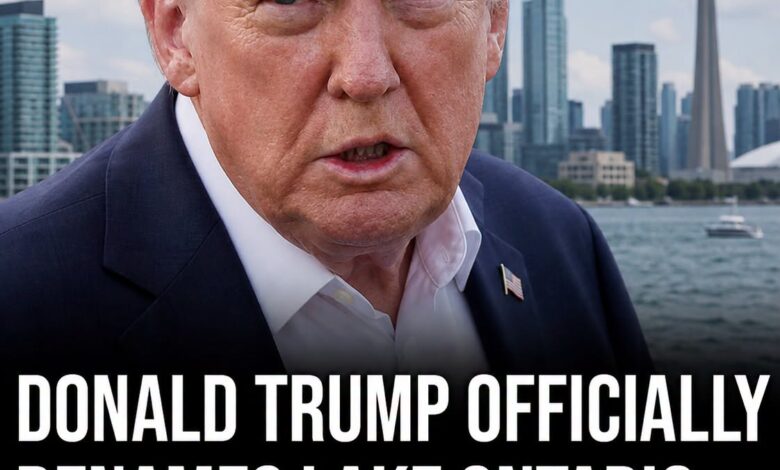
A lake cannot obey a president.
It cannot read an executive order, recognize a tariff, or understand that politicians hundreds of miles away are arguing over what humans should call it.
Lake Ontario simply continues doing what it has done for thousands of years.
Water moves toward the St. Lawrence. Waves break against Canadian and American shores. Ships cross its surface. Families gather along its beaches. Cities rise beside it.
Yet when Donald Trump moved to rename Lake Ontario as “Lake America” for U.S. federal purposes, the dispute quickly became about far more than words on a map.
For Trump, the gesture fit comfortably within a familiar political style.
Take something symbolic.
Make it enormous.
Force everyone to react.
At a moment of heightened tensions with Canada over tariffs and trade, attaching “America” to one of the Great Lakes offered a dramatic way to project strength. It turned geography into political theater and gave supporters another example of a president willing to challenge conventions that others considered untouchable.
To critics, however, the move looked less like strength than provocation.
Lake Ontario is not an exclusively American body of water.
The international boundary runs through it.
Canada occupies much of its northern shoreline, while New York borders it to the south.
No American president can simply rename a shared geographic feature for another sovereign country.
Washington may instruct U.S. federal agencies to use particular terminology on American government documents and maps. It cannot order Canadians to adopt that language.
That limitation transformed the announcement into something peculiar.
On one side of the border, federal documents could say one thing.
Across the water, Canada could continue saying another.
The lake itself would remain exactly where it had always been.
Canadian reaction was immediate.
For many, the issue wasn’t simply that Trump had chosen an irritating new name.
It was what the proposed change appeared to communicate.
Names carry history.
They tell people who was there, what mattered, and which stories survived long enough to become attached to the landscape.
Changing one can therefore feel less like editing a label and more like claiming ownership.
Ontario’s name reaches much further back than modern disputes between Ottawa and Washington.
Prime Minister Mark Carney emphasized precisely that point in responding to the controversy.
Rather than competing with Trump through louder rhetoric, Carney turned toward history.
“Ontario” has Indigenous linguistic roots, commonly traced to the Wendat language and associated with the idea of a beautiful or great lake.
That history gave Canada’s response a deeper argument.
The name did not begin with the Canadian government.
It did not originate in some recent bureaucratic decision.
And it certainly wasn’t created as an insult to the United States.
Its roots reach into Indigenous history that predates both modern countries.
That made the attempted renaming especially provocative to Canadians who saw it as flattening centuries of history into a contemporary political slogan.
Carney’s message was essentially simple:
Governments change.
Presidents change.
Trade disputes change.
The lake was there before all of them.
Ontario Premier Doug Ford responded in a much less restrained style.
Ford’s defiance reflected the anger felt by Canadians who had grown increasingly frustrated with Trump’s rhetoric toward their country.
The disagreement over the lake arrived amid broader tensions involving tariffs, industries, borders, and repeated suggestions that seemed to treat Canada less like a sovereign ally than a neighbor whose independence could be mocked for political effect.
Under those conditions, even a symbolic renaming stopped feeling harmless.
Context changed everything.
Had someone proposed “Lake America” as a joke, it might have disappeared within a news cycle.
Coming amid an escalating political confrontation, Canadians interpreted it as another deliberate poke.
And that reveals something important about symbolic politics.
Symbols matter most when trust is already weak.
The United States and Canada share one of the world’s longest international borders.
Their economies are deeply interconnected.
Supply chains cross the border repeatedly before finished products reach consumers.
Families live on opposite sides.
Tourism moves both directions.
Military cooperation has lasted generations.
The two countries share waterways, infrastructure, security responsibilities, environmental concerns, and enormous volumes of trade.
That relationship has never meant they agree about everything.
But alliances depend partly on an assumption of mutual respect.
Once that assumption begins eroding, small gestures acquire enormous weight.
A tariff is no longer merely economic policy.
A joke is no longer merely a joke.
A renamed lake is no longer merely cartography.
Everything becomes evidence of how one country sees the other.
Trump’s supporters could interpret the controversy differently.
From their perspective, outrage over a name might demonstrate exactly why such gestures work politically.
Trump has long used provocative language to disrupt diplomatic habits and force issues into public discussion.
His defenders may view conventional diplomacy as overly cautious, allowing allies to benefit from arrangements that deserve renegotiation.
If Canada objects loudly, that objection itself keeps attention focused on the broader conflict.
The controversy becomes leverage.
But there is a risk to conducting diplomacy primarily through provocation.
Countries remember humiliation.
Populations remember disrespect.
And political leaders who feel publicly cornered may find compromise harder, not easier.
Canada is particularly sensitive to anything that appears to challenge its sovereignty because Canadian identity has always developed alongside an overwhelmingly larger neighbor.
The United States has roughly ten times Canada’s population and dramatically greater global military power.
American entertainment, business, media, and politics spill across the border every day.
Canada’s distinct identity has therefore never been purely geographical.
It has also been maintained culturally.
Language matters.
Institutions matter.
Symbols matter.
Names matter.
That is why “Lake Ontario” carries significance beyond navigation.
Toronto faces the lake.
Kingston sits near its eastern end.
Communities have built histories along its shoreline.
Generations have learned the name in school.
It appears in songs, weather forecasts, family stories, shipping records, Indigenous histories, tourism campaigns, and countless ordinary conversations.
You cannot erase that cultural familiarity simply by issuing paperwork.
There is also an irony buried inside the dispute.
The Great Lakes themselves are among the strongest reminders that geography frequently refuses to cooperate with nationalism.
Water doesn’t stop at political borders.
Pollution created on one side can affect the other.
Fish populations migrate.
Shipping requires cooperation.
Environmental management requires cooperation.
Emergency response requires cooperation.
The ecosystem doesn’t become American or Canadian depending on which shoreline it touches.
Both countries are forced by geography to share responsibility.
Lake Ontario therefore represents precisely the kind of relationship politics cannot completely separate.
Governments may argue.
Tariffs may rise.
Prime ministers and presidents may exchange insults.
But eventually somebody still has to cooperate over the water.
That makes the fight over its name almost paradoxical.
The lake symbolizes interdependence while the argument attempts to turn it into a symbol of possession.
Carney’s response avoided that trap.
By emphasizing the Indigenous origin of “Ontario,” he shifted the discussion away from who could shout the loudest about national ownership.
His argument suggested that neither Canada nor the United States invented the landscape.
Both are relatively recent political structures compared with the peoples who named, traveled, fished, and lived around these waters long before an international border divided them.
That historical perspective makes modern political swagger look temporary.
And perhaps that is why the response resonated.
Trump’s proposed name was designed for the present political moment.
“Lake America” is unmistakably contemporary.
It carries the language of nationalism, branding, confrontation, and political spectacle.
“Ontario,” by contrast, carries memory.
One name announces power.
The other carries inheritance.
Ultimately, Washington can decide what terminology American federal agencies use.
Canada can decide what appears on Canadian maps.
Neither side requires the other’s permission for its domestic administrative language.
But official terminology and cultural reality are different things.
A government can change a label faster than it can change people’s vocabulary.
Canadians are unlikely to wake up one morning, look across the familiar water, and suddenly adopt a name chosen by an American president during a trade dispute.
People rarely surrender familiar geography that easily.
They inherit names.
They teach them to children.
They attach memories to them.
They speak them until the words become inseparable from the places themselves.
That is why this argument was never really about five letters on a map.
It was about sovereignty.
History.
Identity.
Power.
And who gets to decide what shared places mean.
Trump’s gesture attempted to make the lake part of a political message.
Canada’s response was to make the existing name part of a historical one.
Presidents come and go.
Prime ministers do too.
Tariffs are imposed and removed.
Diplomatic crises that once seemed enormous eventually become chapters in history books.
But long after today’s political arguments have faded, the water will still stretch between two countries.
Waves will continue reaching both shores without asking which nation owns the greater claim to them.
And north of the border, people will keep using the name generations before them inherited.
Lake Ontario.
Not because an American president permitted it.
Not because Ottawa won an argument.
But because some names become too deeply woven into a country’s memory to be replaced by the politics of a moment.
The maps may argue.
The governments certainly will.
The lake will not.
And in Canada, its name will remain what it has long been:
Ontario.