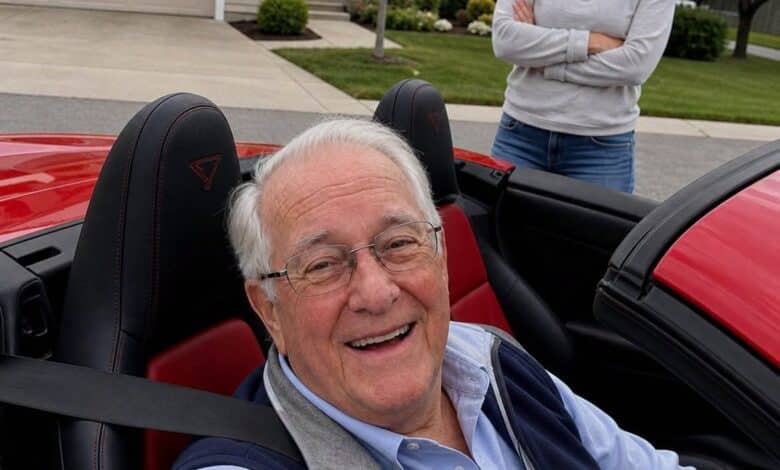
Margaret had been gone twelve days when Harold heard his children begin dividing his life.
They were standing only a few feet from her coffin.
Harold had stepped into the hallway of the funeral home because the room felt too warm, too crowded, too full of people saying Margaret’s name in the past tense. He was returning when he heard his daughter whisper to her brother.
“What do you think happens with the house?”
Her brother lowered his voice.
“Dad can’t stay there forever.”
Then came another question.
“The accounts?”
Harold stopped.
Neither child knew he was listening.
They spoke quietly about property, savings, paperwork, and what Margaret might have left behind. Perhaps they thought practical matters were easier than grief.
But Harold heard something else.
An inventory.
For nearly fifty years, he and Margaret had built a life one ordinary decision at a time. They had saved carefully, repaired instead of replaced, skipped expensive vacations when money was tight, and celebrated finally paying off the house.
Now Margaret was lying in a coffin, and their children were discussing what remained as though the marriage had become an estate before Harold had even buried his wife.
That night, the house was unbearably silent.
Harold left the television on simply because another human voice—even one coming from a late-night commercial—made the rooms feel less empty.
Margaret’s chair remained at the kitchen table.
Her reading glasses were still beside the lamp.
Her mug was in the cabinet.
These were the losses Harold had expected.
What he had not expected was feeling erased while still alive.
In the weeks that followed, his children called regularly.
But too many conversations drifted toward practical questions.
Had he reviewed the will?
Was the house too much for him?
Had he thought about simplifying?
Harold wanted someone to ask whether he had slept through the night.
Instead, they asked whether he had located the property documents.
Then he found Margaret’s message.
It happened while sorting through a drawer where she kept receipts, old photographs, and things Harold had never understood why she saved. Inside was a small reminder of a life they had shared long before mortgages, retirement accounts, and responsible adulthood.
Engraved on it were four words:
Young and reckless again.
Harold laughed.
Then he cried so suddenly he had to sit down.
Margaret had always teased him that someday they would stop behaving sensibly.
They would buy the ridiculous car.
Take the unnecessary trip.
Order dessert first.
Drive somewhere without knowing where they would sleep that night.
They had postponed that version of themselves for decades.
After retirement.
After the house was paid off.
After this.
After that.
There was always another after.
Now Margaret had run out of them.
Harold realized he hadn’t.
Three weeks later, a deep-green car appeared in his driveway.
His son stared at it.
“You bought that?”
“I did.”
“With cash?”
Harold smiled. “That’s generally how buying works.”
His daughter was less amused.
“Dad, that’s a lot of money.”
There it was again.
Not Do you love it?
Not Where are you going?
Money.
Something inside Harold hardened.
“It’s my money.”
The silence afterward was enormous.
Then he began traveling.
Nothing extravagant enough to destroy the life he had built, but enough to make it unmistakably clear that he intended to use that life.
He drove roads Margaret had once circled on maps.
He ate in restaurants where nobody knew he was a widower.
He watched sunsets without apologizing for enjoying them.
Sometimes he carried Margaret’s bracelet in the glove compartment.
He didn’t pretend she was sitting beside him.
He knew better than that.
But grief was easier when it moved.
At home, he made another decision.
He rewrote his will.
His children would receive something.
But most of the estate would go elsewhere—to causes Margaret had cared about, organizations she had quietly supported, and people whose lives could genuinely change because two ordinary people had spent decades saving.
When Harold told the children, anger arrived almost immediately.
“You’re giving away our inheritance?”
Harold looked at his son.
“Your inheritance?”
“You know what I mean.”
“No,” Harold said. “I think that’s exactly the problem.”
His daughter folded her arms.
“Mom would never want this.”
That hurt.
But Harold had spent enough nights alone with Margaret’s memory to know what she valued.
“Your mother wanted her life to mean something,” he said. “And she wanted me to live mine.”
His son stood.
“So this is punishment?”
Harold shook his head.
“No. If I wanted revenge, I would leave you nothing. This isn’t revenge.”
“Then what is it?”
Harold looked from one child to the other.
“It is me reminding you that I’m not dead.”
Nobody spoke.
He continued.
“At your mother’s funeral, I heard you discussing the house. The accounts. What would happen when I couldn’t live here anymore.”
His daughter’s face changed.
“Dad—”
“You hadn’t even asked if I was sleeping.”
“We were worried.”
“You were counting.”
His son looked away.
Harold could have stopped there.
Part of him wanted to.
But Margaret had never believed humiliation made people better.
So he waited.
Finally, his daughter began crying.
Not the defensive tears Harold expected.
Something older broke through.
“I didn’t know what else to talk about.”
Harold frowned.
She wiped her face.
“When Mom died, everything suddenly felt temporary. The house. You. Us. I kept thinking about what happens next because I couldn’t think about what had already happened.”
His son sat down again.
“We sounded awful.”
“You did.”
The answer surprised them.
Harold wasn’t going to erase cruelty merely because he finally understood where it came from.
His son rubbed his hands together.
“I kept thinking that if everything was organized, maybe I’d feel like something was under control.”
“And did you?”
“No.”
Harold understood then.
The inheritance obsession had been ugly.
But beneath it was something more frightened than greedy.
Their mother had died.
For the first time, the children had been forced to see their parents as mortal.
Margaret’s death had not merely taken Margaret.
It had introduced the possibility of Harold’s death.
The money, the house, the will—those were objects they could discuss because the real subject was unbearable.
Someday Dad will be gone too.
Understanding that did not excuse what they had done.
But it gave Harold somewhere to go from there.
“I don’t care whether you inherit this house,” he said. “I care whether you come inside it while I’m still here.”
His daughter covered her mouth.
Harold’s voice softened.
“You can’t love me later.”
That sentence seemed to settle over all three of them.
“You can’t inherit conversations we never had. You can’t divide up dinners we didn’t eat together. You can’t put off knowing me and expect a will to make up for it.”
His son stared at the floor.
“So what happens now?”
Harold thought of Margaret.
Young and reckless again.
“We do better.”
It wasn’t a magical reconciliation.
The will remained changed.
Harold did not cancel the donations.
He did not sell the car.
His children did not instantly become different people.
But they started calling without asking about paperwork.
His daughter came over for coffee.
His son joined him on a drive and, for nearly two hours, neither mentioned money.
They began talking about Margaret too—not her estate, but her.
Her terrible singing.
The way she hid chocolates in the freezer.
How she could remain angry for exactly eleven minutes before forgetting why.
Grief slowly became a person again instead of a collection of assets.
One evening, the three of them stood in the driveway beside Harold’s green car.
His son ran a hand along the hood.
“Mom would’ve laughed at this.”
“She would’ve stolen it,” Harold said.
His daughter smiled.
“Where are you going next?”
Harold glanced toward the windshield.
Margaret’s bracelet rested inside the glove compartment, catching the last light.
“I haven’t decided.”
For once, nobody asked what the trip would cost.
His daughter hugged him.
Not carefully.
Not like an elderly man who might break.
Like her father.
Harold closed his eyes.
He could not return to the years before Margaret died.
His children could not unsay what he had overheard beside her coffin.
The will could not repair grief, and money could not measure love.
But there was still time.
That was Margaret’s final gift.
Not the house.
Not the savings.
Not even the words engraved for him.
She had reminded Harold that being alive was not the same as waiting to die.
The car idled in the driveway.
Margaret’s bracelet glinted inside.
His children stood beside him.
And Harold finally understood that love could not be backdated.
Whatever they wished they had said yesterday was gone.
Whatever they wanted to become tomorrow was uncertain.
But tonight was still available.
So was the next phone call.
The next drive.
The next dinner.
The next chance to choose one another before all that remained was an inheritance.
Harold opened the passenger door.
“Who’s coming?”
This time, both children stepped forward.