Dolly Parton’s family reveal heartbreaking detail in their final goodbye as she is laid to rest beside husband

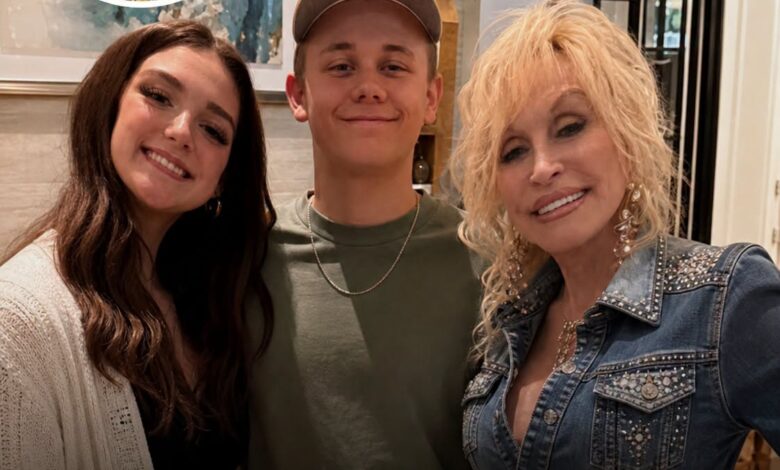
The world knew Dolly Parton by the sparkle.
Her family knew her by the way she made fear disappear.
That difference became especially clear in the quiet of a private Tennessee funeral, far from the stages, cameras, rhinestones, and applause that had surrounded so much of her extraordinary life. There, Dolly was not primarily the songwriter whose words had traveled around the world.
She was family.
For her niece Lainey Mae, she was something even more intimate.
She was “Granny.”
It is difficult to imagine a more revealing title for a woman the public spent decades calling an icon.
Awards can measure success.
Record sales can measure popularity.
Headlines can measure fame.
But none of them can measure what it means to be the person someone calls when they are frightened and need to hear, just once more, that everything might be okay.
That was the Dolly Lainey remembered.
The woman who could take anxiety seriously without making it larger.
The woman who encouraged dreams without making them sound foolish.
The person who never used her own enormous success to make a younger relative feel insignificant.
That may have been one of Dolly’s rarest gifts.
She could fill an arena and still make one person feel seen.
Lainey’s memories reveal a relationship built not from spectacular gestures alone, but from repeated acts of belief.
When beauty school mattered, Dolly helped make it possible.
When the studio felt intimidating, Dolly stood beside her.
When adulthood brought uncertainty, there was a familiar voice reminding her that fear did not have to make the decisions.
Those moments might have seemed ordinary while they were happening.
Death changes their weight.
A conversation becomes something you replay.
A laugh becomes something you are afraid of forgetting.
An old voicemail becomes almost sacred.
A memory of standing beside someone in a studio suddenly matters more than any photograph taken on a red carpet.
That is one of grief’s cruelest transformations.
It turns ordinary moments into treasures only after there can be no more of them.
For years, Dolly’s decision not to have children of her own was treated publicly as a defining biographical fact.
But absence of children never meant absence of maternal love.
Dolly simply sent that love in other directions.
Toward nieces and nephews.
Toward younger artists.
Toward children she would never meet.
Toward people who needed somebody established and powerful to say, “I believe you can do this.”
She mothered through encouragement.
Through opportunity.
Through protection.
Through attention.
And perhaps most importantly, through belief.
There are people who enter a child’s life and explain all the reasons a dream is unrealistic.
Then there are people who quietly help pay the tuition.
Dolly understood the difference.
That instinct extended far beyond her own family.
Her Imagination Library transformed affection for children into something tangible: books arriving in homes, opening worlds for young readers who might otherwise have had fewer opportunities to build their own libraries.
That was classic Dolly.
She rarely seemed satisfied with simply saying something mattered.
She wanted to make the caring useful.
A child needed a book?
Send the book.
A young relative needed training?
Help create the opportunity.
Someone was frightened?
Pick up the phone.
A dream needed encouragement?
Believe first.
That pattern may explain why “Granny” meant so much to her.
The public title was Dolly Parton.
The private title represented trust.
And trust is harder to earn than fame.
Lainey did not need Dolly Parton, the global entertainer, every day.
She needed the woman beneath the performance.
The one who could enter a room without requiring it to become about her.
The one who understood that someone else’s small milestone could be enormous to them.
The one who could celebrate beauty school with the same emotional seriousness the entertainment industry reserved for awards.
That is what family remembers when the public remembers achievements.
The world will remember songs.
“Jolene.”
“9 to 5.”
“I Will Always Love You.”
Generations will discover performances long after the people who first heard them are gone.
Films will remain.
Dollywood will remain part of the landscape she helped shape.
Her philanthropy will continue touching lives she never had the chance to know.
That is immortality in the public sense.
But family grief operates differently.
Lainey will not primarily miss a catalog.
She will miss access.
The ability to call.
The possibility of another conversation.
The knowledge that somewhere in the world existed one particular person who understood the history behind the question before it was even asked.
Public grief says:
We lost Dolly Parton.
Private grief says:
I lost the person who knew me.
Those are not the same loss.
And perhaps that is why the image of Dolly being laid to rest beside Carl Dean carries such emotional force.
Carl represented the part of Dolly’s life fame could never completely enter.
For decades, their marriage existed almost as a counterweight to celebrity.
She belonged to the world professionally.
But she came home to him.
He did not need to compete with the spotlight because their relationship lived somewhere beyond it.
The world could have the concerts.
The photographs.
The interviews.
The larger-than-life image.
Carl knew the woman after the costume came off.
To imagine them together again in Tennessee soil feels almost like the closing of a circle.
After all the movement, stillness.
After all the stages, home.
After a lifetime of thousands calling her name, a resting place beside the man who had known that name before it became a global brand.
Yet even that image cannot make grief tidy.
There is no beautiful metaphor capable of removing the ache from an empty chair.
Family members will still encounter the absence in ordinary places.
A holiday.
A birthday.
A familiar song playing unexpectedly.
Someone will tell a story and instinctively think, “I need to call Granny.”
Then reality will arrive again.
That is how loss works.
Not once.
Repeatedly.
But love repeats too.
Every time Lainey walks into a room with courage Dolly helped build, part of that guidance continues.
Every time she encourages somebody younger, Dolly’s example moves forward.
Every time a child opens a book provided through the Imagination Library, an act of care Dolly set in motion continues without requiring her physical presence.
That may be the difference between fame and legacy.
Fame means people remember your name.
Legacy means something you gave them keeps happening.
Dolly gave plenty that will keep happening.
Music.
Stories.
Opportunities.
Books.
Laughter.
Confidence.
Permission to dream bigger than circumstances suggested was sensible.
And within her family, she left something even harder to catalogue.
She left people who knew what it felt like to be believed in by her.
That kind of love changes a person.
It becomes part of the voice inside their head.
At first, Lainey may remember Dolly telling her not to be afraid.
Years from now, she may realize that voice has gradually become her own.
That is one of the strange ways people survive death.
We lose the person.
Then, slowly, discover pieces of them living in how we speak, how we love, and how we treat the next frightened person who comes to us.
The public will continue celebrating Dolly Parton.
There will be tributes.
Retrospectives.
Songs played louder because she is gone.
Old interviews will acquire new meaning.
Photographs will circulate.
The rhinestones will remain unmistakable.
But none of that can completely capture Granny.
That Dolly belongs to a smaller circle.
To the people who remember the phone calls.
The private jokes.
The studio nerves.
The tuition paid.
The encouragement offered without cameras nearby.
The ordinary moments that did not look like history while they were happening.
Perhaps those moments were the most important history of all.
Dolly spent a lifetime proving that motherhood could take more than one form and that family could be nurtured through presence rather than titles.
She had no children of her own.
Yet she helped raise dreams everywhere she found them.
And when her family gathered quietly in Tennessee to say goodbye, they were not simply burying a legend.
They were saying goodbye to the woman who had made them feel safer in the world.
The world lost the glitter.
They lost Granny.
And while Dolly’s public legacy will live wherever her songs are played, her most intimate legacy will survive somewhere quieter:
inside the people who learned courage because she believed in them before they knew how to believe in themselves.