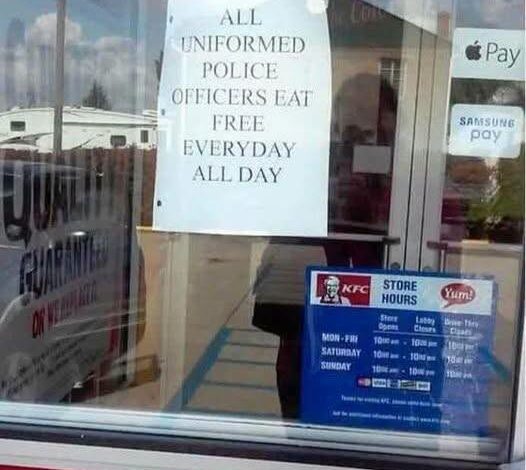
The sign was small enough to miss if you weren’t looking for it.
But once someone photographed it and posted it online, thousands of people suddenly had an opinion.
The message appeared to offer police officers a complimentary meal as a gesture of appreciation for their service. What might once have remained a quiet interaction between a restaurant and local law enforcement quickly became something much larger.
Some people loved it.
Others were furious.
And within hours, a simple restaurant sign had become the center of an argument about police, fairness, first responders, and whether businesses should decide that one profession deserves special recognition over another.
The easiest response would have been to take it down.
Remove the sign.
Wait for the internet to find something else to argue about.
Instead, the restaurant reportedly chose to explain why it was there.
Management’s position was straightforward: the gesture wasn’t intended as a political endorsement or a statement about every controversy surrounding law enforcement.
It was meant as a thank-you.
Police officers routinely work jobs involving unpredictable situations, long shifts, emergencies, domestic disputes, crashes, violent incidents, and calls where they may have little idea what awaits them when they arrive.
Most of that work never becomes national news.
There are no cameras when an officer spends an hour helping at an accident scene.
No viral post necessarily follows a late-night welfare check.
The ordinary parts of public service often remain invisible precisely because nothing catastrophic happens.
The restaurant wanted to acknowledge that.
To supporters, there was nothing controversial about it.
Businesses give discounts to groups all the time.
Teachers.
Students.
Veterans.
Senior citizens.
Healthcare workers.
Military personnel.
A free or discounted meal for police officers seemed like another version of the same idea—a private business choosing to show appreciation to people it valued.
But critics raised another question almost immediately.
Why only police?
What about firefighters?
What about paramedics and EMTs?
What about emergency dispatchers who hear people during the worst minutes of their lives but rarely receive public recognition?
What about nurses and emergency-room staff?
Once the discussion expanded beyond the original sign, it became less about fried chicken and more about who society chooses to recognize as a first responder.
That was a more interesting conversation.
Firefighters enter burning buildings.
Paramedics stabilize patients on roadsides, in bedrooms, and inside ambulances.
Dispatchers make rapid decisions while frightened strangers scream into telephones.
Police officers respond to situations that can shift from routine to dangerous within seconds.
Their responsibilities differ, but each profession can carry extraordinary pressure.
Some commenters therefore suggested that appreciation should be extended across emergency services rather than focused exclusively on law enforcement.
That argument did not necessarily reject the restaurant’s gesture.
In many cases, it broadened it.
If the purpose was gratitude, why stop with one uniform?
Then another voice entered the discussion.
Police officers themselves.
Some reportedly responded to the controversy by making it clear that they hadn’t entered the profession for free meals.
They didn’t expect special treatment.
They didn’t want restaurant employees feeling obligated to serve them differently.
And they certainly didn’t want a complimentary meal transformed into another reason for communities to fight.
That response revealed something the online argument had largely overlooked.
The dollar value of the food was never particularly important.
Recognition was.
Imagine finishing a shift after dealing with an accident, an overdose, a frightened child, a violent argument, or simply hours of tense encounters with strangers.
Then you walk into a restaurant.
Someone says:
“We appreciate what you do.”
The meal might cost only a few dollars.
The acknowledgment can mean considerably more.
That doesn’t require pretending policing is beyond criticism.
It isn’t.
Law-enforcement agencies hold significant authority, and with authority comes an obligation to maintain accountability, professionalism, and public trust.
Communities can appreciate officers who serve honorably while still demanding transparency and reform when misconduct occurs.
Those ideas are not mutually exclusive.
That nuance disappeared in much of the online debate.
The sign became a symbol.
For supporters, it represented respect for police.
For critics, it represented favoritism or an uncritical celebration of an institution they believed deserved greater scrutiny.
For the restaurant, however, the intended meaning appeared far simpler.
Thank you.
Internet controversies rarely tolerate simplicity.
A photograph loses its local context.
People who have never visited the restaurant begin arguing about its motives.
One person’s gesture becomes another person’s political statement.
Soon, everyone is debating what the sign supposedly represents rather than what the people who placed it there intended.
That is what made the decision to leave it up significant.
The restaurant did not need everyone to agree with the gesture.
It simply needed to be clear about why it was making it.
The message wasn’t supposed to say police officers were more valuable than everyone else.
It wasn’t supposed to diminish firefighters, paramedics, dispatchers, teachers, nurses, or anyone else serving their community.
It was one business choosing one particular way to express appreciation.
Could the gesture have been expanded?
Certainly.
A restaurant might decide to recognize all first responders.
Another might offer discounts to teachers.
Another might provide meals to veterans.
Another might quietly feed people experiencing homelessness.
Private acts of generosity don’t necessarily become unfair simply because they aren’t universal.
No single gesture can recognize everyone.
That doesn’t make the gesture meaningless.
The controversy also revealed something about the strange relationship society has with gratitude.
We often wait until tragedy before expressing it.
When a firefighter dies, everyone remembers the danger of the profession.
When a paramedic is injured, people recognize the risks of emergency response.
When an officer is killed, photographs appear, flags are lowered, and communities gather.
Then life continues.
The ordinary days return.
And the people doing those jobs go back to work.
Perhaps appreciation is more meaningful when it arrives before tragedy.
Not because every person wearing a uniform is automatically heroic.
Not because criticism should disappear.
But because behind institutions are individuals, and many of those individuals spend their working lives responding to circumstances most people desperately hope never to experience.
That was ultimately what the little restaurant sign came to represent.
Not free chicken.
Not a grand political declaration.
Not an argument that one profession mattered more than another.
Acknowledgment.
A recognition that someone noticed.
That someone understood, however imperfectly, that difficult work was being done outside public view.
And perhaps the officers who said they didn’t need free food were right.
Most people in demanding professions don’t expect strangers to reward them.
They want decent working conditions.
Fair treatment.
Respect when it has been earned.
And occasionally, a reminder that their efforts haven’t become invisible.
The restaurant could have removed the sign when criticism arrived.
Doing so would probably have ended the controversy faster.
Instead, management reportedly stood behind the intention while explaining what the gesture meant.
That didn’t require critics to agree.
It simply meant disagreement wouldn’t automatically erase the original act of gratitude.
In a culture where almost any public gesture can become an ideological battlefield, there is something worth remembering in that distinction.
Appreciation doesn’t have to mean unquestioning approval.
Recognition doesn’t eliminate accountability.
And thanking one group doesn’t automatically insult everyone who wasn’t named.
Sometimes a meal is simply a meal.
Sometimes a sign is simply a thank-you.
And sometimes the most meaningful thing you can offer someone whose difficult work usually goes unnoticed costs almost nothing at all.
It’s simply saying:
“We see you.
And what you do matters.”