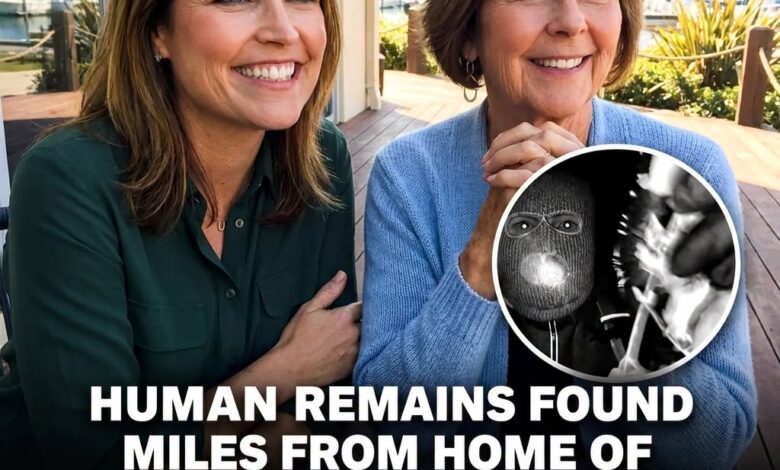
Every new discovery carries the same unbearable question:
Is it Nancy?
For a family waiting for answers, almost anything can become a source of hope or terror. A police vehicle appearing somewhere unexpected. A new search area. A rumor spreading online. A press conference announced without explanation.
And now, human remains discovered in the harsh landscape outside Tucson.
The remains were described as weathered, suggesting they had been exposed to the elements for some time. Investigators cautioned that there was no established connection to Nancy Guthrie’s disappearance.
But caution does little to quiet a frightened imagination.
Nancy is 84.
She vanished from the place where a person should feel safest: her own home.
According to the account surrounding the case, investigators believe she was taken during the night.
That detail alone transformed an ordinary bedroom into something frightening.
A bed is supposed to represent vulnerability without danger.
You close your eyes because you trust the walls around you.
You leave your shoes by the door.
You put your phone down.
You sleep because home is the one place where vigilance is supposed to be unnecessary.
Then morning comes, and someone is gone.
For Nancy’s family, time began dividing itself differently after that.
There was life before she disappeared.
And everything after.
The first hours would have been dominated by practical questions.
Where is she?
Could she have left?
Did anyone speak with her?
Was there an accident?
Did a neighbor see something?
Then investigators began assembling the fragments.
Surveillance footage.
Timelines.
Statements.
Physical evidence.
Every small detail potentially carrying enormous significance.
Among the most disturbing pieces was doorbell-camera footage reportedly showing a masked figure.
A person concealed from identification naturally invites fear.
Who were they?
Why were they there?
Did Nancy know them?
Were they watching the house?
Was the appearance connected to her disappearance at all?
Investigators have to resist the temptation to answer those questions before evidence does.
Families don’t have that luxury.
They lie awake filling the gaps.
That is one of the least understood forms of suffering surrounding a disappearance.
Death is devastating.
Uncertainty is different.
It keeps reopening the door.
A family can imagine rescue in the morning and catastrophe by afternoon.
A phone call can produce hope before anyone answers it.
A breaking-news alert can make someone’s hands shake.
You begin fearing information and desperately needing it at the same time.
For Savannah Guthrie, whose professional life has involved delivering breaking news to millions of other people, that reversal is especially cruel.
Journalists learn to wait for confirmation.
They separate evidence from rumor.
They choose words carefully because facts matter.
But those professional instincts become painfully difficult when the missing person is your mother.
There is no emotional objectivity available there.
Nancy isn’t a headline to her family.
She is the voice on the phone.
The person occupying a familiar chair.
The mother whose habits everyone knows without realizing they know them.
How she says goodbye.
What she orders.
Which stories she repeats.
What makes her laugh.
The ordinary details that seem insignificant until someone is suddenly absent.
Then came the reported ransom messages.
Messages connected to a missing loved one create a terrible dilemma.
Every word matters.
Every phrase is examined.
Does the sender actually know something?
Can they prove Nancy is alive?
Are they trying to manipulate the family?
Are they exploiting a public tragedy?
Claims that Nancy had “perished” would be particularly cruel.
But a claim is not proof.
Investigators must determine whether someone possesses genuine knowledge or is merely weaponizing fear.
That distinction matters enormously.
High-profile disappearances attract attention.
Attention attracts opportunists.
People sometimes insert themselves into tragedies they have nothing to do with.
They send false tips.
Invent sightings.
Create theories.
Pretend to possess information.
Families already experiencing unimaginable stress are then forced to distinguish genuine leads from cruelty disguised as knowledge.
That is why law enforcement can appear frustratingly restrained.
The public wants everything.
Investigators often release almost nothing.
That silence can look suspicious from outside.
Sometimes it simply reflects the reality of an active investigation.
Police may withhold information because revealing it could contaminate witness accounts, expose investigative techniques, alert a suspect, or make it harder to distinguish genuine knowledge from details someone learned through the news.
But understanding why authorities stay quiet doesn’t make their silence easier for a family.
Especially when human remains are found.
The desert surrounding Tucson can be beautiful in ways photographs struggle to capture.
It can also be unforgiving.
Heat.
Distance.
Dry air.
Long stretches where human presence becomes almost invisible.
A person can disappear into that landscape frighteningly quickly.
So when remains were reportedly discovered there, the emotional impact was immediate.
Authorities stressed that no connection to Nancy had been established.
That sentence should matter.
It means exactly what it says.
No confirmed link.
But families living inside uncertainty don’t experience information as cleanly as investigators do.
They hear:
Human remains.
Then everything else becomes difficult to process.
How old are they?
How long have they been there?
Male or female?
What makes investigators believe there is no connection?
Have they identified the person?
Are they waiting for forensic testing?
Could the preliminary assessment be wrong?
Every unanswered question becomes another place fear can live.
And yet the discovery represents another tragedy regardless of whether the remains belong to Nancy.
Someone died.
Someone may have been missing long before anyone searching for Nancy entered that landscape.
Somewhere, another family could be waiting for an answer they stopped expecting years ago.
That is important to remember.
Unidentified remains are not merely evidence in somebody else’s story.
They belonged to a person.
A person with a name.
A history.
Perhaps relatives.
Perhaps friends who wondered where they went.
Identification restores something death took away.
It returns individuality.
It says:
You were here.
You belonged to someone.
Your life was more than the place where you were found.
Nancy’s family wants exactly that kind of certainty.
They want her home.
Ideally alive.
That hope remains possible until reliable evidence establishes otherwise.
But beneath the hope lies another demand:
Truth.
Not theories.
Not anonymous claims.
Not viral speculation.
Truth.
If someone took Nancy, who?
Why?
Where did they bring her?
Who knew?
Who helped?
What happened afterward?
Those questions cannot be answered by social media detectives studying screenshots.
They require evidence.
Digital records.
Surveillance.
Forensics.
Witnesses.
Timelines.
Patient investigative work that often looks frustratingly slow from outside.
The masked figure on video may feel like the obvious center of the mystery.
But appearances can mislead.
A dramatic image becomes psychologically dominant because the human brain loves narrative anchors.
We see a masked person and immediately construct a villain.
Investigators have to do something harder.
They have to prove what that person’s presence actually means.
The same applies to ransom notes.
A frightening sentence isn’t automatically authentic because it sounds specific.
The writer must demonstrate knowledge that could only come from genuine involvement.
Language can be analyzed.
Delivery methods can be traced.
Digital trails may exist.
Physical materials may contain evidence.
Every detail potentially matters.
But every detail can also be misunderstood when released without context.
That’s why responsible reporting becomes especially important.
A missing person is not entertainment.
Uncertainty shouldn’t be converted into certainty because certainty produces a stronger headline.
“Police have not established a connection” is less dramatic than “Desert body may solve mystery.”
But the first formulation respects what is actually known.
The difference matters.
It matters to investigators.
It matters to the unidentified person whose remains were discovered.
And most of all, it matters to Nancy’s family.
Imagine experiencing each rumor from their side.
Someone online posts that Nancy has been seen.
Hope.
The sighting collapses.
Despair.
Someone claims to know where she is.
Hope.
The claim proves unreliable.
Despair.
A search begins somewhere new.
Hope and terror simultaneously.
Human remains are found.
For one terrible moment, everything stops.
Then authorities say there is no confirmed connection.
Relief perhaps.
But not peace.
Because Nancy is still missing.
That is the emotional cruelty of ambiguous loss.
Nothing fully resolves.
You cannot mourn normally because hope remains.
You cannot relax into hope because catastrophe remains possible.
The mind moves constantly between incompatible futures.
In one, the door opens and Nancy comes home.
In another, investigators arrive carrying news nobody wants.
Both possibilities occupy the same day.
Sometimes the same minute.
For Savannah and her family, public attention adds another burden.
Their private terror becomes public conversation.
Strangers analyze facial expressions.
Television segments replay footage.
Every development produces thousands of opinions from people who don’t know Nancy.
Some mean well.
Others treat the disappearance like a mystery series whose ending they are entitled to predict.
But this isn’t a puzzle designed for an audience.
There is no clever satisfaction waiting at the end.
There is an elderly woman whose family wants her back.
That fact should remain at the center of everything.
Nancy’s age also intensifies the urgency.
At 84, prolonged displacement from familiar surroundings can carry serious risks.
Routine matters.
Medication may matter.
Temperature matters.
Hydration matters.
Time matters.
Every passing day can feel heavier because the family understands that urgency even when they cannot act directly on it.
They must depend on investigators.
On strangers remembering something.
On cameras that happened to be recording.
On forensic evidence.
On somebody deciding to speak.
That helplessness may be among the hardest parts.
Families want to search every road themselves.
Knock on every door.
Check every building.
Demand every answer.
But large investigations require coordination.
Evidence can be destroyed accidentally.
Potential suspects can be alerted.
Well-intentioned people can complicate searches.
So families are sometimes forced into the most unnatural role imaginable:
Waiting while someone they love is missing.
And waiting changes time.
Hours become enormous.
Sleep becomes unreliable.
Meals happen because somebody reminds you.
Phones stay charged.
Ringers remain turned all the way up.
Every unfamiliar number carries possibility.
Then eventually there is another development.
Another search.
Another statement.
Another discovery in the desert.
And the cycle begins again.
Perhaps that’s why the unidentified remains carry such emotional force even without a confirmed connection.
They represent the thing Nancy’s family fears most:
An answer arriving too late.
But they also represent something else.
The determination to give the dead their names back.
Whoever was found deserves identification.
Nancy deserves to be found.
And both truths can exist without forcing them into the same story before evidence does.
That distinction is essential.
Because desperation can make coincidence feel like proof.
The location sounds significant.
A phrase in a message seems similar.
Timing feels suspicious.
But investigations cannot be built on emotional resemblance.
They have to survive scrutiny.
The family deserves nothing less.
If there is a connection, it must be demonstrated.
If there isn’t, investigators must continue looking elsewhere.
A premature conclusion could do enormous harm.
It could redirect resources.
It could give a responsible person confidence that the search has moved away from them.
It could turn another unidentified person’s death into a footnote.
And it could force Nancy’s family through yet another unnecessary wave of grief.
So the hardest answer may temporarily remain the only responsible one:
We don’t know.
Those three words can feel unbearable.
But they are better than a comforting lie.
Better than a dramatic theory.
Better than pretending certainty exists where it doesn’t.
Someday, the unanswered questions surrounding Nancy’s disappearance may become a coherent timeline.
A door opened.
Someone arrived.
Something happened.
A vehicle moved.
A message was sent.
Evidence connected one moment to another.
Investigations often look impossibly fragmented until the missing piece appears.
Then events that seemed unrelated suddenly align.
Until that happens, patience isn’t passivity.
It is discipline.
For investigators, it means following evidence rather than pressure.
For journalists, it means resisting sensational conclusions.
For the public, it means refusing to amplify unverified claims.
And for the family, it means surviving another day without the one thing they need most.
Certainty.
Nancy’s disappearance may eventually be solved by something surprisingly small.
A camera nobody initially noticed.
A vehicle recorded at the wrong time.
A phone connecting briefly to a tower.
A fingerprint.
A financial transaction.
Someone remembering a detail they dismissed as insignificant.
Or a person who knows something finally deciding that silence has lasted long enough.
Until then, the image of those remains in the Tucson landscape will inevitably linger.
But it should not be allowed to become Nancy without evidence.
Someone is already there.
Someone whose identity deserves to be restored.
Nancy remains the person investigators are searching for.
Two mysteries do not become one merely because fear places them beside each other.
And perhaps that is the hardest discipline in a case like this:
Holding hope without inventing certainty.
Acknowledging fear without surrendering to speculation.
Demanding answers while allowing evidence enough time to produce them.
For Savannah and the rest of Nancy’s family, none of that makes waiting easier.
Their request remains painfully simple.
Find her.
Tell us what happened.
Give us the truth.
And if the worst has happened, give Nancy back her name, her dignity, and the people who love her.
Until then, every ringing phone carries two possibilities.
The one they desperately want.
And the one they are terrified to hear.