Few subjects in modern politics ignite stronger reactions than questions surrounding a leader’s mental fitness.
Not policy disagreements.
Not campaign strategy.
Not even ideology itself.
Because once debates shift from “I oppose this politician” to “Is this person psychologically or cognitively capable of holding power?” the conversation moves into far more volatile territory — one where medicine, ethics, fear, partisanship, and national security all collide at once.
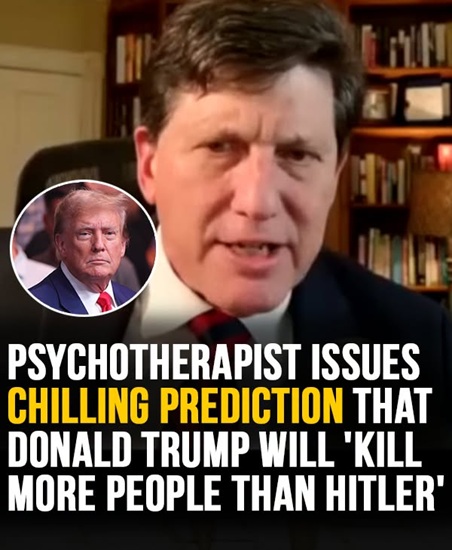
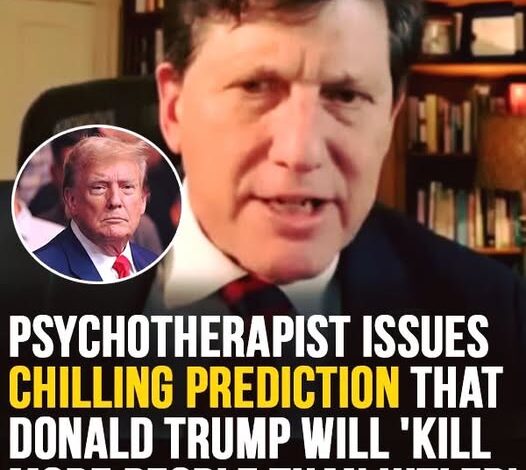
That is exactly why the comments made by psychotherapist John Gartner about Donald Trump continue generating intense controversy years after they first emerged publicly.
On the surface, the story appears straightforward:
a mental health professional publicly expressing concern about the behavior of a sitting president.
But underneath sits a much larger conflict involving trust,
authority,
professional ethics,
and the dangerous modern tendency to transform psychological language into political weaponry.
Gartner became widely known through his involvement with “Duty To Warn,” a group of mental health professionals and citizens arguing that experts have an ethical obligation to speak publicly if they believe a powerful leader may pose serious danger to society.
The phrase itself — “duty to warn” — carries enormous emotional weight because it originates from real psychiatric ethics involving threats of violence. Traditionally, mental health professionals may have legal or ethical obligations to warn potential victims if a patient poses credible danger.
Applying that framework to a president changes everything.
Suddenly psychiatry becomes entangled with global politics,
nuclear power,
military authority,
and public fear.
For Gartner, Trump’s rhetoric, public behavior, and communication style represented more than political provocation. He argued that certain patterns — grandiosity, impulsivity, self-aggrandizement, emotional volatility, and increasingly extreme messaging — could indicate deeper psychological or cognitive concerns.
Critics of Trump found those warnings emotionally compelling because they aligned with fears many already held:
that Trump’s confrontational style reflected instability rather than calculated political branding.
Supporters, however, saw something entirely different.
To them, Gartner’s comments represented political hostility disguised as medical authority.
That distinction matters enormously.
Because modern politics increasingly encourages people to medicalize opponents instead of simply disagreeing with them. Words like “narcissist,” “crazy,” “unstable,” or “dementia” now circulate constantly in public discourse, often detached from careful clinical meaning.
Psychological terminology becomes rhetorical ammunition.
And once that happens, the line between legitimate concern and partisan interpretation grows dangerously blurred.
Trump complicates this conversation even further because his communication style has always been unusually theatrical and provocative — long before politics entered the picture.
As a businessman and television personality, he built an entire public persona around exaggeration,
self-promotion,
conflict,
and dominance.
He praised himself constantly.
Insulted rivals publicly.
Spoke in grandiose terms.
Projected certainty aggressively.
For supporters, this style signals confidence and strength.
For critics, it signals narcissism and recklessness.
Both groups often interpret the exact same behavior through entirely different emotional frameworks.
That polarization explains why Gartner’s comments generated such explosive reactions.
When he suggested Trump’s conduct could reflect dementia-related decline or severe narcissism affecting judgment, many listeners interpreted the warning not merely as psychological speculation, but as an alarm connected to presidential power itself.
And presidential power changes the emotional stakes dramatically.
A world leader controls military systems, diplomatic relationships, intelligence agencies, and decisions capable of affecting millions of lives. Concerns about temperament or impulse control therefore feel existential in ways ordinary political disagreements do not.
Gartner emphasized exactly that point repeatedly.
He argued that immense military authority requires emotional restraint, stable judgment, and reliable decision-making. In his view, any signs of psychological deterioration become public-interest concerns rather than merely private medical matters.
That argument resonates with many people instinctively.
After all, societies already evaluate leaders constantly for judgment, emotional control, and cognitive sharpness. Voters ask:
Is this person too impulsive?
Too angry?
Too old?
Too unstable?
Too reckless?
The difficulty emerges when those concerns become framed explicitly as psychiatric or neurological diagnosis without direct clinical examination.
That is where the “Goldwater Rule” enters the debate.
The American Psychiatric Association discourages psychiatrists from diagnosing public figures they have not personally evaluated and from speaking publicly about those diagnoses.
The rule emerged after psychiatrists publicly speculated about presidential candidate Barry Goldwater’s mental health during the 1964 election, creating major ethical controversy. Supporters of the rule argue that psychiatry loses credibility when clinicians begin making remote diagnoses through media appearances and political commentary.
Without direct evaluation,
medical history,
consent,
and formal examination,
speculation risks becoming indistinguishable from political advocacy.
And that concern becomes especially serious in hyper-polarized societies where every institution already struggles with accusations of bias.
Gartner and others associated with Duty To Warn push back against that limitation, arguing that extraordinary circumstances involving national security justify public concern when behavioral patterns appear alarming enough.
This creates an unresolved ethical tension with no universally accepted answer:
When does professional silence become irresponsible?
And when does public speculation become unethical overreach?
Modern media environments intensify that conflict constantly.
Every verbal stumble,
every unusual speech,
every impulsive social-media post,
every moment of confusion or exaggeration from public figures now spreads globally within minutes.
Audiences dissect clips endlessly looking for evidence supporting preexisting beliefs:
proof of genius,
proof of decline,
proof of corruption,
proof of instability.
Political identity increasingly shapes perception more than objective observation itself.
The most controversial part of Gartner’s comments came when he warned Trump could theoretically “kill more people than Hitler.”
That statement triggered immediate backlash for obvious reasons.
Hitler comparisons carry enormous historical and emotional weight because Nazi atrocities remain among the darkest crimes in human history. Invoking such comparisons in modern political discourse often inflames outrage instantly while reducing space for careful analysis.
Many critics argued Gartner crossed from professional concern into inflammatory political rhetoric at that point.
And perhaps that reaction reveals another important truth:
fear-based language can undermine legitimate concerns by making them sound apocalyptic rather than evidence-driven.
Still, beneath all the controversy lies a broader societal anxiety extending far beyond Donald Trump personally.
Modern democracies increasingly struggle with how to evaluate leadership fitness in an age dominated by spectacle, social media, and nonstop public performance.
Presidents are no longer simply policymakers.
They are constant communicators.
Media figures.
Brand identities.
Emotional symbols.
Every gesture becomes analyzed psychologically:
tone,
body language,
memory lapses,
anger,
humor,
ego,
confusion,
confidence.
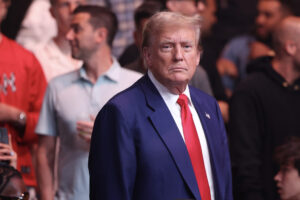
NEWARK, NEW JERSEY – JUNE 01: Former U.S. President Donald Trump attends UFC 302 at Prudential Center on June 01, 2024 in Newark, New Jersey. (Photo by Luke Hales/Getty Images)
And because modern media rewards outrage and virality, extreme interpretations spread faster than nuanced ones.
One side sees strength.
Another sees instability.
One sees authenticity.
Another sees narcissism.
The exact same footage produces completely different emotional realities depending on who watches it.
Trump himself has repeatedly rejected all allegations questioning his cognitive health. He often points to medical evaluations and cognitive tests he claims to have passed successfully, while allies accuse opponents of weaponizing mental-health language for political gain.
Official White House medical reports have also stated he remains fit to serve.
That distinction is critical.
At present, there is no verified public medical evidence proving Trump suffers from dementia or any mental illness preventing him from carrying out presidential duties. Gartner’s statements remain personal interpretations, not medically confirmed conclusions.
And perhaps that is ultimately the most important line in this entire debate.
Because democratic societies become unstable quickly when political disagreement transforms routinely into amateur diagnosis. Once opponents are treated not merely as wrong but mentally defective, compromise becomes almost impossible.
At the same time, citizens absolutely do have legitimate interests in evaluating the temperament, judgment, and emotional stability of powerful leaders.
Both truths exist simultaneously.
Which is why this conversation remains so emotionally charged and unresolved.
The debate surrounding Trump and Gartner is no longer only about one psychologist or one president.
It reflects something larger happening across modern political culture:
a growing collapse between medicine,
media,
partisanship,
fear,
and public trust itself.
And in an era where every controversial opinion can become global news within hours, even speculative psychological commentary now carries enormous political force.
Whether people view Gartner as courageous,
irresponsible,
politically motivated,
or genuinely concerned often depends less on psychiatry than on the deeper question dividing modern America itself:
Who still deserves to be trusted when power, fear, and politics become impossible to separate?