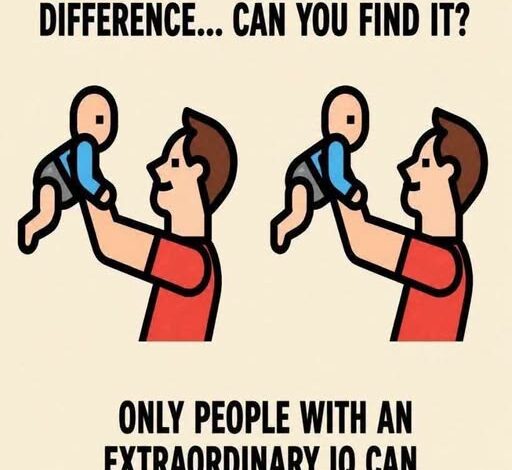
At first glance, there is absolutely nothing wrong with the picture.
That’s what makes it so frustrating.
You look once.
Nothing.
You look again, this time more carefully.
Still nothing.
Then someone tells you the mistake is obvious, and suddenly the puzzle becomes personal.
Now you’re not casually looking anymore.
You’re determined to find it.
Your eyes sweep from one side of the image to the other. You inspect the largest objects first, searching for something misplaced, missing, reversed, or impossible.
Nothing stands out.
So you start over.
Top to bottom.
Left to right.
Maybe there’s a strange shadow.
Maybe one object has the wrong number of parts.
Maybe a letter is backward.
Maybe something doesn’t belong.
Still nothing.
And after a while, an uncomfortable thought appears:
How can I possibly be missing this?
That’s the real power of puzzles like this.
The hidden detail may be tiny, but the challenge isn’t really about the detail.
It’s about attention.
Our brains are incredibly good at understanding scenes quickly.
Within fractions of a second, we identify familiar objects, recognize patterns, and decide what deserves our attention.
That ability is essential.
Imagine having to consciously analyze every chair, window, face, sign, tree, and vehicle you encountered throughout the day.
You’d barely make it out of the house.
Instead, the brain takes shortcuts.
It looks at the overall picture and says:
“I know what this is.”
Usually, that’s helpful.
In a visual puzzle, it’s exactly what gets you into trouble.
Once your brain decides the image is normal, it begins filtering information according to that assumption.
You aren’t necessarily seeing every detail anymore.
You’re seeing what you expect to see.
That’s why you can stare directly at the mistake without recognizing it.
Your eyes may pass over it repeatedly.
But noticing something and looking at something aren’t always the same.
The difference becomes obvious when another person solves the puzzle immediately.
“There.”
“Where?”
“Right there.”
They point.
And suddenly you see it.
Instantly.
The detail that had been practically invisible becomes impossible to ignore.
You stare at it and wonder how you missed something so obvious.
Nothing in the picture changed.
The clue didn’t become larger.
Nobody added a bright circle around it.
Your perception changed.
That’s what makes the experience so satisfying—and slightly unsettling.
We like to believe that our eyes show us reality exactly as it exists.
But perception is more complicated.
The brain constantly interprets, predicts, organizes, and filters what reaches our attention.
It doesn’t merely ask:
“What is there?”
It also asks:
“What should be there?”
That distinction creates the perfect environment for visual tricks.
If nine familiar details appear exactly where expected and the tenth is slightly wrong, your brain may mentally correct the tenth before you consciously notice anything unusual.
Expectation fills the gap.
This is why proofreading your own writing can be surprisingly difficult.
You know what you intended to write.
So sometimes your brain reads the sentence you meant to type instead of the sentence actually sitting on the screen.
Someone else spots the typo immediately.
You read the paragraph five times and miss it.
Then they point it out.
Suddenly, it’s enormous.
Visual puzzles exploit that same weakness.
They give you something familiar enough to encourage confidence.
Then they change one tiny element.
The challenge isn’t simply finding the change.
It’s overcoming your own expectation.
And the harder you try, the stranger the experience can become.
After thirty seconds, you’re curious.
After a minute, you’re irritated.
After two minutes, you’re questioning whether the puzzle is legitimate.
“There isn’t a mistake.”
Then someone who has been looking for five seconds says:
“I found it.”
Now pride enters the equation.
You lean closer.
You zoom in.
You inspect every corner.
At that point, you’re no longer competing against the puzzle.
You’re competing against your own brain.
Ironically, frustration can make the answer harder to find.
Attention narrows.
You keep returning to the same suspicious areas.
You examine them more intensely while ignoring sections you’ve unconsciously decided don’t matter.
That’s why walking away sometimes works.
You stop staring.
You think about something else.
Then you return later and suddenly notice the answer almost immediately.
The image didn’t change while you were gone.
Your mental approach did.
You broke the loop.
Instead of searching the same way, you looked with fresh attention.
That’s an important lesson outside puzzles too.
When we’re convinced we’ve examined a problem completely, we often stop questioning the way we’re examining it.
We ask:
“Where is the answer?”
Sometimes the better question is:
“What have I already decided isn’t important?”
That overlooked corner may contain everything.
Detectives understand this.
Editors understand it.
Engineers understand it.
Doctors understand it.
Professionals who regularly analyze complicated information often develop systems specifically designed to prevent assumptions from controlling what they notice.
They use checklists.
They revisit evidence.
They ask other people to review their work.
They deliberately consider explanations they initially rejected.
Why?
Because intelligence doesn’t eliminate blind spots.
Sometimes expertise actually creates new ones.
The more familiar something becomes, the easier it is to believe you already understand it.
That’s exactly what the puzzle is exploiting.
It isn’t hiding the answer behind anything.
The mistake is usually exposed.
Visible.
Sitting right there.
Yet somehow it remains invisible until attention lands on it in exactly the right way.
And then comes the moment every puzzle lover recognizes.
“Oh.”
That’s usually all you say.
Not because the answer is complicated.
Because it’s embarrassingly simple.
You may even laugh.
How did I not see that?
But that reaction is the entire point.
If the answer were genuinely impossible to detect, finding it wouldn’t be satisfying.
The pleasure comes from discovering that the obstacle wasn’t the picture.
It was your interpretation of the picture.
Once that interpretation changes, everything becomes obvious.
Some people spot these differences faster than others.
That doesn’t necessarily mean they’re more intelligent.
They may simply approach the image differently.
One person studies the center first.
Another checks the corners.
Someone examines colors.
Someone else counts objects.
Different attention strategies reveal different information.
That’s why showing the same puzzle to several people can produce wildly different results.
One person solves it in three seconds.
Another needs three minutes.
A third gives up completely.
Then, after being shown the answer, everyone sees exactly the same thing.
There’s something strangely humbling about that.
Reality can be directly in front of us while our assumptions keep us from recognizing it.
Not because we’re foolish.
Because that’s how efficient perception works.
Most of the time, our mental shortcuts save enormous amounts of effort.
Occasionally, they betray us.
The good news is that attention can be trained.
When a puzzle seems impossible, stop scanning randomly.
Divide the image into sections.
Check each corner separately.
Examine objects individually instead of absorbing the entire scene at once.
Look for differences in shape, direction, number, color, position, or repetition.
And most importantly, question whatever seems too ordinary to inspect.
That’s often where the trick is waiting.
The same habit can be useful in everyday life.
Slow down before assuming.
Read something twice before reacting.
Check the number before pressing send.
Look again when something doesn’t feel right.
Ask whether you’re responding to what is actually there or what you expected to find.
We live in an environment designed for speed.
Images flash past.
Headlines demand instant reactions.
Messages arrive constantly.
Our attention is divided between screens, conversations, notifications, and responsibilities.
Under those conditions, first impressions become incredibly powerful.
And first impressions are frequently incomplete.
A tiny visual puzzle can’t solve that problem.
But it can remind us that attention matters.
Sometimes seeing clearly requires more than opening your eyes.
It requires patience.
It requires curiosity.
And occasionally, it requires enough humility to admit:
Maybe I missed something.
So look at the picture again.
Not faster.
Not harder.
Differently.
Ignore the place your eyes keep returning to.
Check the corner you’ve been skipping.
Question the detail that looks completely normal.
Because the answer probably isn’t buried somewhere impossible.
It isn’t hidden in darkness.
It isn’t protected by some elaborate trick.
It’s sitting in plain sight.
Waiting for the exact moment when you stop seeing what you expect to see—and finally notice what’s actually there.