The entire stadium changed because of one cruel sentence.
Seventy thousand people had come expecting football.
They expected chants rolling through the stands, arguments over referees, overpriced drinks, nervous laughter, and the electric roar that follows a goal.
Nobody expected an old man with a cane to become the center of attention.
And nobody expected a frightened boy carrying a faded blue armband to remind an entire stadium what courage actually looked like.
My grandfather had waited months for that match.
Football had been part of his life for longer than I could remember. Long before television broadcasts filled every weekend, he had stood on terraces in the rain, traveled hours to away matches, and saved ticket stubs from games everyone else had forgotten.
Age eventually changed the way he attended.
His knees hurt.
His hearing wasn’t what it used to be.
Walking from the parking area to our seats required several breaks.
The cane embarrassed him at first.
“I don’t need the bloody thing,” he’d complain.
Then he’d grab it before leaving the house.
That afternoon, however, he seemed twenty years younger.
He wore his old scarf despite the warm weather and carried a faded blue armband in his coat pocket.
I’d seen it many times before.
The fabric was worn almost transparent in places, and the stitching had begun to unravel.
It wasn’t valuable.
At least not financially.
But it had belonged to someone important to Grandpa, and he treated it with the care other people reserved for jewelry.
My son knew the story behind it better than anyone.
He had asked Grandpa about that armband dozens of times.
And Grandpa never grew tired of explaining.
That mattered later.
Our seats were surrounded by supporters already singing when we arrived.
Grandpa lowered himself carefully into his chair.
My son sat beside him.
Everything felt ordinary.
Until the man behind us became irritated.
At first, it was nothing.
A complaint about Grandpa taking too long to sit down.
Then another remark when he stood carefully to let someone pass.
I ignored it.
Grandpa ignored it too.
People become impatient at sporting events.
Alcohol, adrenaline, crowds—sometimes ordinary manners disappear.
Then Grandpa stood again.
Our team was attacking.
Everyone around us jumped to their feet.
Grandpa tried.
He pushed himself upward using his cane, but his legs weren’t fast enough.
The man behind us couldn’t see.
“Sit down, old man!”
Grandpa immediately tried lowering himself.
Then came the sentence.
The one that changed everything.
“If you’re too old to stand properly, you’re too old to be here.”
Grandpa froze.
It wasn’t shouted particularly loudly.
That somehow made it worse.
The words were delivered casually, almost dismissively, as though the man believed Grandpa’s decades of devotion had an expiration date.
I turned around.
“What did you say?”
The man shrugged.
“You heard me.”
I felt anger surge through me.
Before I could respond, I felt a small hand grab my sleeve.
My son.
He looked frightened.
“Don’t,” he whispered.
I thought he was asking me not to argue.
Then he reached toward Grandpa’s coat.
“Grandpa?”
Grandpa looked down.
“Can I have the armband?”
Confused, Grandpa pulled the faded blue fabric from his pocket and handed it to him.
My son stood.
His hands were shaking.
He turned toward the man behind us.
For a moment, nobody spoke.
Then my son held up the armband.
“My grandpa was coming here before you were probably born.”
The man stared at him.
My son’s voice trembled.
“This belonged to his brother.”
Grandpa’s face changed.
My son continued.
“He gave it to Grandpa before he left.”
I watched the color drain from the man’s expression.
“He never came home.”
The noise around us seemed to disappear.
Grandpa’s older brother had given him that armband decades earlier.
It was the last thing Grandpa had received from him before his brother left and never returned.
Grandpa had carried it to important matches ever since.
Not because he believed fabric brought luck.
Because carrying it made him feel as though his brother was still attending beside him.
My son knew every detail.
The stranger knew none of them.
That was the point.
“You don’t know him,” my son said.
The man’s expression hardened defensively.
“I was talking about—”
“You don’t know him,” my son repeated.
His voice cracked this time.
But he didn’t sit down.
People nearby had begun watching.
A woman across the aisle turned completely around.
Someone farther down asked what had happened.
The story moved through the rows in fragments.
An old supporter.
A cruel remark.
A grandson.
An armband.
The man behind us suddenly seemed aware of how many eyes were on him.
He muttered something.
I expected Grandpa to become angry.
Instead, he placed one hand on my son’s shoulder.
“It’s all right,” he said.
My son looked at him.
“No, it isn’t.”
Those three words broke something open.
A man several seats away began clapping.
At first, I thought he was reacting to the match.
Then another person joined him.
Then another.
People started standing.
Not everyone understood exactly what had happened.
They didn’t need to.
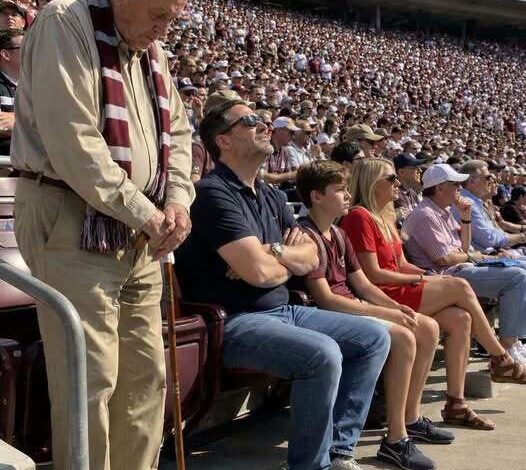
They could see an elderly man leaning on his cane.
They could see a boy holding an old blue armband.
And they could see the embarrassed stranger behind them.
Within seconds, our entire section was applauding.
Grandpa looked around in disbelief.
“What’s happening?” he whispered.
“They’re standing for you,” I said.
His eyes filled immediately.
The applause spread farther than I expected.
People several rows away stood because others were standing.
Some probably never learned the complete story.
It didn’t matter.
For perhaps thirty seconds, the football match became secondary.
Grandpa stood among thousands of strangers, gripping his cane with one hand while his other rested on my son’s shoulder.
The man behind us remained seated.
Then something unexpected happened.
He stood too.
He leaned forward.
“I’m sorry.”
Grandpa looked at him.
The man swallowed.
“I shouldn’t have said that.”
My son stared at him suspiciously.
Grandpa didn’t.
He simply nodded.
“All right.”
That was it.
No revenge.
No screaming.
No demand that security remove him.
Grandpa accepted the apology and turned back toward the field.
The game continued.
But something in our section had changed.
People began helping Grandpa whenever he stood.
Someone brought him water.
A young supporter offered to swap seats so Grandpa could see more easily.
At halftime, strangers stopped to shake his hand.
Grandpa hated the attention.
Or pretended to.
“All this fuss,” he muttered.
But he was smiling.
My son returned the armband.
Grandpa looked at it for several seconds.
Then he shook his head.
“You keep it.”
My son stared at him.
“What?”
“You understand what it means now.”
“I can’t take it.”
“You already carried it when it mattered.”
My son carefully wrapped the faded fabric around his wrist.
Grandpa turned toward the pitch.
I saw him wipe his eyes.
Years later, I would forget almost everything about that match.
I don’t remember the final score.
I couldn’t tell you who scored.
I don’t remember whether there was a controversial penalty or a brilliant save.
But I remember the silence after that insult.
And I remember my son’s hands shaking.
That’s the part people misunderstand about courage.
We imagine courageous people feeling no fear.
But my son was terrified.
He didn’t know whether the man would laugh at him.
He didn’t know whether anyone would support him.
He didn’t have some brilliant speech prepared.
He simply knew that someone he loved had been humiliated.
And remaining silent felt worse than being afraid.
So he stood.
Grandpa talked about that moment for years afterward.
Strangely, he almost never mentioned the insult.
The man who said it gradually disappeared from the story.
Instead, Grandpa talked about my son.
“His hands were shaking,” he’d say.
Then he’d smile.
“But he stood there anyway.”
For weeks after the match, Grandpa kept the program on his bedside table.
The ticket stub remained tucked inside.
Sometimes I’d catch him looking at it.
“You saw them, didn’t you?” he’d ask.
“Saw who?”
“All those people standing.”
“I saw.”
He’d nod quietly.
Then he’d put the program back.
I eventually understood why that mattered so much.
Grandpa wasn’t remembering applause.
He was remembering recognition.
Age had gradually made him feel invisible.
People walked faster than him.
Talked over him.
Became impatient while he counted change.
Sighed when his cane slowed a queue.
The world increasingly treated his slower body as an inconvenience.
Then, for one afternoon, thousands of strangers looked directly at him.
Not because he was famous.
Not because he’d accomplished something spectacular.
They simply recognized that he deserved dignity.
Sometimes that’s enough.
Grandpa died several years later.
While sorting through his belongings, I found the match program exactly where he’d always kept it.
Inside was the ticket.
And behind the ticket was a small note written in his shaky handwriting.
It said:
“The day they stood.”
Nothing else.
My son has the blue armband now.
It’s even more faded.
The stitching is worse.
One day it may become too fragile to wear.
But its meaning has changed again.
It once represented Grandpa’s brother.
Then it represented Grandpa.
Now it represents the afternoon a frightened boy learned that courage doesn’t require strength, age, authority, or confidence.
Sometimes courage is simply refusing to let someone stand alone.
The man who insulted Grandpa probably forgot that afternoon eventually.
Perhaps most of the people in the stadium did too.
That’s fine.
The moment didn’t need to become famous to matter.
Its value was contained in what happened between a grandfather and his grandson.
One man tried to reduce an old person’s lifetime of devotion to his failing legs.
A child answered by reminding everyone that a person’s worth cannot be measured by how quickly they stand.
And seventy thousand people had come to watch athletes demonstrate courage on a field.
Instead, some of them witnessed it several rows away.
A trembling boy.
A faded blue armband.
An old man gripping a cane.
No trophies.
No cameras.
No victory celebration.
Just one small person making one enormous choice.
Grandpa was right to remember the people who stood.
Because long after the score disappeared from memory, that was what remained.
Proof that cruelty can silence a crowd for a moment.
But sometimes all it takes to break that silence is one person deciding:
Not this time.
Not to him.
Not while I’m standing here.