When the baby arrived, the delivery room seemed to shrink around him.
He had been born at only 24 weeks.
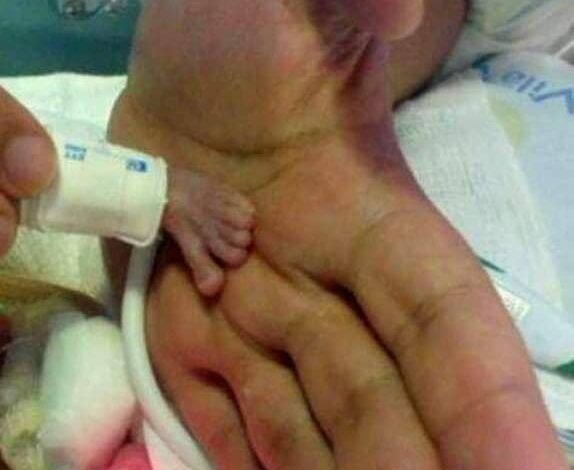
He weighed approximately 720 grams—barely more than a pound and a half.
His skin was delicate and translucent. His chest rose with tiny, uncertain movements. His entire arm looked almost impossibly small beside the fingers of the medical professionals working around him.
There was no time for anyone to stand still and absorb what had happened.
Every second mattered.
At this stage of pregnancy, a baby’s body is still undergoing extraordinary development. The lungs are immature. The brain remains vulnerable. The digestive system is not prepared for ordinary feeding. Maintaining body temperature can be difficult, and even functions adults never consciously think about can become enormous challenges.
Breathing was the immediate concern.
The neonatal team moved quickly.
They warmed him, assessed his heart rate and breathing, and provided the respiratory support his tiny lungs required.
The room filled with the controlled urgency that accompanies an extremely premature birth.
There was no panic.
There couldn’t be.
Every movement had a purpose.
Every number mattered.
Every breath mattered.
His mother could only watch.
She had arrived at the hospital under circumstances nobody had expected, with little opportunity for the medical preparation that ideally occurs before an extremely premature delivery.
Now her child was surrounded by equipment and strangers, and the future had suddenly been reduced to minutes rather than years.
Would he keep breathing?
Would his heart remain stable?
Could his tiny body tolerate everything being asked of it?
There were no promises anyone could responsibly make.
Extremely premature babies face serious risks, and survival is only the first concern. Doctors also watch closely for complications involving the lungs, brain, eyes, intestines, heart, infections, and long-term development.
But before anyone could think months or years ahead, they had to get him through the next few moments.
Once he was stable enough, another challenge began.
He needed specialized neonatal intensive care.
That meant transportation.
For most people, an ambulance ride is measured in miles.
For this baby, it was measured in heartbeats.
The transport team prepared what was essentially a miniature intensive-care environment.
His temperature had to remain controlled.
His breathing support had to remain secure.
His oxygen levels and heart rate required constant observation.
Equipment had to continue functioning despite the movement and vibration of the vehicle.
Then the doors closed.
The ambulance began moving.
Inside, the atmosphere was almost surreal.
Machines hummed.
Monitors flashed numbers.
Tiny alarms demanded immediate attention whenever something drifted outside the desired range.
The medical team watched constantly.
A premature infant weighing 720 grams offers almost no margin for error.
Something that might barely affect a healthy newborn can become significant in a child this small.
A change in temperature.
A shift in oxygen.
A problem with breathing support.
A sudden drop in heart rate.
The clinicians weren’t simply accompanying him to another hospital.
They were carrying an intensive-care unit down the road.
And inside that carefully controlled environment was a child who should still have been protected inside his mother’s womb for months.
That contrast is difficult to comprehend.
At 24 weeks, pregnancy should still have had a long way to go.
There should have been more appointments.
More growth.
More kicks.
More conversations about names, clothes, and preparing the house.
Instead, his mother was facing one of the most frightening experiences imaginable.
The baby she had expected to carry for months longer was already fighting for his life.
Fear can quickly become guilt in situations like this.
Parents often search desperately for an explanation.
Was there something I did?
Something I missed?
Could I have prevented this?
Those questions can become especially painful when prenatal care has been limited or delayed.
Regular prenatal care can help healthcare professionals identify certain risks, monitor fetal development, manage maternal health conditions, and sometimes intervene when complications emerge.
But premature birth is complicated.
There isn’t always one simple cause.
And once an emergency is happening, blame does nothing to stabilize the child lying inside the incubator.
The immediate priority becomes care.
For the baby.
And for the mother.
When he reached the neonatal intensive care unit, his journey was only beginning.
NICUs are places of extraordinary contradiction.
They can be terrifying and hopeful at exactly the same time.
Inside incubators are babies so small that ordinary newborn clothing can overwhelm them.
Parents learn an entirely new vocabulary.
Oxygen saturation.
Ventilation.
Feeding tubes.
Blood gases.
Apnea.
Infection.
Weight gain.
Every number becomes emotionally charged.
A few grams can feel like a victory.
A difficult night can feel devastating.
A stable morning can feel like winning the lottery.
For parents, time changes inside the NICU.
Life becomes organized around rounds, updates, test results, alarms, feeding schedules, and opportunities to touch or hold a baby who may initially seem too fragile to handle.
The simplest parental instincts suddenly require permission.
Can I touch him?
Can I hold him?
Can I feed him?
When can I take him home?
And perhaps the hardest question:
Is he going to be okay?
Doctors may not be able to answer that last question immediately.
Medicine can provide probabilities.
It can describe risks.
It can explain what the scans and laboratory results show.
But an individual child’s future cannot always be predicted from the first hours of life.
So everyone learns to live inside uncertainty.
One day at a time.
Sometimes one hour at a time.
The baby’s mother had imagined meeting her son differently.
She might have pictured holding him against her chest immediately after delivery.
Instead, there were tubes, wires, machines, and medical professionals between them.
Yet parenthood had already begun.
It began in waiting.
In watching.
In learning.
In celebrating tiny improvements nobody outside a NICU would normally understand.
Another gram gained.
Another stable night.
A little less respiratory support.
A successful feeding.
A chance to place a hand gently against his body.
Eventually, perhaps, the opportunity to hold him skin-to-skin.
For a baby this premature, progress rarely moves in a perfectly straight line.
There can be good days followed by frightening ones.
A complication may appear just when everyone has started feeling hopeful.
Treatment may need to change.
Tests may reveal new concerns.
That unpredictability is part of what makes neonatal intensive care so emotionally exhausting.
But there can also be astonishing resilience.
The tiny body that seemed impossibly fragile at birth begins doing things it couldn’t do before.
The lungs mature.
Feeding improves.
Weight increases.
Temperature regulation becomes easier.
Machines that once seemed inseparable from the baby gradually disappear.
One by one.
Not because of a miracle that happens overnight, but because of thousands of tiny biological victories supported by intensive medical care.
And behind every machine are people.
Neonatologists.
Nurses.
Respiratory therapists.
Paramedics.
Obstetric teams.
Other specialists.
People who have trained for the moments when a child arrives months before expected.
Their work is both intensely technical and deeply human.
They calculate medication doses for bodies weighing less than a bag of sugar.
They recognize changes that can be almost invisible to everyone else.
They stabilize babies small enough to fit across two adult hands.
And they often help frightened parents understand that caring for an extremely premature baby is a journey rather than a single emergency.
The mother’s experience also carries a broader message.
Prenatal care matters.
Regular appointments provide opportunities to identify potential problems before they become emergencies. They allow healthcare professionals to monitor both mother and baby and respond when warning signs appear.
Not every premature birth can be prevented.
Even excellent prenatal care cannot eliminate every complication.
But early and consistent medical care gives families and clinicians more opportunities to recognize and manage risks.
That message should never become a weapon for shaming mothers.
Pregnant women can miss care for many reasons.
Financial hardship.
Transportation problems.
Fear.
Lack of access.
Unstable housing.
Work obligations.
Domestic circumstances.
Simply not realizing how serious a symptom may be.
Judgment doesn’t solve those problems.
Access and support can.
For this mother, however, those larger questions could wait.
There was only one person occupying her thoughts.
Her son.
The 720-gram baby who had entered the world before anyone was ready.
Looking at him, imagining adulthood almost seemed impossible.
How could something so tiny someday become a child running through a house?
How could those miniature fingers someday hold a pencil?
How could that tiny chest someday produce laughter?
How could the fragile little person surrounded by machines someday look up and say, “Mama”?
Nobody could guarantee that future.
That is the painful truth.
Extremely premature birth can have serious consequences, and some families experience outcomes no parent should ever have to face.
Hope does not require pretending those risks don’t exist.
Real hope can exist beside fear.
It can acknowledge every uncertainty and still say:
Today, he is here.
Today, he is fighting.
Today, we keep going.
Perhaps that’s what makes the image of such a tiny premature baby so powerful.
Adults instinctively measure strength by size.
By muscle.
By independence.
By how much someone can endure without assistance.
The NICU turns that definition upside down.
Sometimes strength weighs 720 grams.
Sometimes courage is a mother standing beside an incubator when she desperately wishes she could trade places with the child inside.
Sometimes progress is measured in milliliters of milk and grams on a scale.
And sometimes the biggest dreams begin with the smallest imaginable goal:
One more breath.
Then another.
Then another.
Until breaths become hours.
Hours become days.
Days become weeks.
And somewhere inside all that uncertainty, a family begins allowing itself to imagine something beyond the hospital walls.
A crib at home.
First steps.
Birthdays.
School.
Laughter.
A little voice calling from another room.
And one word that, after everything they endured, might someday sound more extraordinary than anything else:
“Mama.”