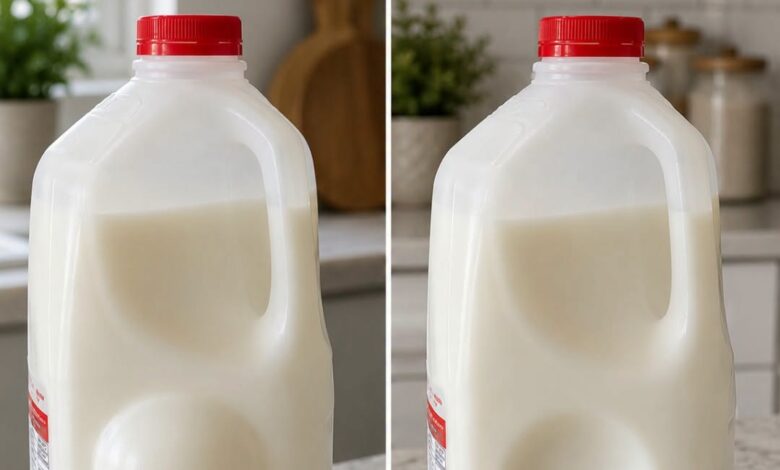
Have you ever noticed the strange circular dent on the side of a plastic milk jug?
Most people never give it a second thought.
Some assume it’s decorative. Others think it’s simply a leftover mark from the manufacturing process.
But that little circle has a job.
And once you understand why molded plastic containers are shaped the way they are, you’ll probably never look at a milk jug quite the same way again.
A gallon of milk has to survive a surprisingly rough journey before reaching your refrigerator.
It is filled at a processing facility, packed into crates, stacked, refrigerated, loaded onto trucks, unloaded at stores, placed into coolers, handled by employees, carried by customers, driven home, and repeatedly pulled in and out of a refrigerator.
Throughout that journey, the thin plastic container has to remain lightweight while still resisting bumps, squeezing, temperature changes, and the weight of the liquid inside.
That’s where clever packaging design becomes important.
The circular indentation molded into many milk jugs can add structural characteristics to an otherwise broad, relatively flat section of plastic.
Think about a perfectly flat sheet of thin material.
It’s fairly easy to flex.
Add curves, ribs, folds, or molded contours, however, and the same amount of material can behave very differently.
Automobile panels use this principle.
So do bottles, cans, storage containers, and countless other everyday products.
Those shapes aren’t necessarily decoration.
They’re engineering.
Milk jugs are usually made from high-density polyethylene, or HDPE, a plastic chosen partly because it can be lightweight, durable, and suitable for food packaging.
Manufacturers want to use enough material to keep the container functional without unnecessarily making every jug thicker and heavier.
Multiply even a tiny amount of extra plastic by millions of containers, and the difference becomes enormous.
That’s why the shape of a container matters almost as much as the amount of material used to make it.
Curves and indentations can influence how a jug responds when squeezed or bumped.
They can also give portions of the container room to flex rather than forcing stress into one uncontrolled area.
This has led to a popular explanation that the circle works as an emergency pressure-release feature that simply “pops out” whenever milk expands.
The reality is a little less dramatic.
Different jug manufacturers use different molds and structural designs, so you shouldn’t assume every circular panel is a universal pressure gauge engineered to behave in exactly the same way.
Temperature changes can affect both the contents and the container, but ordinary refrigerated milk isn’t expected to undergo dramatic expansion and contraction that requires a dedicated pressure valve.
Still, controlled flexibility is valuable.
Imagine dropping a completely rigid container filled with nearly a gallon of liquid.
When it strikes the floor, that energy has to go somewhere.
A lightweight plastic jug can deform slightly, allowing its walls and molded features to absorb and distribute some of the stress.
That’s preferable to having the plastic immediately crack or split.
And anyone who has ever dropped a gallon of milk knows why that matters.
One failed jug can turn a kitchen floor—or an entire grocery shipment—into a disaster.
There’s another reason the circular panel attracts attention.
Sometimes people notice that the indentation appears different when milk has spoiled.
That observation isn’t entirely imaginary.
Microorganisms can produce gases as food deteriorates. In a sealed container, gas accumulation may increase internal pressure and cause packaging to swell or distort.
A flexible portion of a jug may visibly change shape as that happens.
But here’s the important part:
Don’t treat the circle as a reliable freshness indicator.
A normal-looking indentation doesn’t guarantee that milk is safe, and a changed container shape doesn’t automatically tell you exactly what happened.
If a milk jug appears unusually swollen, leaking, damaged, or pressurized, it’s sensible to be cautious.
For everyday freshness, proper refrigeration, storage time, the product’s condition, and signs of spoilage are far more useful than relying on one molded feature.
The fascinating part is that the circle doesn’t need a secret superpower to be interesting.
Its real story is packaging engineering.
Look around your kitchen and you’ll start seeing similar ideas everywhere.
Plastic water bottles have ribs.
Laundry-detergent containers have molded contours.
Food tubs have reinforced edges.
Metal cans have carefully shaped tops and bottoms.
Even cardboard packaging is folded in ways that dramatically increase its strength.
Manufacturers are constantly balancing competing demands.
Make the package strong.
Make it light.
Keep the contents protected.
Use material efficiently.
Make it easy to manufacture.
Make it survive transportation.
And keep the final product affordable.
That humble milk jug is the result of all those compromises.
Its handle isn’t shaped randomly.
Its corners aren’t accidental.
Its plastic thickness matters.
Neither do its molded panels exist in isolation from the rest of the design.
Together, those features help turn a surprisingly small amount of plastic into a container capable of safely carrying several pounds of liquid.
So the next time you open your refrigerator, take another look at the jug.
That little circular indentation isn’t a mysterious button.
It isn’t something you need to press.
And it isn’t a foolproof spoilage detector.
It’s better understood as part of the carefully molded geometry that helps a lightweight plastic container maintain its shape, flex when necessary, and use material efficiently.
It’s easy to overlook because good engineering often works that way.
When it succeeds, nobody notices.
We simply grab the handle, pour the milk, and put the jug back.
Meanwhile, the strange little circle quietly remains where it has been all along—a reminder that even the most ordinary objects in our homes can contain more engineering than we realize.