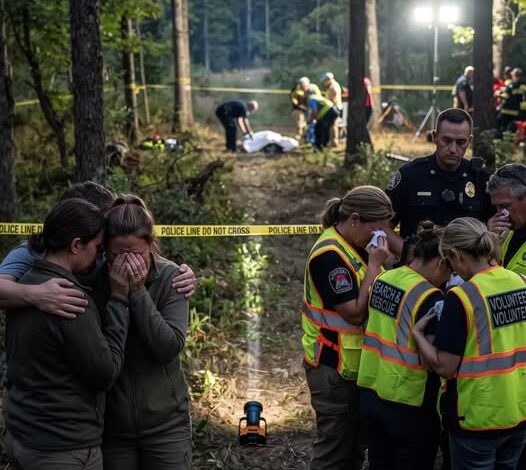
The search began with the kind of phone call every parent hopes they will never have to make.
On July 6, 2020, officers responded to an apartment complex in Baraboo, Wisconsin, after a 10-year-old girl named Kodie was reported missing.
Her mother was terrified.
Kodie was gone.
Her shoes were still there.
So was her phone.
And there was another detail that made the situation especially urgent: her mother reported that Kodie had threatened to harm herself and might have taken an unknown quantity of pills.
Suddenly, this wasn’t simply a missing-child investigation.
It was a race against time.
Police began searching around the 1100 block of 12th Street, looking anywhere a frightened child traveling on foot might have gone.
Firefighters joined the effort.
K-9 teams were brought in.
Searchers moved through the surrounding area, checking places where a child might hide, become disoriented, or seek shelter.
As the hours passed, the search widened.
Every minute mattered.
Kodie was only 10 years old, believed to be on foot, and potentially facing a medical emergency.
For her family, the waiting must have been unbearable.
Every sound outside could have meant someone was bringing news.
Every ringing phone could have been the call saying she had been found.
And every hour without an answer made the uncertainty heavier.
As daylight disappeared, authorities did not stop looking.
The search continued into the night.
Then the case reached people far beyond Baraboo.
An Amber Alert spread across Wisconsin, placing Kodie’s disappearance in front of thousands of strangers.
Phones lit up with her information.
People who had never met her suddenly knew her name.
Drivers watched the sides of roads more carefully.
Residents looked through neighborhoods and nearby areas.
For a brief time, an enormous network of people shared the same hope:
Someone would see her.
Someone would recognize her.
Someone would bring her home.
That is one of the strange realities of a missing-child alert.
A family crisis suddenly becomes everyone’s concern.
A photograph appears on screens belonging to people hundreds of miles away, and an ordinary day changes.
People begin looking at every child walking beside a road.
Every distant figure becomes a possibility.
Every update carries enormous weight.
Through the night, that hope remained.
Maybe Kodie had wandered farther than expected.
Maybe she was hiding somewhere.
Maybe someone had seen her but hadn’t yet realized who she was.
Maybe the next call would be the one everyone was waiting for.
But on July 7, the search came to the ending nobody wanted.
Authorities announced that Kodie had been found dead.
In an instant, the purpose of the search changed.
There was no longer somewhere else to look.
No neighborhood left to check.
No hopeful possibility waiting beyond the next street.
The child everyone had been trying desperately to bring home was gone.
For the people who searched, for the officers and firefighters who had spent hours looking, and most of all for Kodie’s family, there was no simple way to absorb that reality.
An Amber Alert can disappear from a phone screen in seconds.
Grief does not.
Behind every missing-child notification is a family experiencing hours that may divide their lives permanently into a before and an after.
Behind the police vehicles, search dogs, flashing lights, and public alerts is someone desperately waiting for a person they love to walk back through the door.
Kodie was not simply a name in an alert.
She was a 10-year-old child.
Someone’s daughter.
Someone whose shoes were still waiting where she had left them.
Someone whose phone remained behind while hundreds of people searched for her.
Those ordinary objects became heartbreaking reminders of how suddenly a normal day can become something unimaginable.
The community had spent those long hours hoping for a reunion.
Instead, it was left mourning.
And perhaps that is why cases involving children stay with communities for so long.
The search may officially end when authorities make an announcement, but the emotional consequences continue in homes, schools, neighborhoods, and among the people who participated.
There are also moments when stories like Kodie’s should remind us to pay closer attention to children whose suffering may not be obvious.
A child can be surrounded by adults and still be carrying emotions she does not know how to explain.
Fear, despair, isolation, and overwhelming distress do not belong only to adults.
Children can experience them too.
And because children may lack the language to describe what is happening inside them, their words and behavior deserve careful attention.
Sometimes a statement that sounds impulsive may be a genuine plea for help.
Sometimes a sudden change in behavior deserves another question.
Sometimes simply staying present long enough to listen can matter more than we realize.
None of that changes what happened in Baraboo.
It cannot rewrite July 6.
It cannot change the announcement that came the following day.
But remembering a tragedy should mean more than remembering its ending.
It should mean remembering the human being at its center.
For one long night, people across Wisconsin looked for a little girl they had never met.
They searched roads.
They checked neighborhoods.
They watched their phones.
They hoped.
And when that hope ended, an entire community was left confronting the silence that followed.
The Amber Alert eventually disappeared.
The search teams eventually went home.
The streets became quiet again.
But for the people who loved Kodie, nothing simply returned to normal.
Because some searches end when someone is found.
Others leave behind a question that lasts far longer:
How do we become better at noticing when a child is hurting before that child disappears?