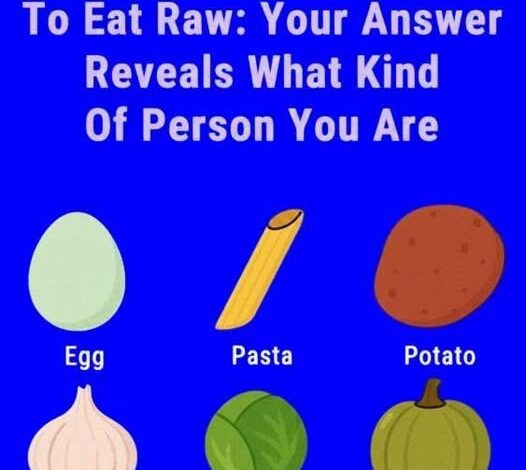
You’re trapped in a room with six foods, and there’s only one rule:
You have to choose one to eat raw.
At first, it sounds ridiculous.
Then you look at the choices again.
Suddenly, you’re negotiating with yourself.
The egg?
The potato?
Dry pasta?
Pumpkin?
Something sprouting?
The strange option in the corner that you’re not entirely sure you can identify?
You laugh.
Then you hesitate.
And that hesitation is what makes these silly internet questions so addictive.
Not because your choice secretly reveals your personality. There is no scientifically established personality test hiding inside a plate of uncooked food.
But the way you approach the problem can still be interesting.
Some people immediately search for the safest option.
They aren’t interested in proving anything.
They examine the choices, consider which one seems easiest to tolerate, and make the decision that appears least unpleasant.
If that’s you, you’re probably already thinking:
Why would I make a bad situation worse?
That’s practicality.
You don’t need every decision to become an adventure. When life hands you six terrible options, your instinct is to minimize the damage and move forward.
Other people immediately choose the most intimidating item.
Not necessarily because they want to suffer.
They simply hate backing down from a challenge.
Tell them something is difficult, and some invisible switch flips inside them.
“Fine. Watch me.”
They’ll crunch.
Chew.
Grimace.
And somehow turn a ridiculous food challenge into a test of personal honor.
Then there are the loophole hunters.
These are the people who refuse to accept the question as presented.
“Wait. How raw?”
“Can I peel it?”
“Does soaking count as cooking?”
“What exactly qualifies as eating it?”
“Are those sprouts?”
Within thirty seconds, they’ve transformed a simple hypothetical into a legal proceeding.
And perhaps that’s their real instinct.
When confronted with an unpleasant choice, they don’t immediately choose between A and B.
They search for C.
They’re not necessarily avoiding the challenge.
They’re redefining it.
Then you have the impulsive chooser.
They look once.
Point.
“That one.”
Done.
No spreadsheet.
No debate.
No twenty-minute investigation into whether raw pumpkin is technically pleasant.
They trust instinct and deal with consequences afterward.
Sometimes that produces brilliant decisions.
Sometimes it produces a mouthful of something they immediately regret.
But at least nobody can accuse them of wasting time.
And then there’s the person who can’t decide.
They inspect every possibility.
They imagine every texture.
Every taste.
Every possible consequence.
They choose the egg.
Change to the potato.
Return to the egg.
Ask whether they can choose neither.
Then reconsider the pasta.
If this sounds familiar, it doesn’t necessarily mean you’re indecisive.
You may simply dislike making choices without enough information.
Your brain wants certainty before commitment.
Unfortunately, hypothetical internet rooms filled with raw food rarely provide certainty.
That’s why the question becomes surprisingly revealing—not as a diagnosis, but as a conversation.
Because the food isn’t really the interesting part.
The interesting part is what your mind does when every available answer seems imperfect.
Do you minimize risk?
Accept discomfort?
Search for a loophole?
Choose quickly?
Overanalyze?
Laugh and refuse to play?
Those patterns appear in much more important situations too.
Imagine three terrible restaurant options.
A difficult work decision.
A vacation where every flight is inconvenient.
An argument where nobody gets everything they want.
Real life constantly gives us choices that aren’t between “good” and “bad.”
They’re between imperfect alternatives.
And people develop different strategies for handling them.
Some ask:
Which option hurts least?
Others ask:
Which one gets me the best story?
Some ask:
Which choice makes the most logical sense?
And the cleverest person in the room may ask:
Who said I have to accept these choices at all?
That’s why these absurd viral questions spread so easily.
They’re socially safe ways to reveal ourselves.
Ask someone directly, “How do you respond when faced with uncertainty and limited options?” and they’ll probably give you a polished answer.
Ask them which food they’d eat raw and suddenly they’re passionately defending a potato.
That’s much more fun.
Still, one important distinction matters.
Don’t confuse the game with science.
Choosing an egg doesn’t prove you’re brave.
Choosing pasta doesn’t establish that you’re practical.
Choosing sprouts doesn’t mean you’re a genius.
Human personality is far too complicated to be decoded by a single hypothetical decision.
But your reasoning?
That’s worth noticing.
Maybe you chose something because it looked familiar.
Maybe familiarity makes uncertainty easier for you.
Maybe you chose the strangest option because curiosity routinely beats caution.
Maybe you immediately started searching for technicalities because you dislike being trapped inside other people’s rules.
Or maybe you simply thought:
That one looks easiest to swallow.
Perfectly reasonable.
Sometimes a potato is just a potato.
So look at the choices one more time.
Don’t ask what your selection supposedly “reveals” about your destiny.
Ask something better:
Why did I choose it?
Was it safety?
Courage?
Convenience?
Curiosity?
Strategy?
Pure chaos?
Your answer probably won’t unlock some hidden psychological secret.
But it might make you laugh at how quickly your brain created an entire survival strategy for a situation that doesn’t exist.
And perhaps that’s the real reason these puzzles work.
For a few seconds, we’re allowed to imagine ourselves under pressure without facing any actual consequences.
We get to discover whether we’re the cautious one, the daredevil, the overthinker, or the person already looking around the imaginary room for an exit.
So choose.
But choose carefully.
Because the moment you announce your answer, someone in the comments is absolutely going to tell you that you picked the worst one.