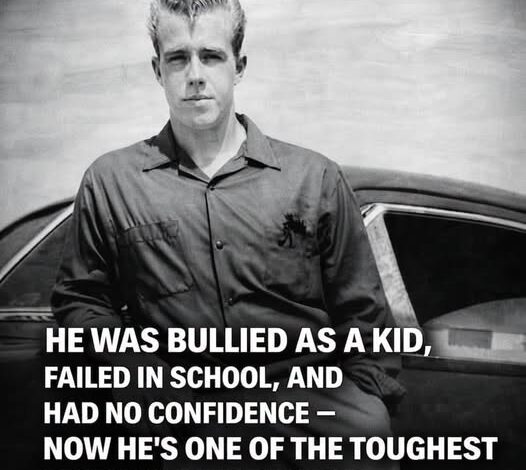
Before Chuck Norris became the man audiences believed could defeat anyone, he was a boy who struggled to believe in himself.
Long before the martial-arts championships, Hollywood movies, television fame, and impossible jokes about his strength, Norris remembered himself as painfully shy and deeply insecure.
There was no obvious sign that this quiet child would someday become an international symbol of toughness.
His early years were complicated by instability at home. As his family life fractured, Norris carried feelings he didn’t always know how to express. He wasn’t the fearless figure people would later recognize on movie posters.
He was uncertain.
Reserved.
And searching for somewhere he belonged.
When he joined the United States Air Force as a young man, he wasn’t stepping confidently toward a carefully designed future. Military service offered structure and, in some ways, an escape from the uncertainty that had followed him through childhood.
Then he was stationed in South Korea.
That assignment changed everything.
There, Norris encountered martial arts.
What began as physical training soon became something much more important.
Tang Soo Do demanded discipline.
There were movements to repeat until they became instinctive, mistakes that couldn’t be talked away, and progress that could only be earned through patience.
For someone who had spent years feeling uncertain about himself, that structure was transformative.
Martial arts gave Norris something his younger self had desperately lacked:
A measurable way to become better.
You couldn’t simply wish yourself into becoming stronger.
You practiced.
You failed.
You practiced again.
Slowly, confidence followed competence.
When Norris returned to the United States, he didn’t leave martial arts behind. He continued training and eventually began teaching, turning what had helped rebuild him into something he could share with others.
But his path toward becoming a champion was hardly effortless.
He lost.
Those losses mattered.
It’s easy to look at someone after decades of success and imagine that greatness revealed itself immediately. Norris’s story was messier.
Competition exposed weaknesses.
Defeat challenged his confidence.
Other fighters showed him exactly where he needed to improve.
He could have treated those experiences as proof that he wasn’t good enough.
Instead, he returned to training.
Again.
And again.
That willingness to come back after losing became one of the defining patterns of his life.
Eventually, the shy boy who once doubted himself became an accomplished martial-arts competitor and instructor.
Success opened unexpected doors.
Among the people Norris encountered through martial arts was Bruce Lee.
Their connection eventually produced one of the most memorable moments of Norris’s film career: their famous confrontation in The Way of the Dragon.
The scene became iconic because it didn’t feel like an ordinary Hollywood fight.
Two highly trained martial artists faced each other in a carefully constructed battle that showcased their physical abilities and contrasting styles.
For Norris, it also represented an extraordinary distance traveled.
The insecure child who once struggled with confidence was now standing opposite Bruce Lee on a movie set, performing for audiences around the world.
Hollywood noticed.
More roles followed, and Norris gradually developed the screen identity that would define him for decades: controlled, disciplined, physically formidable, and almost impossible to intimidate.
Movies transformed him into an action star.
Television made him part of American popular culture.
When Walker, Texas Ranger arrived, Norris found perhaps his most enduring character.
Week after week, audiences watched Cordell Walker confront criminals with the same qualities Norris had spent much of his real life developing—discipline, persistence, physical confidence, and an unwillingness to retreat when circumstances became difficult.
The series ran for years and introduced Norris to viewers who might never have known anything about his martial-arts competition days.
Eventually, something even stranger happened.
Chuck Norris stopped being merely an actor.
He became a myth.
Internet jokes began portraying him as a human being capable of accomplishing the impossible.
According to the exaggerated legend, normal laws of nature simply didn’t apply to Chuck Norris.
The jokes were intentionally absurd.
Yet their popularity depended on an image Norris had spent decades building.
Audiences believed the joke because they already recognized the character: the silent, unstoppable man who never seemed frightened.
There is something wonderfully ironic about that transformation.
The world turned Chuck Norris into a symbol of absolute confidence.
But confidence wasn’t where his story began.
It was something he built.
That distinction matters.
The most interesting part of Norris’s journey isn’t that he eventually became famous for appearing unbeatable.
It’s that he once knew exactly what it felt like to feel anything but unbeatable.
Martial arts didn’t magically erase every insecurity.
What they offered was a method.
Show up.
Practice.
Accept correction.
Lose without quitting.
Return tomorrow.
Repeat.
Those lessons traveled with Norris far beyond the training floor.
They followed him into tournaments where defeat could be public.
They followed him onto movie sets where he had to learn an entirely different profession.
They followed him into television, where maintaining a successful series required years of consistency rather than one spectacular moment.
His career ultimately became a demonstration of something far less glamorous than the mythology surrounding him.
Persistence.
The kicks were impressive.
The championships mattered.
The movies created fame.
The television series created longevity.
But underneath all of it was the habit of returning after disappointment.
That may be the most meaningful difference between the frightened boy Norris once described and the man millions eventually recognized.
He didn’t wake up fearless one morning.
He practiced becoming stronger.
One movement at a time.
One failure at a time.
One return at a time.
Decades later, popular culture would jokingly insist that Chuck Norris could never be defeated.
His real story suggests something more interesting.
He could be defeated.
He simply learned that defeat didn’t have to be the end.
And perhaps that is the part of his legacy worth remembering most.
Strength isn’t always something you’re born carrying.
Sometimes it begins when a frightened person decides to come back tomorrow and try again.