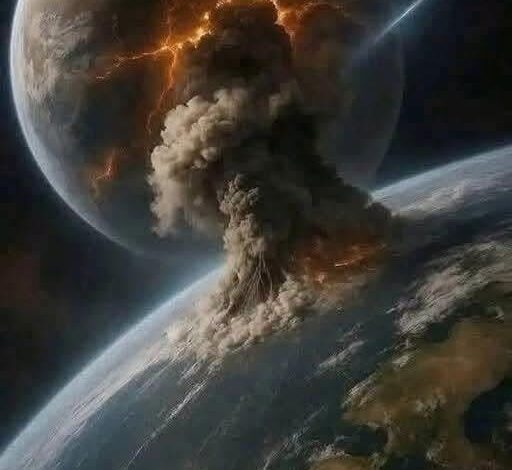
The asteroid will miss us.
That is the most important part of the story.
But perhaps it shouldn’t be the end of it.
52768 (1998 OR2) is a massive near-Earth asteroid, the kind of object whose size alone is enough to inspire dramatic headlines and uneasy questions about what would happen if its path were ever different.
This time, there is no collision to fear.
No desperate evacuation.
No final countdown.
It will pass Earth at a safe distance and continue along its orbit, indifferent to the anxiety its presence creates below.
And yet there is something deeply unsettling about watching an enormous piece of ancient rock move silently through space.
Because the universe does not care whether we are ready.
Human civilization operates on schedules.
Morning alarms.
Workdays.
Elections.
School years.
Mortgages.
Birthdays.
We measure life in manageable pieces because that is how we survive psychologically.
Space works differently.
Asteroids have been traveling through the Solar System for billions of years. They do not recognize borders, governments, economies, or human plans.
They simply follow physics.
Most never come anywhere near us.
Some pass close enough to be classified and carefully monitored.
And, over geological time, some collide.
Earth itself carries the evidence.
Impact craters scar the planet.
Ancient geological layers preserve the aftermath of catastrophic events.
The history of life is partly a history of surviving forces beyond its control.
That is why an asteroid safely passing Earth shouldn’t automatically be dismissed as another sensational headline.
The danger isn’t this particular encounter.
The lesson is that such objects exist at all.
Fortunately, humanity is no longer completely helpless.
Astronomers continuously search the sky for near-Earth objects, calculate their trajectories, refine orbital predictions, and determine whether any known asteroid poses a meaningful future threat.
That work rarely produces dramatic television.
There are no sirens when an astronomer improves an orbital calculation.
No crowds gather when another potentially hazardous object is catalogued.
Most planetary-defense work consists of observation, mathematics, engineering, international coordination, and patience.
It is almost boring.
And that is precisely what successful prevention often looks like.
The ideal asteroid disaster is the one that never becomes a disaster because someone discovered the object years or decades before impact.
Time changes everything.
Find a dangerous asteroid days before collision and humanity may have few meaningful options.
Find it decades beforehand and the problem becomes radically different.
You don’t necessarily need to destroy it.
You may only need to alter its velocity slightly.
Given enough time, a tiny change can accumulate into an enormous difference in position.
Earth can be missed not by thousands of kilometers at first, but by engineering a small deviation years earlier and allowing orbital mechanics to do the rest.
This is no longer purely theoretical.
NASA’s Double Asteroid Redirection Test, better known as DART, deliberately crashed a spacecraft into Dimorphos in 2022.
The goal was not to destroy the asteroid.
It was to determine whether a kinetic impact could measurably alter an asteroid’s motion.
It did.
Humanity had demonstrated something extraordinary:
Under the right circumstances, we can alter the trajectory of a celestial object.
It was one experiment.
It did not make Earth asteroid-proof.
Different objects present different challenges. Their size, composition, structure, rotation, velocity, and warning time all matter.
A loosely bound rubble pile may behave differently from a dense rocky body.
A very large asteroid would present challenges far beyond those of a smaller object.
And discovering a threat too late could drastically reduce our options.
But DART changed the conversation.
For most of human history, an asteroid impact belonged to the category of disasters we could observe but not prevent.
Now, at least in some scenarios, prevention is conceivable.
That makes preparedness more important, not less.
Once a civilization possesses the ability to recognize a danger and potentially reduce it, failing to prepare becomes a choice.
The difficult part is psychological.
Humans are exceptionally responsive to immediate threats.
Smoke enters a room and we run.
Markets crash and governments react.
A hurricane approaches and communities evacuate.
But threats measured in decades are harder.
They don’t feel urgent.
A dangerous asteroid discovered with a possible impact many years away would compete for attention with everything happening today.
Wars.
Inflation.
Elections.
Disease.
Natural disasters.
Economic crises.
People might reasonably ask why billions should be spent responding to something that might not happen for decades.
Then the probability could increase.
Suddenly, the years we wasted would become priceless.
Planetary defense therefore demands a form of maturity humans often struggle to practice:
Acting before panic makes action unavoidable.
That begins with finding objects early.
The sky is enormous.
Some asteroids are dark and difficult to detect.
Others approach from directions that make observation challenging.
Improved telescopes, infrared surveys, orbital calculations, and international data sharing increase the likelihood that dangerous objects will be discovered with enough warning to respond.
Detection is the first defense.
Because you cannot redirect what you do not know is coming.
Then comes characterization.
How large is the object?
What is it made of?
Is it solid?
Porous?
A collection of loosely bound material?
How quickly is it rotating?
Exactly where will it be decades from now?
Those questions aren’t academic if an asteroid is on a threatening trajectory.
They determine what kind of intervention might work.
Then comes coordination.
An asteroid capable of causing regional or global devastation would not be one country’s problem.
Its consequences could cross borders even if the impact itself occurred in a single nation.
Atmospheric effects, disrupted infrastructure, economic shock, displaced populations, and environmental damage could spread far beyond the impact zone.
Planetary defense is therefore one of those rare issues where the phrase “humanity’s problem” is literally appropriate.
An incoming asteroid would not care which flag stood beneath it.
Perhaps that is the strangest gift objects like 1998 OR2 give us.
Perspective.
From space, many of the distinctions consuming our daily lives disappear.
There is one planet.
One thin atmosphere.
One civilization that has become technologically sophisticated enough to detect rocks moving millions of kilometers away, yet remains vulnerable to forces that existed long before us.
The safe passage of an asteroid is therefore not a prophecy of doom.
It is something more useful.
A rehearsal without consequences.
A reminder to test systems before we need them.
To build telescopes before something dangerous appears.
To develop deflection techniques before a countdown begins.
To create international procedures before governments are forced to improvise under pressure.
To practice communicating risk without either minimizing it or creating unnecessary panic.
Because if humanity ever discovers an asteroid genuinely headed toward Earth, the most valuable resource may not be rockets.
It may be time.
Twenty years.
Thirty years.
Fifty years.
Enough time to observe.
Enough time to calculate.
Enough time to design.
Enough time to launch.
Enough time to fail once and try again.
That is the luxury we should be protecting now.
There is no reason to fear 52768 (1998 OR2) simply because it exists.
Its passage is not evidence that catastrophe is imminent.
Near-Earth asteroids regularly move through our cosmic neighborhood, and astronomers track them precisely because understanding their trajectories allows us to distinguish harmless encounters from genuine threats.
That distinction matters.
Preparedness built on panic is unstable.
Preparedness built on science lasts.
The real message isn’t:
“Be afraid.”
It is:
“Keep watching.”
Keep mapping the sky.
Keep improving the models.
Keep testing technologies capable of changing an object’s trajectory.
Keep building cooperation between agencies and nations.
And keep doing all of it while nothing is wrong.
Because that is when preparation is cheapest.
That is when mistakes can be corrected.
That is when experiments can fail safely.
That is when humanity still has choices.
Someday, another object will be discovered.
Perhaps it will pass millions of kilometers away.
Perhaps astronomers will briefly calculate a small impact probability before additional observations eliminate it.
Perhaps generations will pass without any serious threat at all.
We should hope so.
But hope and preparation are not opposites.
The smartest civilization is not one that lives terrified of catastrophe.
It is one capable of imagining catastrophe calmly enough to prevent it.
So when 1998 OR2 disappears again into the darkness, there will be no explosion.
No dramatic ending.
No reason to celebrate survival as though Earth narrowly escaped destruction.
Just an asteroid continuing on its ancient path.
And a planet beneath it filled with people possessing something previous generations never had:
The ability to look upward, identify certain dangers before they arrive, and perhaps do something about them.
The asteroid will pass.
The warning is quieter.
We have time.
The question is what we choose to do with it.