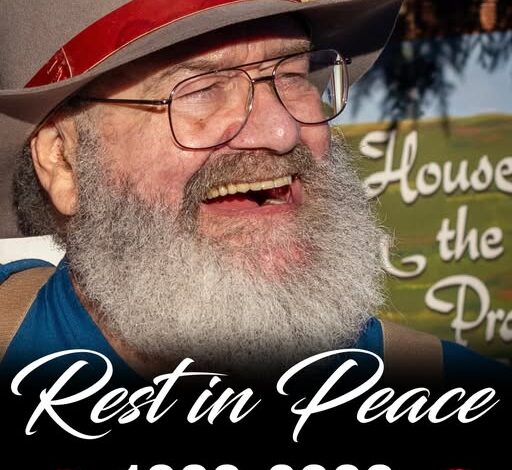
In an era that increasingly rewards noise, self-promotion, and constant visibility, there is something deeply moving about people who leave lasting impressions quietly.
That is why so many who knew Victor French Jr. speak about him less in terms of accomplishments and more in terms of presence. He did not build his identity around spectacle, despite growing up connected to one of television’s most beloved legacies. Instead, he seemed to understand something many public figures spend lifetimes chasing unsuccessfully:
being remembered warmly matters more than being remembered loudly.
Born in 1960, Victor French Jr. carried a name already woven into television history through his father, Victor French Sr., whose performances on Little House on the Prairie, Highway to Heaven, and other classic series left enduring emotional marks on generations of viewers.
Children who grew up watching those shows often associated Victor French Sr. with a very particular kind of screen presence:
rugged but compassionate,
stern but deeply human,
the flawed protector whose heart ultimately outweighed his rough edges.
For many families, those programs became more than entertainment. They became part of household rhythm itself — reruns playing in living rooms after school, lessons about kindness and resilience absorbed quietly through fictional stories carrying real emotional sincerity.
Living beside a legacy like that can shape a child in complicated ways.
Some people spend years trying either to escape famous family shadows entirely or capitalize on them aggressively. Victor French Jr. seemed to choose neither path. Instead, he remained connected to his father’s memory with remarkable steadiness and restraint.
That balance is harder than it looks.
Maintaining a loved one’s legacy without turning grief or nostalgia into performance requires emotional maturity. It means understanding that remembrance is not ownership. The stories belong partly to audiences too — to viewers whose childhoods and family memories became emotionally intertwined with those shows.
People who met Victor Jr. at fan gatherings often describe exactly that kind of humility.
He did not reportedly arrive carrying celebrity entitlement or treating appearances as obligations beneath him. Instead, attendees remember someone approachable:
willing to listen,
willing to laugh,
willing to share stories without trying to dominate rooms with himself.
That distinction matters because audiences instinctively recognize authenticity. Fans attending nostalgia conventions are rarely searching only for autographs or photographs. More often, they are seeking emotional continuity — reassurance that the warmth they associated with beloved stories still exists somehow in the people connected to them.
Victor Jr. appears to have understood that intuitively.
The description of him making strangers “feel like old friends” captures something emotionally profound about certain personalities. Some people possess a rare ability to reduce social distance quickly. They create ease around themselves not through charisma in the glamorous sense, but through attentiveness:
remembering names,
asking sincere questions,
listening fully instead of waiting to speak.
These qualities often seem small externally, yet they leave disproportionately large emotional impact.
Actors and public figures are frequently remembered for dramatic moments:
award speeches,
major performances,
headlines,
career achievements.
But privately, the people who matter most in communities are often those who consistently make others feel welcome and valued in ordinary interactions.
That appears to be how many cast members and friends remembered Victor Jr.
Alison Arngrim and Dean Butler — themselves deeply connected to the Little House legacy — reportedly emphasized not grand accomplishments, but warmth.
That choice of memory says something important.
At the end of life, people rarely speak most passionately about résumé lines. They remember atmosphere:
who comforted others,
who eased tension,
who showed kindness quietly when cameras were absent.
Warmth becomes a form of emotional architecture. Certain individuals make rooms feel safer simply by entering them. Their presence lowers defensiveness. People breathe easier around them.
And perhaps what feels especially poignant is that Victor Jr. reportedly maintained this gentleness even while facing illness himself.
Illness often strips away emotional energy gradually. Pain, fatigue, medical uncertainty, and fear can narrow people inward understandably. Yet some individuals continue extending reassurance outward despite carrying burdens privately. Not because suffering becomes easy, but because kindness has become habitual enough to survive hardship itself.
That kind of steadiness leaves deep impressions on others precisely because it feels increasingly rare.
Modern culture tends to equate significance with visibility:
followers,
recognition,
status,
constant public validation.
But human memory operates differently than algorithms do.
People rarely carry the loudest person with them emotionally for decades.
They carry the kindest.
The one who listened carefully.
The one who remembered birthdays.
The one who made difficult moments softer without demanding credit afterward.
Victor French Jr.’s story resonates because it reflects that quieter definition of legacy.
Not everyone changes the world through fame or innovation.
Some change it through emotional atmosphere.
Through showing up repeatedly.
Through preserving connection.
Through treating strangers gently enough that they leave interactions feeling less alone than before.
And perhaps that role matters especially within communities built around nostalgia and shared memory. Fan gatherings for shows like Little House on the Prairie are not really only about television. They are about continuity:
people reconnecting with childhood,
family traditions,
older relatives now gone,
simpler emotional landscapes attached to certain stories.
Someone like Victor Jr. became a bridge inside those experiences — linking audiences not just to actors or fictional characters, but to feelings they feared modern life had outgrown:
sincerity,
gentleness,
neighborliness,
emotional openness without irony.
That emotional continuity is powerful.
Especially now, when so much public life feels accelerated, transactional, and emotionally guarded.
The phrase “kept showing up” may actually describe his legacy more beautifully than any larger tribute could.
Because consistency itself becomes sacred over time.
Showing up to events.
Showing up for conversations.
Showing up kindly even during personal struggle.
Showing up not because attention is addictive, but because connection matters.
There is dignity in that kind of reliability.
And perhaps the reason his memory affects people so deeply is because it reminds them that meaningful lives are not always the most publicly celebrated ones.
Some people become unforgettable through enormous achievement.
Others through emotional generosity repeated quietly over years.
Victor French Jr. appears to belong to the second category.
A man who understood that legacy is not only inherited through famous names or preserved through public recognition.
Sometimes legacy survives through something much softer:
the feeling people carry afterward when someone treated them with genuine warmth in a world that too often forgets how important simple human kindness still is.