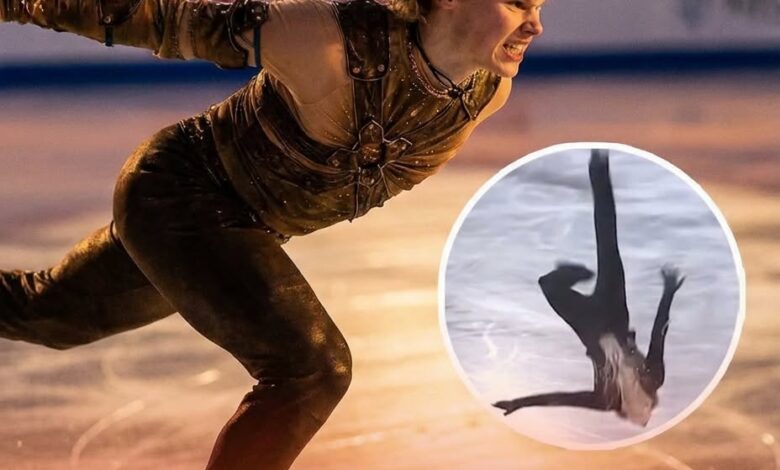
For a split second, Ilia Malinin was upside down beneath the Olympic lights.
Then his blades hit the ice.
The Milano Ice Skating Arena erupted.
It wasn’t simply the reaction to another spectacular element from one of America’s most daring figure skaters. The crowd had just witnessed something that had effectively disappeared from legal Olympic competition for nearly half a century: a backflip.
For decades, the move had occupied an unusual place in figure-skating history—famous, thrilling, and forbidden. Generations of Olympic skaters competed knowing that attempting one could cost them dearly.
Now, with one explosive leap, Malinin brought it back.
The Team USA star unleashed the backflip during the men’s short program portion of the team event, adding another extraordinary moment to a career already built around pushing the technical limits of skating. At 21, Malinin had arrived at the Games carrying enormous expectations.
Yet when the opportunity came, he didn’t play it safe.
He attacked the moment.
His performance earned 98.00 points, but the number told only part of the story. What spectators remembered was the instant Malinin launched backward, rotated through the air, and returned to the ice as thousands of people realized they had just watched a piece of Olympic history come alive again.
To understand why it mattered, you have to go back to 1976.
At the Innsbruck Winter Olympics, American skater Terry Kubicka performed a backflip during competition. The move was astonishing, but figure skating’s governing body soon moved in the opposite direction.
In 1977, the International Skating Union banned the element.
The concern centered largely on safety. A backflip is fundamentally different from the traditional rotational jumps that dominate elite figure skating, and the maneuver was regarded as too dangerous for sanctioned competition.
The prohibition lasted for decades.
That didn’t mean the backflip disappeared.
Instead, it became something almost mythical—a move skaters could perform in exhibitions but not freely use when Olympic points were at stake.
Then came Surya Bonaly.
At the 1998 Nagano Olympics, the French star produced one of the most rebellious and unforgettable moments in figure-skating history.
Bonaly knew the backflip was illegal.
She did it anyway.
Her version was especially remarkable because she landed on one blade, turning an already extraordinary athletic feat into an enduring image of defiance.
She was penalized.
But the moment survived far longer than the deduction.
For years afterward, Bonaly’s backflip became symbolic of something larger than technical skating. It represented individuality, risk, and a willingness to challenge the boundaries of what the sport permitted.
That history hovered over Malinin’s Olympic performance.
There was one crucial difference.
This time, the move was legal.
In 2024, the International Skating Union changed its rules and removed the long-standing prohibition on backflips and certain other somersault-type movements.
Suddenly, an element associated with penalties could return to legitimate competition.
And Malinin was an almost inevitable skater to embrace it.
His reputation has been built on technical ambition. He has repeatedly demonstrated a willingness to attempt elements that other elite competitors approach cautiously, earning attention for expanding perceptions of what is possible on the ice.
At the Olympics, though, difficulty carries another kind of pressure.
There are no ordinary Olympic moments.
Every mistake becomes magnified. Every landing can affect medals. Every decision unfolds in front of a global audience.
That makes choosing spectacle over caution particularly striking.
Malinin could have focused exclusively on maximizing security.
Instead, he gave the audience something they hadn’t expected to see.
The response was immediate.
“The audience just roared,” Malinin said afterward.
That roar captured the significance better than any technical explanation could.
People understood they had seen something unusual.
For Malinin, the Olympic atmosphere also appeared to sharpen his awareness of the moment itself. Elite athletes spend years chasing results, often moving immediately from one goal to another.
The Games can interrupt that rhythm.
They remind competitors that even reaching the Olympic stage is uncertain.
Careers change.
Bodies change.
One mistake can alter an entire season.
Malinin spoke about appreciating the experience and remaining present rather than allowing the pressure surrounding the Olympics to consume him.
That perspective made the backflip feel even more fitting.
It was risky, theatrical, and completely alive.
Yet the competition itself offered another reminder that history and victory aren’t always the same thing.
Japan’s Yuma Kagiyama finished ahead of Malinin in the segment, leaving the American second despite the performance that dominated much of the conversation afterward.
On paper, that distinction mattered.
In memory, perhaps less so.
Olympic history has always contained two kinds of achievements.
There are results that belong permanently to record books: gold medals, world records, final scores, podium placements.
Then there are moments.
The moments don’t always belong to the winner.
They’re the seconds that make people lean toward their televisions, shout from arena seats, or immediately replay what they aren’t certain they actually saw.
Bonaly understood that in 1998.
Her backflip didn’t bring her an Olympic medal. Technically, it worked against her score.
Yet decades later, people still watch it.
Malinin’s backflip arrived under entirely different circumstances, but it connected two eras of the sport.
Kubicka had performed the move before the prohibition.
Bonaly had defied the prohibition.
Malinin performed after the door finally reopened.
Three American Olympic cycles of skating history, separated by decades, suddenly converged in a few airborne seconds.
The reaction quickly moved beyond the arena.
Clips circulated online as viewers celebrated the audacity of the maneuver. Some focused on the technical skill required. Others marveled simply at seeing a backflip performed in Olympic competition without the automatic penalty that once accompanied it.
For younger fans, it looked revolutionary.
For longtime skating followers, it looked like something returning from another age.
And that may be what made the moment so powerful.
Sports evolve through rules, technology, training, and increasingly ambitious athletes. What one generation considers unacceptable can eventually be reconsidered. What disappears can return in a different form.
Malinin didn’t erase the history of the backflip.
He added another chapter to it.
When he launched himself backward beneath the Olympic lights, nearly fifty years of controversy followed him into the air.
Then his skates came down.
The crowd exploded.
The score appeared.
Competition continued.
But something had changed.
A move that had spent decades outside the boundaries of legal Olympic figure skating was back on one of sport’s biggest stages.
Malinin may have finished second in that portion of the competition, but podium positions aren’t the only things the Olympics preserve.
Sometimes history lasts only a second.
Sometimes it happens upside down.
And sometimes all it takes is one fearless landing to make nearly half a century disappear.