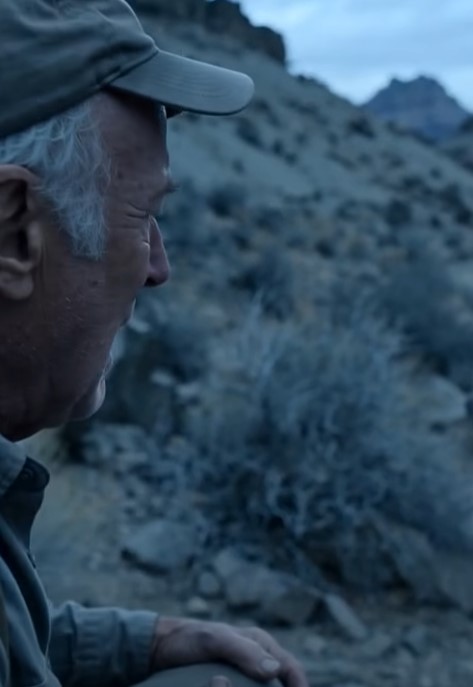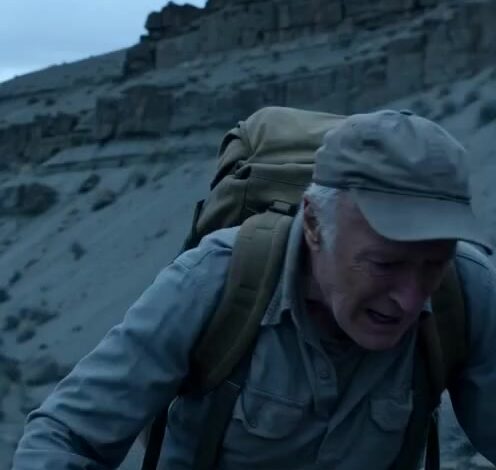
What makes Richard and Jess’s story so emotionally powerful is that it is not really about a dog getting lost in the desert.
It is about two wounded creatures learning, very slowly, how to trust survival less than connection.
At the beginning, both of them are living versions of isolation. Richard’s solitude appears orderly and chosen — a retired geologist alone in a remote Arizona cabin, surrounded by canyon walls and routines shaped by silence. Jess’s isolation is more visible: scars across his muzzle, fear of human contact, instinctive retreat from affection. Yet emotionally, they mirror each other more than either initially realizes.
Neither trusts closeness easily.
And that is why the early months matter so much.
Many rescue stories romanticize healing into something immediate and dramatic. This story does the opposite. Richard does not “fix” Jess through force, dominance, or sentimental optimism. He understands something profoundly important about trauma:
trust cannot be demanded from someone whose survival depended on fear.
So instead, he offers presence.
Quietly.
Repeatedly.
Without expectation.
The image of him sitting on the floor near the fireplace while Jess watches from a distance captures this beautifully. There is no performance there, no attempt to rush emotional progress. Richard allows coexistence before connection.
That patience becomes the foundation of everything that follows.
And then comes the thunderstorm.
Emotionally, the storm functions as more than weather. It becomes the moment fear overwhelms Jess’s defenses enough that instinct finally gives way to vulnerability. Trembling inside the crate while thunder rolls through canyon walls, Jess expects danger. Instead, he finds Richard sitting nearby calmly, not forcing touch, not opening the crate, simply remaining present.
That distinction matters enormously.
Traumatized beings — animal or human — often heal not through grand rescue moments, but through repeated experiences of safety during fear. Richard teaches Jess something revolutionary through stillness:
panic does not always lead to harm.
So when Jess finally rests his head into Richard’s hand for the first time, the gesture feels enormous precisely because it is so small.
Trust rarely arrives dramatically.
It arrives quietly,
through accumulated evidence.
That moment transforms Richard too.
The story makes clear that this emotional breakthrough means more to him than decades of geological achievement. After a lifetime studying landscapes shaped by erosion, pressure, and time, he suddenly experiences something equally profound inside himself:
the slow reshaping of loneliness into attachment.
Which is why Jess’s disappearance devastates him so completely.
The description of the empty yard is especially haunting because absence changes physical space immediately. The cabin has not moved. The fence still stands. Morning routines remain technically possible. Yet emotionally, the world has altered.
There is no movement near the door.
No shadow beside the fence.
No living presence completing the rhythm of the home.
People who bond deeply with animals often describe this exact sensation after loss: silence itself becomes unbearable.
The torn collar caught in brush intensifies that horror because it suggests panic rather than choice. Jess did not simply wander away curiously. He escaped through fear or instinct, disappearing into one of the harshest landscapes imaginable for a domestic animal.
And Richard’s response reveals the depth of attachment already formed.
He does not hesitate.
He prepares immediately.
Water.
Medical supplies.
Food.
Flashlight.
Treats wrapped in an old flannel shirt carrying his scent.
That flannel shirt becomes emotionally symbolic throughout the story because scent represents memory more powerfully than language ever could for animals. Richard understands instinctively that if Jess survives, recognition may depend less on sight than on familiarity embedded in smell itself.
The desert search transforms the story from emotional healing into endurance.
Day after day, Richard moves through canyon systems and dry washes despite age, exhaustion, dehydration, and uncertainty. The landscape itself becomes almost antagonistic:
shifting terrain,
extreme temperatures,
predator tracks,
silence vast enough to swallow hope.
Importantly, the desert mirrors Jess’s psychological state.
Both are harsh,
isolating,
and difficult to navigate safely.
As the weeks stretch into months, the search begins feeling almost irrational from the outside. Even Richard’s son urges caution. But emotionally, Richard has crossed a threshold beyond practicality. Jess is no longer merely a pet. He is companionship,
purpose,
and emotional connection after years of isolation.
Losing him means returning not just to solitude, but to the emptiness that existed before trust entered the cabin.
The canyon fall on the fiftieth day becomes a crucial turning point because for the first time Richard himself experiences physical vulnerability mirroring Jess’s earlier fear. Injured, stranded, briefly disoriented, he confronts the possibility that the search could end with both of them lost to the desert.
And in that moment, he reaches for the flannel shirt.
Not food.
Not maps.
Not survival tools.
The shirt.
Emotionally, that gesture reveals what truly keeps him moving: connection itself.
The shepherd’s later warning adds another painful layer:
Jess may no longer fully belong to the life Richard remembers.
After months alone, survival instinct has likely overtaken domestication. Jess has adapted to wilderness psychologically as much as physically. This creates one of the story’s deepest emotional tensions:
what if survival itself has erased trust?
That fear makes the eventual reunion extraordinarily moving.
When Richard finally sees movement near the rocks on the one hundred and thirteenth day, the scene avoids sentimentality beautifully. Jess does not sprint toward him joyfully like a movie ending. He hesitates.
He is thin,
scarred,
cautious,
changed.
There is no immediate recognition in his eyes because prolonged survival has rewritten his instincts temporarily.
And Richard understands immediately that force would destroy everything.
So once again, he chooses patience over control.
He lowers himself.
Avoids sudden movement.
Places the flannel shirt and treats nearby.
The same philosophy that built trust initially becomes the method of reclaiming it:
allow safety to reveal itself slowly.
The moment Jess finally moves forward is emotionally devastating because it represents memory overcoming fear. Scent reconnects him to something larger than survival:
care,
warmth,
belonging,
home.
And when he finally rests his head against Richard’s chest, the reunion feels earned rather than manufactured.
Both of them have changed profoundly by then.
Richard carries permanent injury.
Jess carries physical scars and survival memory.
Neither emerges untouched.
Yet perhaps that is exactly the point.
The story does not suggest love prevents hardship.
It suggests connection can survive hardship if built patiently enough.
Even afterward, recovery remains gradual. They shelter in caves, ration supplies, rebuild strength slowly. Healing is still work. Trust still requires repetition. Survival still leaves marks.
But when they finally return to the cabin after one hundred and fifty-eight days, Jess walking directly to Richard’s chair and resting against him symbolizes something deeper than reunion.
It symbolizes choice.
After everything — fear, wilderness, adaptation, separation — Jess chooses connection again.
And perhaps that final truth is what makes the story linger emotionally:
that bonds formed gently and patiently can endure even environments built to destroy softness.
Richard spent his life studying landscapes shaped by erosion, pressure, and time.
In the end, the most important thing he learned was not geological at all.
It was that trust, once truly earned, can survive astonishing distances —
through fear,
through silence,
through wilderness,
and all the harsh places living creatures sometimes disappear inside before finding their way home again.