I stepped out into the yard early in the morning, almost automatically, with my phone and a cup of coffee in my hands.

I noticed it because the grass looked wrong.
That is the only way I can explain it.
The rain had finally stopped sometime before dawn after pounding the house for most of the night. By morning, everything outside had that washed-out appearance that comes after a serious storm. The driveway was shining. Water dripped steadily from the gutters. Small puddles had formed along the fence.
I was standing at the kitchen window with a cup of coffee when something near the flower bed caught my attention.
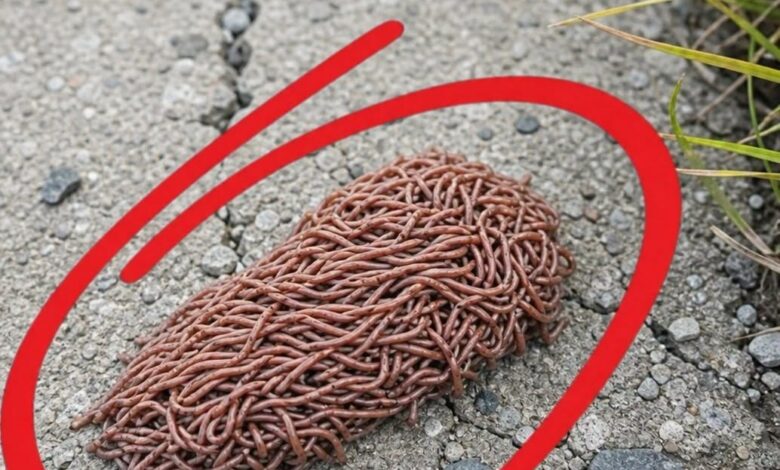
At first, I thought it was a pile of rope.
Then it moved.
I stopped with the cup halfway to my mouth.
The object was maybe twenty feet from the window, sitting on a patch of saturated grass. It was dark reddish-brown, irregularly shaped, and glistening in the morning light.
Another part of it moved.
Then another.
I put down my coffee.
For several seconds, my brain refused to understand what my eyes were seeing.
The mass seemed to pulse.
Not dramatically.
It shifted in tiny waves, as though the entire thing were breathing.
I moved closer to the glass.
“What in the world…?”
The words came out quietly.
There was nobody else in the room.
I grabbed my phone and zoomed in rather than going outside.
The image sharpened.
And my stomach turned.
Worms.
Hundreds of them.
Maybe more.
Earthworms were twisted together in a dense, living knot.
Individual bodies slid across one another, disappearing beneath the mass and emerging somewhere else. Some stretched outward onto the surrounding grass before curling back toward the others.
The whole thing was constantly changing shape.
I had seen earthworms after rain before.
Everyone has.
A few scattered across a sidewalk never bothered me.
This was different.
This looked organized.
Intentional.
Almost like a single creature made from hundreds of smaller ones.
Every horror movie I’d ever watched suddenly seemed much less ridiculous.
I took a photograph and sent it to my brother.
His response arrived almost immediately.
Burn the house down.
Not helpful.
I sent the picture to a friend who gardens.
Her answer was slightly more useful.
Those are definitely worms. I’ve never seen them do THAT.
Great.
So now three of us were confused.
I started searching online.
“Giant ball of worms after rain.”
“Earthworms tangled together lawn.”
“Mass of worms after storm.”
The results slowly turned something horrifying into something biologically fascinating.
Earthworms live in soil that contains tiny pockets of air.
They don’t breathe with lungs like we do. Oxygen and carbon dioxide move through their moist skin.
Moisture is essential to that process.
But extreme saturation changes their underground environment.
After prolonged or heavy rain, water can fill spaces in the soil and alter the conditions worms depend on.
That helps explain one of the most familiar sights after storms: earthworms appearing on sidewalks, lawns, driveways, and roads.
The old explanation many of us heard as children was simple.
“They come up because they’ll drown.”
Reality is more complicated.
Scientists have proposed several reasons earthworms surface during and after rain, and the explanation can vary with species and conditions.
Waterlogged or low-oxygen soil may contribute.
Moving across wet ground can also allow some worms to travel without drying out as quickly as they would under hot, dry conditions.
Rain and vibrations may influence their behavior too.
Whatever had brought these particular worms to the surface, they had ended up concentrated in one place.
And that concentration was what made the scene look so disturbing.
One worm is ordinary.
Five worms are garden life.
Hundreds intertwined into a moving mound activate some prehistoric alarm in the human brain.
I kept watching.
Every few seconds, the pile changed.
A worm would extend from the edge, stretch across the grass, and then vanish beneath another layer.
Sunlight caught the wet bodies and made them shine.
Knowing they were harmless didn’t improve the experience.
If anything, understanding what I was looking at made it stranger.
This wasn’t a movie prop.
Nobody had dumped spaghetti in my yard.
These were living animals responding to environmental conditions happening directly beneath my feet.
I had walked across that lawn thousands of times.
I’d mowed it.
Watered it.
Sat on it.
Watched children play on it.
Yet beneath the surface was an entire community of organisms I almost never thought about.
The storm had temporarily erased the boundary between their world and mine.
And apparently their world contained nightmare knots.
I decided to go outside.
This took more courage than I’m proud to admit.
I put on boots even though the worms were nowhere near the door.
Then I walked slowly toward the flower bed.
From ground level, the mass looked worse.
Much worse.
I stopped several feet away.
There was no smell.
No aggressive movement.
No obvious center.
Just earthworms.
A lot of earthworms.
They weren’t interested in me.
They weren’t invading the house.
They weren’t preparing for some coordinated attack on humanity.
They were simply trying to survive whatever conditions the storm had created.
That realization changed the scene.
Only slightly.
Disgust gave way to sympathy.
Imagine spending your entire life underground and suddenly finding your habitat flooded or otherwise unsuitable.
You surface.
Everything is exposed.
Sunlight threatens to dry you out.
Birds can see you.
The ground you’ve reached may be unfamiliar.
Every direction is dangerous.
What looked like a horror scene from my kitchen window was, from the worms’ perspective, something closer to an emergency.
I decided not to touch them.
That was partly because I didn’t know whether disturbing the mass would help.
It was also because absolutely nothing in my body wanted to pick up a ball of several hundred earthworms.
Nature and I had reached a reasonable compromise.
I wouldn’t kill them.
They wouldn’t require physical affection.
Over the next few hours, the yard began drying.
When I checked again around lunchtime, the mass had changed significantly.
It was smaller.
Individual worms had dispersed across the damp soil.
By late afternoon, most were gone.
The terrifying living knot that had dominated my morning had almost completely disappeared.
A few worms remained beneath leaves and along the edge of the garden.
The lawn looked normal again.
That was somehow the strangest part.
Normal.
Within hours, the scene had vanished so thoroughly that someone walking through the yard that evening would never have known anything unusual had happened.
The grass was grass again.
The flower bed was a flower bed.
The underground world had closed its door.
But I couldn’t stop thinking about it.
We have a remarkable ability to treat familiar landscapes as empty backgrounds.
A lawn is something to mow.
Soil is something plants grow in.
A fallen log is debris.
A puddle is an inconvenience.
But none of those spaces are empty.
A handful of healthy soil can contain an astonishing variety of organisms.
Bacteria.
Fungi.
Tiny arthropods.
Larvae.
Nematodes.
Worms.
Roots weave through this hidden ecosystem while organisms break down dead material and move nutrients through the soil.
Earthworms themselves can dramatically influence soil structure.
As they burrow, they create channels.
They consume organic material and soil.
Their activity can alter aeration, drainage, and nutrient cycling.
Their ecological role isn’t identical everywhere—some earthworm species can even cause problems in ecosystems where they are invasive—but the broader lesson remains:
The ground beneath us is alive.
Most of the time, we don’t notice because that life operates at scales or in places we rarely see.
Then something changes.
Heavy rain falls.
A temperature shifts.
A seasonal emergence begins.
And suddenly the invisible becomes impossible to ignore.
That’s what unsettled me most.
Not the worms themselves.
The revelation.
My yard hadn’t suddenly become strange that morning.
It had always been strange.
I’d simply never been paying attention.
The organisms beneath the lawn had been moving, feeding, reproducing, competing, and surviving while I walked above them thinking about emails and groceries.
The storm didn’t create that hidden world.
It exposed a tiny piece of it.
There’s also a practical reason to pay attention when unusual numbers of worms or other animals suddenly appear.
Environmental conditions matter.
Heavy rainfall, flooding, soil saturation, temperature changes, chemical exposure, and disturbances to habitat can all alter animal behavior.
An unusual sight isn’t automatically evidence of something dangerous, but observing context can help explain what’s happening.
If you encounter a strange mass of worms after rain, there’s usually no reason to panic.
Avoid pouring chemicals, salt, pesticides, or other substances onto them simply because they look unpleasant.
If they’re ordinary earthworms in a safe outdoor area, allowing conditions to improve naturally may be the simplest response.
If worms are stranded on hot pavement and you choose to help, handling them gently and moving them toward suitable moist soil may sometimes make sense—but proper species identification and local ecological considerations matter, particularly in places where invasive earthworms are a concern.
And don’t assume every worm-like animal is harmless simply because it resembles an earthworm.
If you encounter an organism you cannot identify, especially an unusual flatworm or brightly marked species, photographing it without unnecessary handling is a sensible first step.
My visitors, thankfully, were far less exotic.
They were ordinary earthworms behaving in an extraordinary-looking way.
Yet that didn’t stop the photograph from becoming legendary in my family.
My brother still sends it to me whenever heavy rain is forecast.
Your friends are coming back.
Very funny.
I pretend it doesn’t bother me.
But I have developed one new habit.
After a major storm, I look down before stepping into the yard.
Not obsessively.
I’m not living in fear of earthworms.
But I’m more observant than I used to be.
I notice mushrooms that appear overnight.
Tiny holes in the soil.
Tracks in the mud.
Spiderwebs covered in morning droplets.
Insects gathering around plants I’d previously ignored.
Once you realize how much activity surrounds you, it’s difficult to return completely to blindness.
And maybe that’s the unexpected gift of seeing something that initially disgusts or frightens you.
Curiosity can replace fear.
Not always.
Sometimes something creepy remains creepy even after you understand it.
I can confirm that a writhing mound of worms belongs firmly in that category.
But understanding changes the kind of fear.
I no longer looked at the mass and imagined some unknown threat.
I looked at it and saw hundreds of small animals caught in conditions they hadn’t chosen.
The storm had transformed their habitat.
They responded.
Then, when conditions changed again, they disappeared.
By the following morning, there was almost no evidence they’d been there.
I stood at the same kitchen window holding another cup of coffee.
Sunlight covered the grass.
Birds hopped along the fence.
Everything looked peaceful.
For years, that view had represented familiarity.
Safety.
Ordinary life.
Now it looked different.
Not dangerous.
Alive.
There were worlds beneath that grass I would probably never see.
Things crawling beneath stones.
Networks of roots and fungi.
Animals moving through tunnels inches below my shoes.
Entire lives unfolding without needing my awareness or permission.
And every so often, rain would pull part of that hidden world into daylight.
I still wouldn’t call the worm pile beautiful.
Some experiences do not need that kind of revision.
It was horrifying.
It was fascinating.
It was completely natural.
Those things can all be true.
But I’ll never forget watching that dark mass move beneath my window and realizing that the yard hadn’t changed at all.
I had.
For the first time, I wasn’t merely looking at the ground.
I was seeing what lived there.