My dog noticed it before I did.
We were halfway through our usual morning walk when Max suddenly stopped beside a patch of tall grass and lowered his nose.
At first, I assumed he’d found exactly what dogs usually find fascinating and humans usually wish they hadn’t.
“Leave it.”
He ignored me.
“Max.”
His tail began wagging.
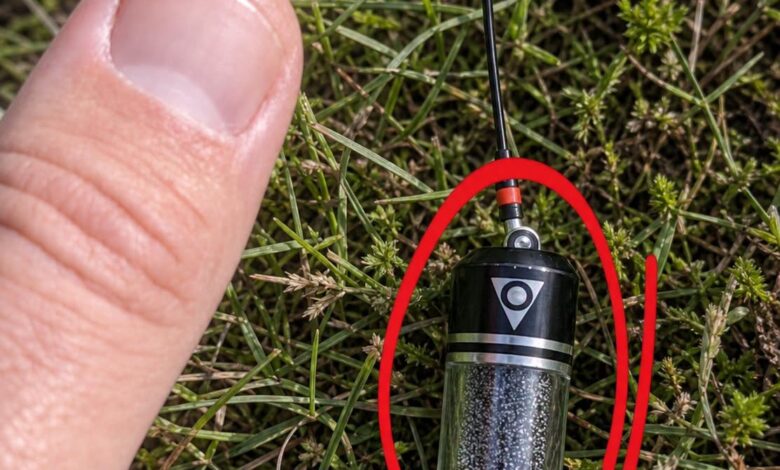
Then I saw something metallic between the blades of grass.
It was tiny.
Maybe a few centimeters long, with a thin wire extending from one end.
I pulled Max backward.
My first thought was ridiculous.
Bomb.
My second wasn’t much better.
Hidden camera.
The object looked too deliberate to be ordinary litter. It wasn’t a bottle cap or piece of broken electronics. The components seemed carefully assembled, almost miniature.
I crouched several feet away.
There was a small rectangular section, what looked like a battery, and an impossibly thin antenna.
I didn’t touch it.
Instead, I took out my phone and zoomed in.
That was when the mystery became even stranger.
There were tiny markings on one side.
Numbers.
Letters.
And what appeared to be a frequency.
I searched the combination online.
Within minutes, my fear transformed into fascination.
The object wasn’t an explosive.
It wasn’t a surveillance microphone.
It appeared to be a miniature radio transmitter—the kind researchers can attach to birds, bats, rodents, and other small animals to study their movements.
I stared at the little device lying in the grass.
Suddenly it looked completely different.
Minutes earlier, I’d imagined somebody hiding it there.
Now I imagined it moving through the sky.
Or through trees.
Or beneath bushes.
Attached to an animal going about a life completely unaware that its movements had become scientific data.
Wildlife tracking sounds futuristic, but researchers have used radio telemetry for decades.
The basic idea is surprisingly straightforward.
A small transmitter sends out a radio signal.
Researchers use specialized receivers and antennas to detect that signal.
By locating it repeatedly, they can learn where an animal travels, where it rests, how large its territory is, where it migrates, and sometimes whether it has survived.
For wildlife biologists, those movements can answer questions that would otherwise be nearly impossible to solve.
Where do birds go after leaving a nesting site?
Which habitat does an endangered animal actually depend on?
How far does a bat travel to feed?
Do animals avoid roads?
What happens after an animal is relocated?
Where are young animals dispersing?
A tiny transmitter can help turn those invisible journeys into information.
And information can influence conservation.
If researchers discover that an endangered species repeatedly uses a particular wetland, forest corridor, or resting site, protecting that location becomes easier to justify.
If tracked animals consistently die near a particular road, wildlife crossings or other interventions may be considered.
If migrating birds depend on a seemingly insignificant patch of habitat, scientists can identify its importance before it disappears.
The technology has become remarkably small.
That’s necessary because attaching equipment to wildlife comes with an obvious responsibility:
The tracker shouldn’t prevent the animal from behaving normally.
Researchers must consider the size and biology of the species, the attachment method, the duration of the study, and the weight of the device.
A transmitter suitable for a large mammal would obviously be inappropriate for a tiny songbird.
For very small species, every fraction of a gram matters.
Depending on the research project, devices can be fitted using collars, leg attachments, harness-style systems, adhesive methods, or other carefully selected techniques.
Some are designed to fall off eventually.
Others may stop transmitting when their batteries expire.
And occasionally, a tracker becomes separated from its animal.
That seemed like a plausible explanation for the object at my feet.
Perhaps its attachment had failed.
Perhaps it had been deliberately designed to release.
Perhaps the animal had shed it.
Maybe a predator had been involved.
I had no way of knowing.
But suddenly I wanted to know where it had been.
Had it crossed miles of countryside?
Had it spent months on a bird?
Had researchers been listening for its signal?
Was someone, somewhere, wondering why a dot had stopped moving?
The little transmitter had turned an ordinary dog walk into a detective story.
Then another thought occurred to me.
Should I pick it up?
My instinct said no.
And that turned out to be sensible.
When you find unfamiliar scientific equipment outdoors, moving it isn’t necessarily helpful.
Its exact location may itself contain useful information.
Researchers looking for a lost transmitter might expect it to remain where it was dropped.
Some equipment may also have identifying numbers that allow the responsible research group to be contacted.
A photograph and precise description of the location can sometimes be more useful than carrying the object home.
And, more generally, touching unknown equipment isn’t a great idea when you don’t actually know what it is.
So I left it alone.
I took photographs.
I noted where I’d seen it.
Then I continued walking.
But something about the discovery stayed with me.
It wasn’t fear anymore.
It was awareness.
I’d always thought of wildlife as largely anonymous.
A bird lands on the fence.
Another disappears into a tree.
A rabbit crosses a field.
A bat flickers through the evening sky.
We see them for seconds and then they’re gone.
But scientists studying those animals are trying to build continuous stories from those brief appearances.
The animal we see for three seconds may have traveled hundreds or thousands of kilometers.
It may return to the same tiny patch of land every year.
It may cross highways, cities, farms, forests, and borders.
Tracking technology allows researchers to follow pieces of those journeys.
Traditional radio telemetry is only one method.
Modern wildlife research can also involve GPS devices, satellite transmitters, acoustic tags, identification bands, camera traps, and tiny electronic tags detected by specialized stations.
Different systems reveal different things.
Some produce precise location histories.
Others simply tell researchers when an animal passed within range of a receiver.
Together, they can create astonishing maps.
A line on a computer screen may represent a bird crossing continents.
A cluster of points may reveal a hidden nesting area.
A sudden stop in movement may tell researchers something has happened.
When you look at those maps, it’s easy to focus on the technology.
But every line represents a living animal making decisions.
Where to eat.
Where to hide.
Where to rest.
Where to reproduce.
Where to flee.
Science isn’t directing those movements.
It’s trying to understand them.
Still, I’ll admit that discovering the tracker gave me an unexpectedly eerie feeling.
We’re accustomed to hearing about tracking in relation to humans.
Phones know where they are.
Cars contain navigation systems.
Apps request location access.
Websites record behavior.
Cameras appear everywhere.
So seeing a tiny tracking device in the grass immediately triggered the vocabulary of surveillance.
Who’s watching?
Why?
What are they collecting?
The difference, of course, is important.
Ethical wildlife research is conducted for scientific purposes under rules and protocols intended to protect the animals being studied. Tracking an animal to understand migration isn’t the same thing as secretly monitoring a person’s private life.
But emotionally, the resemblance was difficult to ignore.
A creature moves through the world.
A signal follows.
Far away, someone interprets the movement.
The animal never sees the map.
That idea followed me for the rest of the walk.
Max couldn’t have cared less.
He’d already discovered a more interesting smell twenty meters away.
I tightened his leash and laughed at myself.
Five minutes earlier, I’d been imagining secret agents and hidden cameras.
Reality was both less dramatic and more interesting.
The tiny device wasn’t watching me.
It had probably been watching—or more accurately, helping researchers locate—something much harder for humans to follow.
A bird.
A bat.
A small mammal.
Some creature whose private geography had become valuable because understanding where animals go can help us understand what they need.
Later, I looked through the photographs again.
Without context, the transmitter still looked suspicious.
A tiny battery.
A circuit.
An antenna.
Something manufactured and precise lying among dirt and leaves.
It didn’t belong visually.
Maybe that’s why it had frightened me.
Nature and technology are supposed to occupy separate boxes in our minds.
Trees over here.
Electronics over there.
But modern conservation often places them side by side.
Sensors listen in forests.
Cameras watch trails.
Satellites follow migration.
Receivers detect tiny transmitters carried by animals most of us will never notice.
Technology that can feel intrusive in one context can become extraordinarily valuable in another.
The important questions are who is collecting information, why they’re collecting it, and what safeguards govern the process.
I never learned which animal had carried the transmitter I found.
In some ways, I’m glad.
The mystery remains better that way.
Sometimes when Max stops suddenly during our walks now, I look more carefully at the ground.
Not because I expect to find another tracker.
Because that tiny object reminded me how many stories are moving around us unnoticed.
The bird overhead may be halfway through a migration spanning countries.
The bat disappearing behind a roof may feed kilometers away before returning before dawn.
The animal vanishing into the weeds may be part of a study that will eventually protect an entire habitat.
Most of those journeys happen without us ever seeing them.
Occasionally, though, something gets left behind.
A band.
A tag.
A transmitter.
A tiny piece of technology sitting silently in the grass.
If you find something similar, resist the urge to immediately pocket it or dismantle it. Photograph it from a safe distance, look for identifying information without unnecessarily handling it, note the location, and consider contacting the relevant local wildlife or research authority if you can identify one.
Sometimes what looks like strange electronic litter isn’t litter at all.
It may be a missing piece of somebody’s research.
As for me, I walked away that morning with Max beside me and the device still exactly where we’d found it.
I had started the walk believing the strangest thing hidden in the grass might be something dangerous.
Instead, I found evidence of an invisible scientific world operating alongside our own.
Somewhere, perhaps, a researcher had once watched a signal move across a screen.
Somewhere, an animal had carried that signal without understanding what it meant.
And for one brief morning, the signal’s journey crossed mine.
I never touched it.
I didn’t need to.
Sometimes finding the mystery is enough.
Because after seeing that tiny antenna among the grass, I couldn’t stop looking differently at everything moving around me.
And wondering how much of the world is being quietly studied while the rest of us simply walk past.