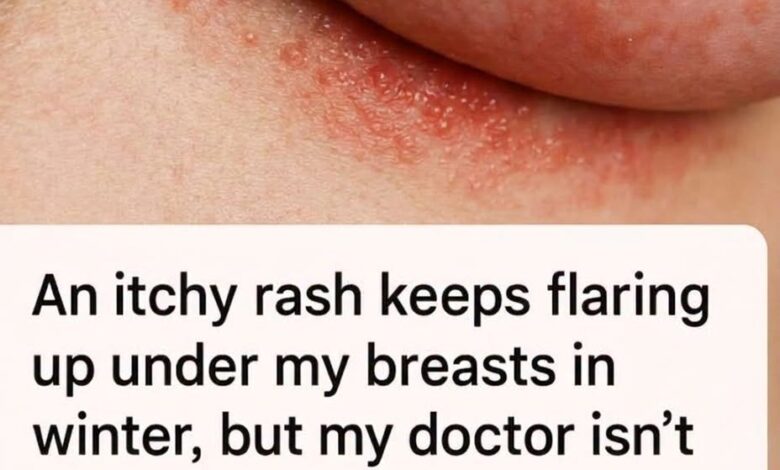
An itchy rash keeps flaring up under my breasts in winter, but my doctor isn’t available right now. What can I do today?

Most people associate sweaty skin rashes with summer.
So when the skin beneath your breasts suddenly becomes red, itchy, sore, or raw in the middle of winter, it can be confusing.
It’s cold outside.
You’re barely sweating.
Why would a heat-related rash appear now?
The answer is that the weather outside isn’t necessarily what matters.
Under several layers of clothing, inside a heated home, and beneath a close-fitting bra, the skin under the breasts can experience its own tiny climate.
Warm.
Dark.
Moist.
And constantly rubbing against another surface.
Those conditions can contribute to a common inflammatory problem called intertrigo.
Intertrigo develops where skin repeatedly touches skin, particularly in areas where moisture and friction become trapped. It can occur beneath the breasts, under the abdomen, in the groin, between the buttocks, or in other skin folds.
It isn’t exclusively a summer problem.
Winter can create surprisingly favorable conditions for it.
You leave home wearing a coat, sweater, thermal layer, and bra.
Then you enter a heated building.
Your body warms.
You sweat slightly.
You may not even notice.
But moisture can remain trapped beneath the breasts for hours.
Add friction from clothing and normal movement, and the skin barrier can become irritated.
The first sign may be nothing more than mild redness.
Then comes itching.
Or burning.
The skin may begin feeling tender.
Sometimes it becomes moist or develops small cracks.
An unpleasant or musty odor can occasionally appear, particularly when microorganisms are involved.
And that’s where a relatively simple irritation can become more complicated.
Warm, moist skin folds can provide favorable conditions for yeast, particularly Candida, as well as certain bacteria.
This doesn’t mean every red patch beneath the breasts is an infection.
Friction and moisture alone can cause inflammation.
But once skin becomes damaged, secondary infection may become easier to develop.
That’s why early care matters.
If you notice irritation beginning, one of the most useful things you can do is remarkably simple:
Keep the area gently clean and thoroughly dry.
Aggressive scrubbing isn’t necessary.
In fact, it can make things worse.
Already irritated skin doesn’t need to be attacked with a washcloth, exfoliating product, or strongly fragranced body wash.
Wash gently with lukewarm water and a mild, fragrance-free cleanser if needed.
Then dry carefully.
Pat.
Don’t rub.
If the fold remains damp, some people find that a hair dryer on a cool setting helps remove residual moisture without creating additional friction.
Avoid using hot air on irritated skin.
The goal is dry skin, not cooked skin.
Once the area is dry, reducing friction becomes important.
A thin barrier layer of plain petrolatum or zinc oxide may help protect irritated skin from repeated rubbing and moisture.
Think of it as creating a small protective boundary between vulnerable skin and the conditions aggravating it.
More product isn’t necessarily better.
A thick, messy layer that traps additional moisture may defeat the purpose.
Clothing matters too.
A bra that presses tightly against inflamed skin can keep the irritation going all day.
When practical, choose a properly fitting, breathable bra and change it if it becomes damp.
Soft fabrics may be more comfortable while the skin heals.
Some people find cotton helpful because of its breathability, although fit and moisture management can matter just as much as the specific fabric.
If you exercise or sweat heavily, don’t remain in a damp bra for hours afterward.
Change.
Wash gently.
Dry thoroughly.
That simple routine can make a substantial difference.
Laundry products deserve consideration as well.
Sometimes what looks like intertrigo may actually be contact dermatitis—or irritated skin may be worsened by fragrances, fabric softeners, detergents, or materials touching the area.
If you’ve recently changed detergent, body wash, lotion, perfume, or bra material, think about the timing.
A fragrance-free laundry detergent may be worth trying if your skin is sensitive.
And avoid applying perfume or heavily fragranced products directly to an irritated fold.
Then there’s the question many people eventually ask:
What about antifungal cream?
If the rash is caused or complicated by yeast, an over-the-counter antifungal medication such as clotrimazole or miconazole may be appropriate for some people when used according to its label.
But here’s the important part:
Not every under-breast rash is fungal.
Eczema, psoriasis, contact dermatitis, bacterial infection, and other conditions can sometimes resemble one another.
Treating every red patch as yeast can delay the correct diagnosis.
Certain visual clues may make yeast more suspicious, such as an intensely red rash accompanied by smaller surrounding spots or bumps, but appearance alone isn’t always enough for a reliable diagnosis.
If you’re uncertain, particularly if the rash keeps returning, a clinician or pharmacist can help determine what treatment makes sense.
Be especially careful with steroid creams.
Hydrocortisone may reduce inflammation in some types of rashes, but steroids can also complicate or mask certain infections when used incorrectly. Skin folds can absorb topical medications differently, and prolonged steroid use may thin the skin.
Don’t repeatedly apply strong steroid creams to an undiagnosed rash because they temporarily make the redness look better.
Getting the diagnosis right matters more than temporarily hiding the symptom.
Powders are another popular strategy.
Their purpose is usually to reduce moisture and friction.
A talc-free body powder may help some people, but powders should be used cautiously.
Avoid inhaling them or creating clouds of airborne powder, and don’t cake powder onto broken, wet, or severely irritated skin.
Powder mixed with moisture can also clump rather than solve the underlying problem.
Sometimes a clean, soft, absorbent material placed appropriately within the fold can help manage moisture, provided it is changed frequently and doesn’t create additional rubbing.
Whatever method you choose, the basic objective remains the same:
Reduce moisture. Reduce friction. Protect the skin.
Prevention follows similar principles.
Pay attention to the environment beneath your clothing, not merely the temperature outdoors.
If you’re bundled up and become hot indoors, remove a layer before sweat accumulates.
Wear clean bras and make sure they dry fully between uses.
After showering, dry beneath the breasts rather than immediately dressing while the fold is still damp.
After exercise, change sweaty clothing promptly.
If you experience frequent episodes, identifying patterns can be useful.
Does the rash happen after wearing one particular bra?
After workouts?
During periods of heavier sweating?
After switching laundry detergent?
Does it improve when you spend more time without tight clothing?
Does it return to exactly the same location?
Those details can help a healthcare professional distinguish recurrent intertrigo from other skin conditions.
Some people are also more prone to intertrigo.
Larger or deeper skin folds naturally create more skin-to-skin contact.
Heavy sweating can increase moisture.
Diabetes can increase susceptibility to certain infections, particularly when blood glucose is poorly controlled.
Reduced mobility can also contribute because moisture and friction may persist unnoticed.
None of this means someone experiencing intertrigo has poor hygiene.
That’s an important misconception.
You can shower regularly and still develop it.
Human bodies have folds.
Skin produces heat.
People sweat.
Surfaces rub.
Sometimes irritation happens.
The goal isn’t to scrub harder.
It’s to change the conditions allowing inflammation to continue.
There are also times when home treatment should stop and medical care should begin.
Seek prompt medical advice if the area becomes increasingly painful, hot, swollen, rapidly spreading, or starts producing pus or significant drainage.
Fever, chills, or feeling generally unwell alongside a worsening rash also deserve medical attention.
Open sores, substantial bleeding, blistering, darkening skin, or rapidly worsening symptoms shouldn’t simply be covered with another layer of cream.
If you have diabetes, a weakened immune system, or another condition that increases the risk of infection or poor wound healing, it can be wise to seek professional advice earlier.
And if you’ve been carefully managing what seems like mild intertrigo but it isn’t improving, keeps returning, or looks unusual, have someone qualified examine it.
A persistent rash deserves a diagnosis.
There is no prize for enduring discomfort because the location feels embarrassing.
Clinicians see skin problems in intimate areas constantly.
To them, an under-breast rash isn’t shameful.
It’s skin.
And skin deserves appropriate treatment.
Perhaps the most surprising lesson is that winter doesn’t automatically protect us from moisture-related irritation.
Sometimes it creates exactly the conditions needed.
Cold weather encourages heavier clothing.
Heavy clothing traps heat.
Indoor heating increases the temperature difference.
Bras and multiple layers reduce airflow.
A little unnoticed perspiration becomes trapped.
Then friction does the rest.
So if the skin beneath your breasts suddenly becomes irritated this winter, don’t assume something terrible is happening—but don’t ignore it either.
Start gently.
Wash without scrubbing.
Dry the fold completely.
Reduce rubbing.
Choose breathable, comfortable clothing.
Protect irritated skin with an appropriate barrier when helpful.
Consider antifungal treatment only when yeast is reasonably suspected and the product is appropriate for you.
And pay attention to what your skin does next.
Mild irritation often responds to straightforward changes.
A worsening or persistent rash may need professional evaluation.
Most importantly, don’t let embarrassment turn a manageable skin problem into weeks of unnecessary pain.
Sometimes relief begins with nothing more complicated than giving irritated skin what it has been asking for all along:
Less moisture.
Less friction.
A little protection.
And enough attention to notice when it needs more help than you can provide at home.