For six months, I knew the weight of my granddaughter only through imagination.
I knew the curve of her cheeks from photographs. I knew the tiny squeak she made before she cried, the way her dark hair curled when she got warm, and the sleepy smile that appeared whenever my son bounced her stroller.
But I had never held her.
Not once.
Every visit ended the same way.
Willow stayed pressed against Nancy’s chest, strapped into her stroller, or sleeping somewhere conveniently beyond my reach.
At first, I understood.
Nancy was a first-time mother.
I remembered what that fear felt like. When my son Tristan was born, I checked his breathing so often that my husband once woke to find me hovering over the crib with a flashlight.
Every cough sounded dangerous.
Every stranger’s hands looked dirty.
Every piece of advice sounded like criticism.
So when Nancy seemed protective of Willow, I told myself not to become that mother-in-law.
I would be patient.
Eventually, I thought, she’d relax.
She never did.
Willow was born in early spring.
Tristan called me the following morning.
“Mom,” he whispered.
Something in his voice made me sit down.
“What happened?”
He laughed, and then I realized he was crying.
“Nothing happened. She’s here.”
My hand flew to my mouth.
“Willow?”
“She’s perfect.”
I heard voices behind him and the faint electronic sounds of the hospital.
“How’s Nancy?”
“Exhausted. Happy. She’s doing great.”
I cried after we hung up.
That afternoon, I arrived at the hospital carrying yellow tulips because Nancy had once mentioned loving them. Under my arm was a white knitted blanket I’d spent weeks making for Willow.
The moment I entered the room, I saw her.
My granddaughter.
She was asleep in the bassinet, one tiny cheek turned toward the window.
I stopped walking.
I’d expected happiness.
I hadn’t expected the strange ache that came with it.
There was Tristan’s child.
My baby’s baby.
I approached slowly.
“She’s beautiful.”
Nancy smiled tiredly.
“She is.”
I stood beside the bassinet for several seconds before asking the question I’d been waiting months to ask.
“Could I hold her?”
Nancy’s expression changed.
Only slightly.
“She just fell asleep.”
“Oh.”
I stepped backward immediately.
“Of course.”
There would be plenty of time.
That was what I believed.
Two weeks later, I visited their house.
“She just ate.”
The next visit:
“She’s been really fussy.”
At Easter:
“She doesn’t like being passed around.”
Then:
“She’ll probably cry.”
Then:
“Maybe when she’s older.”
Always something.
Never outright hostility.
Nancy remained polite enough that challenging her would have made me seem unreasonable.
But the answer was always no.
One afternoon, Willow started crying during Easter dinner.
Her face reddened and her little legs kicked beneath the blanket.
I instinctively reached toward the stroller.
Nancy moved between us.
Fast.
“I’ve got her.”
I froze.
“I was only going to pick her up.”
“I know.”
She smiled.
But she didn’t move.
Behind her, Tristan stared at the floor.
That was when the hurt became something else.
Because my son knew.
He knew I was being kept away, and he wasn’t saying anything.
Tristan had hated confrontation since childhood. At eight, he once apologized to another boy who had knocked him off a bicycle because the boy started crying.
Now he was a husband and father.
Apparently, he was still that little boy trying desperately to keep everyone from becoming upset.
So I swallowed my feelings.
Then I began noticing something strange.
I wasn’t the only person Nancy wouldn’t allow near Willow.
Nobody held her.
My brother Oren tried one evening.
Oren had raised four children and possessed some mysterious ability to make babies adore him. He leaned toward Willow with both hands extended.
“Come see Uncle Oren.”
Nancy immediately turned the stroller.
“She’s overstimulated.”
Oren glanced at me.
I saw the question in his eyes.
Another time, a family friend asked to hold Willow for a photograph.
“Maybe later,” Nancy said.
Later never came.
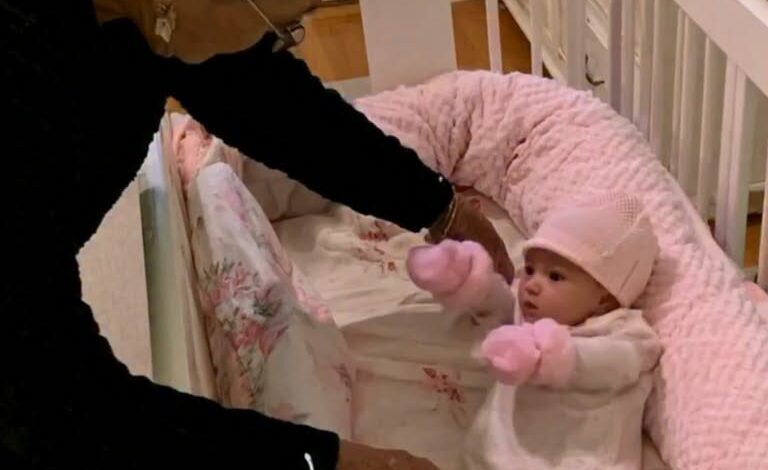
And then there were the mittens.
Willow always wore them.
Always.
Pink cotton mittens.
Pink fleece mittens.
Little knitted mittens.
Cool day, warm day, indoors, outdoors—it didn’t matter.
Her hands were covered.
One afternoon in July, I watched sweat gather along Willow’s hairline.
“She’s getting warm,” I said.
Nancy nodded.
“I know.”
“Maybe take her mittens off?”
Nancy stiffened.
“She scratches herself.”
“We could trim her nails.”
“They’re trimmed.”
I waited.
Nothing else came.
Conversation finished.
After that, I couldn’t stop noticing those mittens.
At night, ridiculous explanations ran through my head.
Was Willow injured?
Did she have eczema?
Was Nancy hiding bruises?
I hated myself for even thinking it.
I considered asking Tristan privately, but something stopped me.
If there were a medical problem, surely they would tell me.
Wouldn’t they?
By my fifty-eighth birthday, Willow was six months old.
Tristan and Nancy brought her to a small gathering in my backyard.
For once, everything felt easy.
Oren was grilling.
Someone had music playing.
Willow sat beneath the patio umbrella in her stroller, kicking happily.
Pink mittens covered both hands.
Then Nancy suddenly went pale.
She pressed one hand against her stomach.
“I don’t feel good.”
Tristan immediately stood.
“Come inside.”
“I think I’m going to be sick.”
He hurried after her.
And for the first time in six months, Willow was left beside me.
Alone.
I stared at her.
She stared back.
My heart began pounding as though I were about to commit some terrible crime.
Then Willow made a soft sound.
I bent toward her.
“Hello, sweetheart.”
Her face crumpled.
Before I could talk myself out of it, I unfastened the stroller and lifted her.
The second her body settled against my chest, tears filled my eyes.
She didn’t scream.
She didn’t recoil.
She simply rested there.
Warm.
Soft.
Perfectly content.
“I’m Grandma,” I whispered.
“I’ve been waiting a very long time for you.”
I rocked her gently.
Then something brushed my wrist.
One mitten had come loose.
I watched it slide halfway off.
Without thinking, I pulled it free.
And froze.
Willow had six fingers.
Six tiny, beautiful fingers.
For several seconds, I couldn’t understand why I was surprised.
Then six months of strange behavior rearranged themselves in my mind.
The mittens.
The stroller.
The refusal to let anyone hold her.
The excuses.
I looked toward Willow’s other hand.
That mitten had shifted too.
Along its side, barely visible, was a thin pink surgical scar.
My stomach dropped.
“Sienna.”
Nancy’s voice came from behind me.
I turned.
She stood in the doorway.
Her eyes went immediately to Willow’s uncovered hand.
Her face drained of color.
“Please give her back.”
“Nancy—”
“Please.”
Her voice broke.
I handed Willow to her immediately.
Nancy pulled the baby against herself and began crying.
Not angry tears.
Terrified ones.
Tristan appeared behind her.
He looked at Willow’s bare hand.
Then at me.
And suddenly I understood that whatever secret they had been carrying was crushing both of them.
Tristan quietly asked everyone else to go inside.
Soon the four of us were alone.
Nancy sat clutching Willow.
I took the chair opposite her.
“Why didn’t you tell me?”
She stared downward.
“I couldn’t.”
“Why?”
Nothing.
“Nancy, did you think we’d reject her?”
Her head snapped up.
“No.”
“Then what were you afraid of?”
She looked at Willow.
“People.”
That one word explained everything.
Tristan sat beside his wife.
“The doctors diagnosed polydactyly after she was born.”
I nodded toward Willow’s scar.
“And the other hand?”
Nancy closed her eyes.
“We had the extra finger removed.”
She began crying again.
“Everyone said doing it early would make things easier. They said she wouldn’t remember. They talked about teasing and school and people staring.”
Her voice fractured.
“I agreed.”
I waited.
“But afterward, I hated myself.”
“Nancy—”
“I kept looking at that scar and thinking I’d made a decision about her body because I was afraid of strangers.”
She kissed Willow’s head.
“When I looked at her other hand, I couldn’t do it again.”
“So you covered it.”
She nodded.
“I thought I was protecting her.”
My heart softened.
But I couldn’t lie to her.
“No.”
Nancy looked at me.
“You were protecting yourself from seeing other people’s reactions.”
She flinched.
“I know.”
For a moment, nobody spoke.
Then I said something I hadn’t thought about in years.
“My sister Alina had six fingers.”
Tristan stared at me.
“What?”
“On both hands.”
“Why have you never told me?”
I shrugged.
“Because there wasn’t much to tell.”
Nancy looked genuinely stunned.
“She kept them?”
“Every one.”
A laugh escaped me.
“She played piano beautifully. She could braid hair faster than anyone I’ve ever met. When people asked about her hands, she’d tell them God knew she had more work to do than everybody else, so He gave her extra equipment.”
Nancy laughed through her tears.
I hadn’t heard her laugh like that in months.
“She wasn’t ashamed?”
“Not until someone suggested she should be.”
Nancy looked down at Willow.
I leaned closer.
“That’s the part you have control over.”
Her eyes met mine.
“You cannot prevent every stare.”
She swallowed.
“You cannot prevent every stupid question. You cannot guarantee that some child won’t eventually say something cruel.”
I reached across the table.
“But you can decide what Willow learns at home.”
Nancy began crying again.
“Our job isn’t to teach her how well she can hide.”
I squeezed her hand.
“It’s to teach her that she never needed to.”
The silence that followed felt different.
Lighter.
Nancy looked at Willow for a long time.
Then, slowly, she removed the second mitten.
She placed both pink mittens on the table.
Willow stretched her hands toward the sunlight.
Nancy stared at them.
Then she smiled.
“She really is beautiful.”
“She is.”
“Perfect?”
I smiled.
“Completely.”
We eventually went back inside.
Nancy carried Willow without covering her hands.
Nobody screamed.
Nobody recoiled.
The world didn’t stop.
Oren noticed first.
He leaned closer.
“Well, look at you.”
Nancy tensed.
Oren grinned.
“Extra blessing.”
Someone laughed.
Another person said Willow was adorable.
Then somebody asked whether there was any cake left.
That was it.
Life continued.
I watched Nancy’s shoulders slowly come down from around her ears.
For six months, she had apparently been waiting for catastrophe.
Instead, she got cake.
Later that evening, after everyone had left, I was collecting plates when Nancy approached me.
Willow was in her arms.
No mittens.
“I owe you something,” she said.
“You don’t owe me anything.”
“Yes, I do.”
She looked at her daughter.
“I’ve kept this from you because I was scared.”
Then she stepped forward.
“I’m tired of being scared.”
She placed Willow into my arms.
There was no excuse this time.
No hesitation.
No stroller between us.
Just my granddaughter.
Willow looked up at me with those sleepy dark eyes.
Then her little hand closed around my finger.
Six tiny fingers curled against my skin.
I started crying.
Nancy did too.
And standing there with Willow finally resting in my arms, I understood something I hoped we’d spend the rest of her childhood teaching her.
The world will always notice differences.
Some people will ask questions.
Some will stare.
A few may even be cruel.
We cannot build enough walls to prevent that.
But we can make sure the first voices a child hears are stronger than all the others.
We can teach her that her body isn’t an apology.
That difference isn’t defect.
That she never has to make herself smaller, quieter, or less visible to make strangers comfortable.
For six months, Nancy believed hiding Willow’s hand was an act of protection.
But children eventually learn what we’re hiding.
And if we’re not careful, they also learn why.
That night, the mittens stayed on the table.
Willow stayed in my arms.
And for the first time, nobody was trying to conceal anything.
I looked down at those six little fingers wrapped around mine and smiled.
The people who truly love you don’t count the things that make you different.
They count themselves lucky that they get to hold you at all.