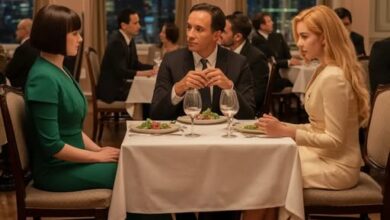
Julián clenched his jaw. He didn’t look at me much. He just placed a thick envelope and a bag of folded papers on the table..

“From this day forward, you are no longer a daughter in this house, Valeria. Your place is beside the man who needs someone to care for his children.”
Those were the words Aunt Ramona spoke without hesitation while standing behind me in front of an old cracked mirror.
I was only eighteen years old.
My borrowed white dress smelled faintly of mold and old wood, as though it had already belonged to another unhappy woman before me. My hands trembled so badly that I could barely tie the ribbon around my hair. Outside, the January fog rolled down the green hills of our coffee-growing town in Veracruz, swallowing the roads and rooftops like a giant gray blanket trying to hide everyone’s secrets.
That town had always been full of silence.
The kind of silence that protected gossip, pain, and women who were never asked what they wanted.
My father had died when I was still a little girl. My mother struggled for years after that, slowly becoming weaker until illness finally took her away too. When she died, Aunt Ramona inherited everything: the house, the documents, the land papers… and me.
She used to remind me constantly that I survived because of her generosity.
But that morning I finally understood something terrible:
Charity can become another form of ownership.
The man waiting outside was named Julián Morales.
He was thirty-seven years old, broad-shouldered, sunburned from years working coffee fields, and carried exhaustion in his eyes like a permanent shadow. His wife Clara had died two years earlier, leaving him alone with three children.
Emiliano was nine.
Toño was six.
Little Marisol was only four.
“She’s obedient and hardworking,” Aunt Ramona told him while looking me over like merchandise. “She cooks, cleans, washes clothes, and knows how to care for children. She won’t give you trouble.”
Julián said very little.
He simply placed a thick envelope and folded documents onto the table.
Money.
Payment.
Transaction complete.
Nobody asked whether I agreed.
Nobody asked whether I was afraid.
That same afternoon, they loaded my old suitcase into Julián’s truck. Inside it were only two dresses, my mother’s earrings, and everything left of the life I once knew.
As the truck crossed the river toward his property, I stared at the mist-covered mountains and silently wondered whether my entire future had just been sold.
Julián’s home stood surrounded by coffee trees, roaming chickens, muddy paths, and orange groves heavy with fruit. The house itself was clean but painfully quiet.
Not peaceful quiet.
Mourning quiet.
The children watched me from the doorway like strangers inspecting an intruder.
Little Marisol hid behind a chair.
Toño stared suspiciously.
But Emiliano spoke first.
“My mother is dead,” he said coldly. “You don’t get to replace her.”
The words struck harder than I expected.
But I refused to answer with anger.
“I didn’t come here to replace anyone,” I replied softly. “I came because I was sent.”
The first weeks were awful.
I burned meals.
Ruined laundry.
Forgot how Marisol liked her hair braided.
Over-salted soup.
Under-cooked rice.
Marisol cried whenever I tried bathing her.
Toño refused to eat if I served his plate.
Emiliano deliberately moved things around the kitchen to make me appear incompetent.
And Julián?
He barely spoke.
Every morning before sunrise he disappeared into the coffee fields and returned after dark exhausted and covered in mud.
But slowly, small things began appearing beside the stove each morning.
Tiny notes written in rough handwriting.
“Marisol likes warm milk, not hot.”
“Toño gets frightened during storms.”
“Emiliano pretends to hate soup. He really hates being controlled.”
Then one night I found another note waiting beneath my cup.
“You don’t have to force them to love you. Just don’t reject them back.”
I read those words over and over.
Because nobody had ever told me kindness could be enough.
Everything changed the night Marisol became seriously ill.
Her fever rose dangerously fast. Her tiny body burned with heat while heavy rain trapped the roads and prevented the doctor from arriving.
Julián rode into town searching desperately for help, leaving me alone with her.
For two nights I barely slept.
I sat beside her bed changing cold cloths, whispering prayers, and singing lullabies my own mother once sang to me whenever fear kept me awake.
At dawn on the third day, Marisol finally opened her eyes weakly.
She touched my cheek gently and whispered:
“Don’t leave, Mama Vale.”
I looked up and saw Julián standing silently in the doorway.
His eyes filled with emotion he couldn’t explain.
And for the first time since arriving there, I allowed myself to believe my life might still hold something beyond survival.
But hope frightened me.
Especially after the night I overheard Julián speaking with his brother outside.
“I married her because the children needed someone,” he admitted quietly. “That’s all.”
My heart shattered silently.
Not wife.
Not partner.
Not family.
Just necessity.
A practical solution wearing a white dress.
The next morning I left a letter on the kitchen table.
“If my only value here is usefulness, then please don’t ask me to stay until I forget who I am.”
Then I walked away carrying my suitcase through rain-soaked roads with nowhere to go.
Julián found me hours later sitting beneath a mango tree near the bridge.
He didn’t shout.
Didn’t force me back.
Didn’t demand obedience.
Instead, he stood before me looking exhausted.
“I was wrong,” he admitted quietly. “After Clara died, I buried every feeling I had left. I convinced myself this arrangement would protect everyone from pain.”
I laughed bitterly.
“Well, it didn’t protect me.”
He lowered his eyes.
“I know.”
Silence settled between us while rain tapped softly against the leaves.
Finally he removed his jacket and placed it gently over my shoulders.
“If you choose to leave,” he said, “I’ll take you anywhere you want. But if you return, it won’t be as a servant or replacement. It’ll be because you choose it yourself.”
Nobody had ever offered me a choice before.
So I returned.
Not because everything was forgiven.
But because for the first time someone saw me as a person instead of a burden.
Life slowly changed after that.
Julián began speaking more.
Asking if I was tired.
Bringing sweet bread from town.
Leaving flowers hidden among farm tools.
The children softened too.
Toño started searching for me after nightmares.
Marisol followed me everywhere.
Even Emiliano slowly stopped treating me like an enemy.
One afternoon while folding laundry, I discovered an old photograph of Clara.
She was beautiful.
Warm smile.
Kind eyes.
Peaceful face.
I immediately felt guilty for existing inside her home.
When Julián noticed the picture in my hands, he spoke softly.
“She loved this family deeply.”
“I don’t want anyone to think I’m trying to erase her,” I admitted.
“That’s exactly why they love you,” he answered.
Then he handed me a dark blue shawl.
“It belonged to my mother,” he explained. “Clara wore it after each child was born. Now I want you to keep it.”
I nearly cried.
Because family, I realized, isn’t created instantly.
It’s stitched together slowly through patience, pain, forgiveness, and small acts of tenderness.
But peace never lasts forever.
One violent storm changed everything again.
Part of the corral roof collapsed during heavy rain. A frightened calf became trapped beneath broken wood, and Emiliano rushed forward to help before anyone could stop him.
He slipped in the mud.
His head struck a rock.
Blood mixed with rainwater while Julián carried him desperately to the truck.
At the clinic, doctors told us to wait.
That word nearly destroyed me.
I stayed beside Emiliano’s bed all night talking endlessly so he wouldn’t drift away.
I told him stories.
Promised to teach him cooking.
Described his favorite horse.
At sunrise his fingers squeezed my hand weakly.
He opened his eyes slightly and whispered:
“Don’t cry, Mama Vale.”
Julián turned away to hide his tears.
And something inside me finally healed completely.
Until Aunt Ramona arrived.
She stepped into the house wearing gold earrings, expensive fabric, and the same cruel smile that haunted my childhood.
“I came to collect the rest of the debt,” she announced coldly.
Julián frowned.
“I already paid you.”
She laughed mockingly.
“You paid for taking her away. But her mother’s debt still belongs to her.”
Then she placed a document onto the table.
My name appeared at the bottom beside a forged signature.
The truth exploded from there.
My mother had never left debts.
Ramona had secretly mortgaged our land, stolen harvest profits for years, forged documents, and manipulated everyone involved.
She convinced Julián that marrying me was repayment.
She convinced me I had been sold.
She trapped both of us.
“You stole my life,” I finally shouted.
Ramona sneered.
“Poor girls don’t have lives to steal,” she answered. “They survive by being useful.”
Then Emiliano appeared weakly from the hallway.
“She belongs here because we love her,” he said firmly.
Toño stood beside him.
“And if she leaves, I’m leaving too.”
Little Marisol hugged my legs tightly.
“She’s my mama.”
For once, Ramona had nothing to say.
The truth spread rapidly through town.
Some defended her.
Others stayed silent.
But many women quietly approached me afterward.
One whispered:
“I was married off for debt too.”
Another confessed:
“I wish I had spoken when I was young.”
I realized my suffering had never been mine alone.
The judge eventually ruled in my favor.
The forged documents were exposed.
The land returned to me.
Ramona lost the reputation she valued more than people themselves.
When everything was finally over, Julián took me to my mother’s old land at sunrise.
The coffee plants were neglected, but alive.
Just like me.
“It’s yours,” he said quietly. “And your future is yours too. If you want to leave, I won’t stop you.”
I looked at him carefully.
At the man who once saw me as necessity.
Then became the man who learned how to love me honestly.
At the children who had unknowingly stitched my broken heart back together.
And for the first time in my life, I answered without fear.
“I’m staying,” I said softly. “Not because I owe anyone anything. Because I want to.”
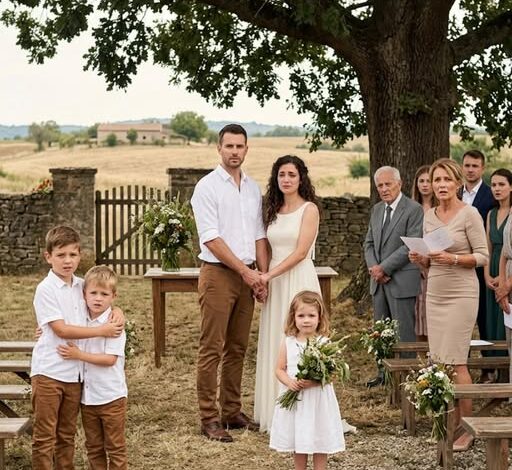
Months later we married again properly.
No envelopes.
No lies.
No debts.
Only flowers, music, neighbors, laughter, and truth.
Emiliano proudly walked me down the aisle.
Toño nearly lost the wedding rings.
Marisol scattered flower petals everywhere while giggling.
And when Julián took my hands before the altar, tears filled his eyes.
“Forgive me,” he whispered, “for treating you like a solution when you were actually a blessing.”
I smiled through tears.
“I wasn’t always brave,” I admitted. “I first had to learn that my voice mattered.”
Years later, when our daughter was born, we named her Clara Isabel.
Clara for the woman whose memory taught me respect.
Isabel for my mother, whose roots remained alive inside me no matter who tried stealing them away.
At eighteen years old, everyone believed my life would disappear inside someone else’s home.
They thought fear would silence me forever.
But they were wrong.
Because a woman’s story does not end when others try deciding her future.
It changes the moment she finally says:
“I choose.”