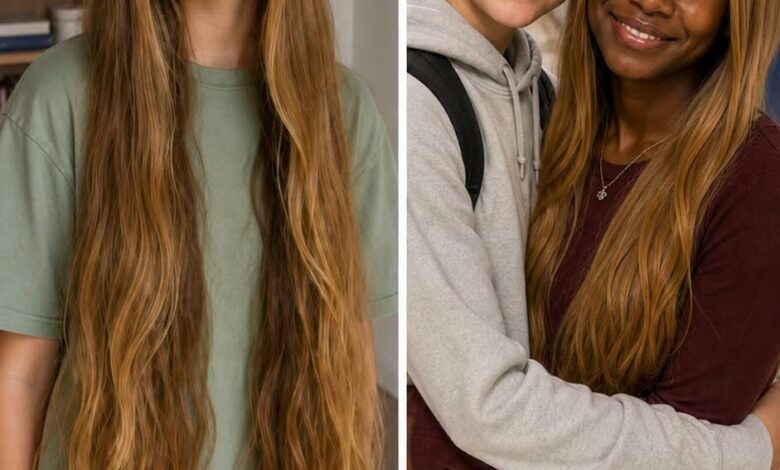
The scissors had not even touched Letty’s hair when her mother asked one final time.
“Are you absolutely sure?”
Letty looked at the long strands falling well past her shoulders. It had taken years to grow them. She knew that once they were cut, there would be no changing her mind.
Still, she nodded.
“I’m sure.”
To anyone watching, it might have looked like an ordinary haircut.
It wasn’t.
The decision had begun weeks earlier at school, when Letty learned that one of her classmates was undergoing medical treatment and had lost their hair.
At first, she didn’t completely understand.
Children notice changes quickly, but they don’t always understand the reasons behind them. Letty knew her classmate looked different. She noticed the whispers, the glances, and the uncomfortable way some children seemed unsure of what to say.
Then she learned why.
The treatment helping her classmate fight illness could also cause hair loss.
That detail stayed with her.
On the way home, Letty was unusually quiet.
Her parents noticed.
“Everything okay?” her mother asked.
Letty hesitated before answering.
“What happens when kids lose all their hair because they’re sick?”
Her parents explained as gently as they could. Sometimes children undergoing certain medical treatments lose their hair temporarily. For some, that change can be emotionally difficult, especially when they already feel frightened or different from their friends.
Then Letty asked another question.
“Can someone give them hair?”
Her parents explained that organizations exist that collect donated hair and use qualifying donations to help create wigs or hairpieces for people experiencing medical hair loss.
Letty listened carefully.
Then she reached up and touched her own hair.
It was long.
Very long.
She had spent years growing it.
“What if I give them mine?”
Her parents initially thought she was simply exploring the idea.
They reminded her that donating would require cutting off a substantial amount.
Her hair would look completely different.
It would take years to become that long again.
Letty understood.
“I know.”
“You might miss it afterward.”
“That’s okay.”
Her father looked at her.
“You don’t have to do this just because you feel sad for someone.”
Letty shook her head.
“I don’t want them to feel bad when they look in the mirror.”
That was the moment her parents realized this wasn’t an impulsive idea.
Their daughter had made a decision.
In the days before the appointment, they gave her opportunities to reconsider.
Letty never did.
Instead, she became increasingly excited about what the haircut represented.
She wasn’t thinking about what she was losing.
She was thinking about where it might go.
Finally, the day arrived.
At the salon, her hair was carefully divided and secured according to the donation requirements.
Letty sat remarkably still.
The stylist gathered the first section.
“Ready?”
Letty smiled.
“Ready.”
Snip.
A thick section came free.
Then another.
And another.
Within minutes, years of growth rested in carefully tied bundles instead of cascading down Letty’s back.
She stared at herself in the mirror.
For one brief moment, her expression changed.
Her fingers moved instinctively toward the place where her long hair used to be.
Her mother held her breath.
Then Letty smiled.
Not the nervous smile of someone pretending she liked the result.
A huge, delighted grin.
“It feels so light!”
Everyone laughed.
The stylist shaped what remained into a fresh new cut.
When Letty finally stood, she looked dramatically different.
But she also looked proud.
The following morning brought another challenge.
School.
The moment Letty entered the classroom, heads turned.
“What happened to your hair?”
“Why did you cut it?”
“Whoa!”
Children crowded around her.
Letty could have simply said she wanted a new hairstyle.
Instead, she told them the truth.
She explained that she had learned how medical treatment could make some children lose their hair.
She explained that donated hair could sometimes be used to help create wigs.
Then she told them she wanted another child to have something that might help them feel more comfortable and confident.
The room became quieter.
One classmate stared at Letty’s short hair and asked, “But weren’t you sad to cut it?”
“A little,” Letty admitted.
Then she shrugged.
“It grows back.”
Four ordinary words.
Yet they changed the conversation.
What Letty had understood was remarkably simple: something temporary for her might mean something significant to somebody else.
Her classmates began asking questions.
Could children donate?
How long did hair need to be?
What other things could people give?
Did kindness always require money?
Their teacher recognized an opportunity.
Instead of allowing the discussion to end with Letty’s haircut, the class began talking about empathy.
Not empathy as an abstract vocabulary word.
Empathy as action.
It is easy to say you feel sorry when another person is hurting.
It is different to ask, “What can I do?”
Letty had asked that second question.
Soon, something unexpected happened.
Other children began asking it too.
One student went home and gathered toys they had outgrown for a local charity.
Another family collected clothing.
Some students talked about helping at community events.
Others began thinking about food drives, animal shelters, elderly neighbors, or classmates who sometimes ate lunch alone.
Nobody copied Letty exactly.
That wasn’t the point.
Her choice had given them permission to imagine generosity in their own language.
Teachers noticed another change as well.
The conversations around illness and physical differences became gentler.
Children who might previously have stared began understanding that someone looking different could be dealing with something difficult.
They talked about why teasing someone’s appearance can hurt.
They discussed inclusion.
They learned that a classmate going through treatment did not suddenly become a different person simply because their hair had changed.
Those lessons could have been delivered through a worksheet.
Letty made them real.
And she had done it without standing on a stage or giving a speech.
She had simply sat in a salon chair and said yes when the scissors were ready.
That is one of the strange things about kindness.
We tend to imagine it as something enormous.
A wealthy person writing a giant check.
A heroic stranger rescuing someone.
A public campaign attracting thousands of supporters.
Those things matter.
But most kindness doesn’t begin that way.
It begins quietly.
A child notices another child struggling.
Someone asks a question at the dinner table.
A family searches for ways to help.
A salon appointment gets scheduled.
Scissors close.
Hair falls.
And somewhere beyond that moment, another person may eventually feel a little less alone.
Letty could not control exactly what happened after her donation.
She couldn’t know who might ultimately benefit or what that person’s story would be.
That uncertainty didn’t diminish the gesture.
If anything, it made the decision more generous.
She wasn’t helping because she expected gratitude.
She wasn’t waiting to meet a recipient.
She didn’t need her name attached to the final outcome.
She simply knew she possessed something she could give.
So she gave it.
Her parents watched the experience change her too.
Letty discovered that generosity does not always feel like losing something.
Sometimes giving produces an unexpected sense of abundance.
Her hair was shorter.
Yet she felt bigger somehow.
More capable.
She had discovered that even as a child, she could affect the world beyond herself.
That’s a powerful lesson to learn young.
Children are often told to wait.
Wait until you’re older.
Wait until you have money.
Wait until you understand more.
Wait until you can make a “real” difference.
Letty’s haircut challenged that idea.
She didn’t have a fortune.
She didn’t run a charity.
She didn’t have political influence or thousands of social-media followers.
She had hair.
And compassion.
That was enough to begin.
Perhaps the most meaningful consequence appeared in the way her classmates responded.
One act didn’t produce dozens of identical acts.
It produced dozens of questions.
What do I have?
Who needs help?
What could I give?
Those questions are where communities change.
A child who learns to ask them may eventually become an adult who keeps asking them.
The specific answers will evolve.
Today it might be toys or hair.
Years from now it could be time, expertise, money, mentorship, blood donation, community service, or simply showing up for someone who has nobody else.
The habit begins with noticing.
Letty noticed.
She saw that another person’s experience might be frightening.
She imagined what it might feel like.
Then she refused to stop at sympathy.
She acted.
Months later, her hair began growing longer again.
Of course it did.
Eventually, the dramatic difference between the old photographs and the new haircut became less noticeable.
But what happened inside that classroom lasted longer.
Her classmates remembered the explanation.
Her teachers remembered the discussion.
Her parents remembered watching their daughter surrender something she valued without being forced.
And somewhere, perhaps, another child eventually looked into a mirror and felt a little more like themselves.
Letty may never know.
She doesn’t need to.
That is the beautiful uncertainty of generosity.
We rarely get to see every place our kindness travels.
A gesture passes from one person to another, sometimes changing shape along the way.
One haircut inspires a donation.
A donation inspires volunteering.
Volunteering introduces someone to a neighbor they would never otherwise have met.
That neighbor inspires another act.
The original person may never see any of it.
Yet the chain exists because somebody went first.
On the morning of Letty’s haircut, the question seemed straightforward:
Was she willing to give up the hair she had spent years growing?
But the answer became about much more than hair.
It was about understanding that another person’s pain mattered even when she could not personally fix it.
It was about realizing that compassion becomes more powerful when translated into action.
And it was about discovering that sacrifice doesn’t have to be enormous to be meaningful.
When Letty returned to school, everyone noticed what was missing.
Her long hair.
But as she explained what she had done, they began noticing what had taken its place.
Courage.
Empathy.
Purpose.
The hair would grow back.
The lesson didn’t need to.
Because one little girl had already planted it in an entire room of children:
You don’t have to change the whole world to make it kinder.
Sometimes you only have to give what you can—and trust that kindness will keep traveling after it leaves your hands.